Patrick Gallagher
Fictional. Generated by AI — not a real person, and no likeness of one is intended.
33, soldier in Philadelphia · rolled by @connor.waskiewicz · card — no film
History
who has worn him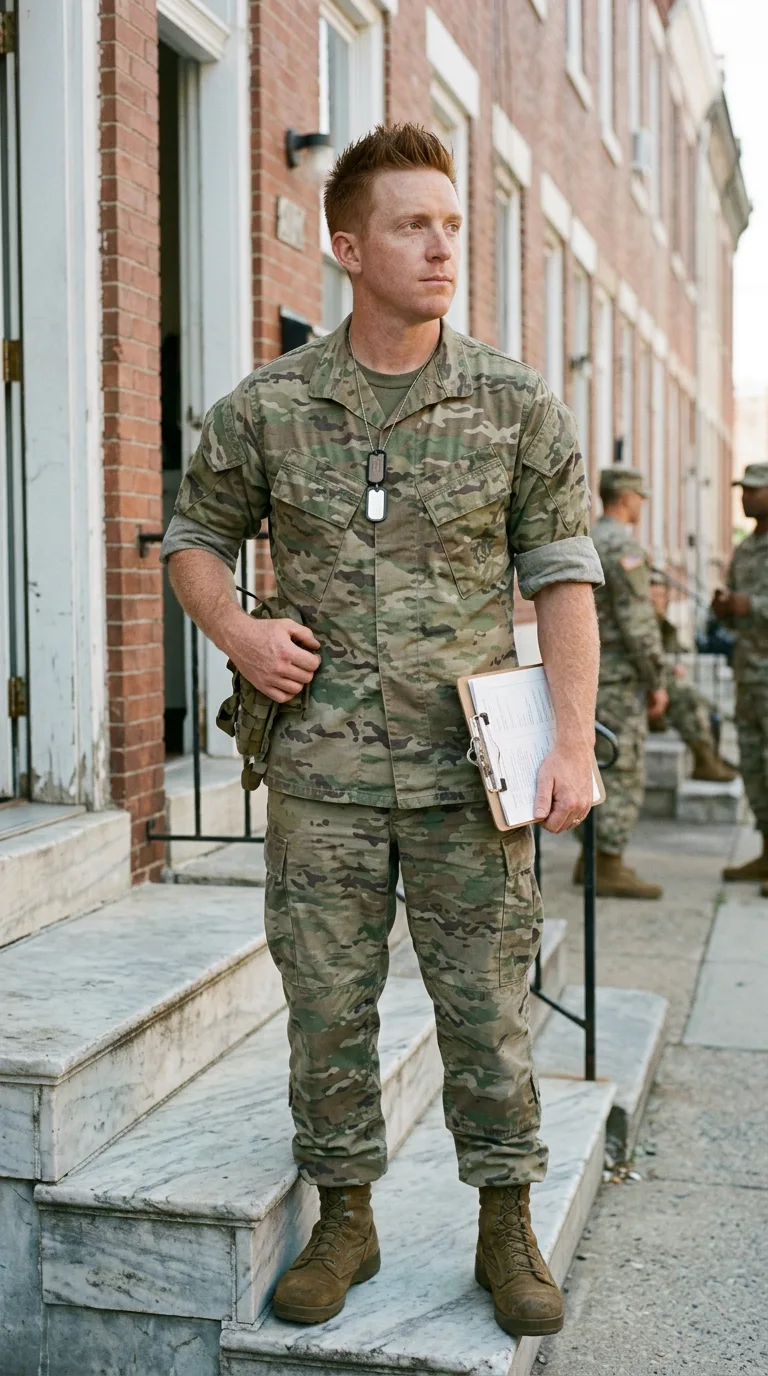
Rarest thing about him: Red — common, 1 in 60
Season 1seed 1476580899 · engine v11
Character card
lineage 2NZHHJ
His body-swap story
@connor.waskiewicz, wearing Manuel Arredondo, rolled the wheel on and woke up as Patrick Gallagher, spent under a minute in him, then spun the wheel and woke up as Howard Lindahl
You are Manuel Arredondo, for now, and the lunch hour in Nashville is bright and flat on the window of a chain sandwich place. Your hands, his hands, are small and quick, and they keep drifting to the edge of the table to drum. He has a bad left knee from sitting folded at a desk. He is five-four and heavy, and the chair holds him like an argument it has already lost. The screen is open on the wheel.
He was a decent body. That's the trouble. Nothing was wrong with him. But twenty minutes ago a woman at the next table laughed at something her friend said, a big loose laugh, and you realized you had been wearing his face for less than a minute and nobody had looked at it. You wanted to be looked at. You want, you think, to be somebody who stands in a doorway and is waited for. You pay. You spin. The wheel ticks down through its names and settles, and the sandwich shop goes out like a cut cord.
Brick. Cold marble under your boots, worn into a dip where a hundred years of feet have gone. Your right hand is mid-motion on a clipboard, your left hovering at a pouch on your hip, and the rhythm of it breaks. You've done the motion wrong. You do it again, slowly, correctly. Then ten more, each one checked, though this job hasn't needed checking in years. Your leg is bouncing. It has been bouncing the whole time.
Five-eight, and the weight sits easy in the hips. Thirty-three. The shoulders know how to hold a load. The air smells of wet stone and diesel and somebody's coffee, and sun comes down the block in a long gold slab, first light, the street not yet awake.
The clipboard's clip is cold under your thumb, and he comes: a hallway, a woman's voice saying his name, Pat, Pat, sing-song, from upstairs, and a small child asleep on his chest on a couch with the television low. He did not move for an hour so she would stay asleep. His arm went dead and he was happy.
The dog tags knock against your sternum, and there is the sound they make in a drawer, in the dark, because he took them off to be only a husband. Then the sleeves: this morning, in the bedroom with the light not yet on, the left cuff rolled twice, the right once, because the right never stays. His wife's hand, flat on his back for a second as he bent to lace the boots. The knot pulled hard, double-tied, his father's way.
The band on your left hand is warm. He turned it with his thumb in a church parking lot once, at a meeting where the coffee was terrible and he said out loud, for the first time, that he had not had a drink in four hundred days. Nobody clapped. A man handed him a cup. He cried in the car, and it was the best day of the year.
The marble steps: a girl, before his wife, sitting on this very stoop with her knees up, an old girlfriend, laughing at him, and he wasn't sorry, only fond, and it hurt like a pressed bruise he likes to press. Money in a savings account, not much, a number he checks like a pulse. Two children's shoes by a door, one pair with a hole.
The knee does not hurt. The body is not tired. It wants to move, so it bounces.
You look at your hands. Freckles run to the wrist. The ring is plain and a little scratched. You turn them over, and they are steady, and then you lift your eyes to the street.
"Well," you say, in his voice, a little hoarse. "Look at that."
The sun reaches the end of the block. You wait to learn how long.