Osvaldo Terán
Fictional. Generated by AI — not a real person, and no likeness of one is intended.
61, beekeeper in Brisbane · rolled by @tyler.iverson · card — no film
History
who has worn him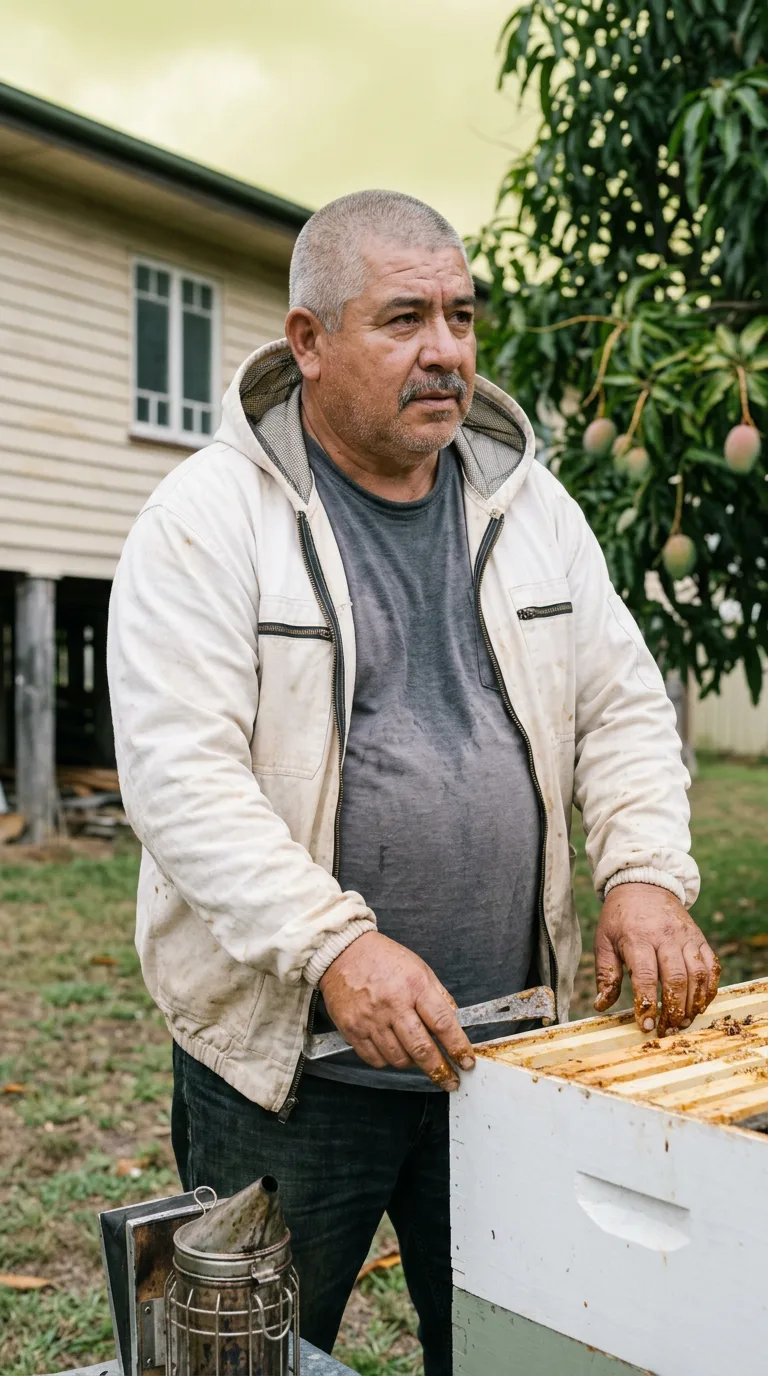
Rarest thing about him: Brisbane — legendary, 1 in 3,165
Season 0seed 1657266682 · engine v10
Character card
lineage 9IC4OB
His body-swap story
@tyler.iverson rolled the wheel on and woke up as Osvaldo Terán — their first, spent 3 minutes in him, then spun the wheel and woke up as Colton Wexley
The tab has been open for an hour, maybe more. Doomscroll, close it, reopen it. You have known about vessel.cards for exactly one dull evening, but you have known about *this* — the wanting, the specific hunger of being someone else, anyone else, waking up behind a stranger's eyes — for as long as you can remember tracking time at all. Every film with a body-swap in it. Every thread at two in the morning that you told yourself you'd stop reading. Nobody ever sold it before. Now there's a wheel, and a price, and your thumb over the button, and nothing on your calendar that matters more than this.
You spin.
There is no falling, no rushing dark. There is a hive tool in a heavy hand, halfway through sliding under a frame lid, and the frame lid does not lift. The hand — your hand, now — jerks, stutters, sets down wrong. You feel the whole body catch on it, the way a man catches on a curb he didn't see, and then correct: slow, deliberate, the tool going back under the lip of the box the way it is supposed to go. It works. It comes free. You are standing in a dirt yard at some hour with no daylight in it at all, breath fogging faint in cool air, a smoker hissing sweet and acrid somewhere near your knee, and you are enormous and heavy and sixty-one years old and none of it is yours yet.
The next ten lifts you do slowly. Checked. Each one a decision, where a moment ago it was only muscle. Nothing in this yard has needed checking in years, and you can feel that fact sitting in the body like a bruise it doesn't have — an unease with no cause it can name, because there is no cause it's allowed to know.
Then the shirt against your back gives you the morning.
Gray shirt, the good one with the stretched collar, off the hook by the window before light, the room smelling of last night's rain coming through the flyscreen. Sleeves in. Cotton gone soft from years of washing. Osvaldo's hands — thick fingers, a callus map at the base of each one from hive tools and framing wire — button nothing because there's nothing to button, just pull it down over the belly that his mother would have called a blessing and his doctor calls a problem, and reach for the jacket, canvas, the zip that sticks a third of the way and always has. He doesn't think in words when he dresses. He thinks in weather. Tonight the sky was doing something ugly-green even in the dark, the kind of pressure that means storm before six, and that is the only reason he is out here at this hour at all instead of asleep like a sane man — the flow's about to break, and if he doesn't pull what he can tonight the rain does it for him and does it wrong.
The jacket brings more. Thirty years of it, on and off this same body in this same yard, before the belly, before the gray had eaten all the black out of his hair. A wife who left early enough that grief has gone soft and unspecific, more habit than wound now, a shape in the house he stopped setting a second plate for so long ago he doesn't count the years. No kids to have kept a piece of her for him. Church on Sunday, mostly for the singing and the coffee after, a faith worn easy and without display, the kind you don't discuss because discussing isn't the point of it. A body that has hurt him lately in a new, quiet way — pressure behind the eyes some mornings, a doctor's flat voice saying *salt*, saying *walk more*, a pill bottle by the toothbrush he half-remembers and half-resents. Hands that know this hive box the way a man knows his own tongue: which frame is heavier, which corner the bees favor, when the smoke's too thin and needs more punk in the can.
And under all that, small and constant — his hands aren't holding the tool now, they're at his side a second, and they go, without him sending them, to the ring on his right hand, and they turn it. Just once. Not a wedding band; nobody left to make it that. Just his father's, kept for reasons he never explains to anyone because nobody's asked in twenty years.
The smoker needs pumping. You feel the memory of ten thousand identical motions rise up to meet the actual motion, and for a second they are the same thing, and the checking stops, and it is only Osvaldo's hands again doing Osvaldo's work in the dark before a storm he can smell coming off the mango tree.
Then you stop. You look down at the hand on the tool — thick, spotted, gold-brown with propolis stain worked so deep into the creases it will never wash fully out — and you turn it over the way he never does, palm up, like it's new.
You lift your eyes off it, out into the black yard, toward where a house on stumps sits with all its lights off and everyone in it asleep, and you say, out loud, to no one:
"Whose yard is this."
Somewhere behind that, unspoken, unshaped yet even to you: how long you get to keep asking that question in this particular voice, in this particular yard, before the wanting turns over again like a ring on a finger, and you are gone into someone else, and he is only yours until then.