Nabil Haddad
Fictional. Generated by AI — not a real person, and no likeness of one is intended.
63, waiter in New York · rolled by @marcus.delgado · card — no film
History
who has worn him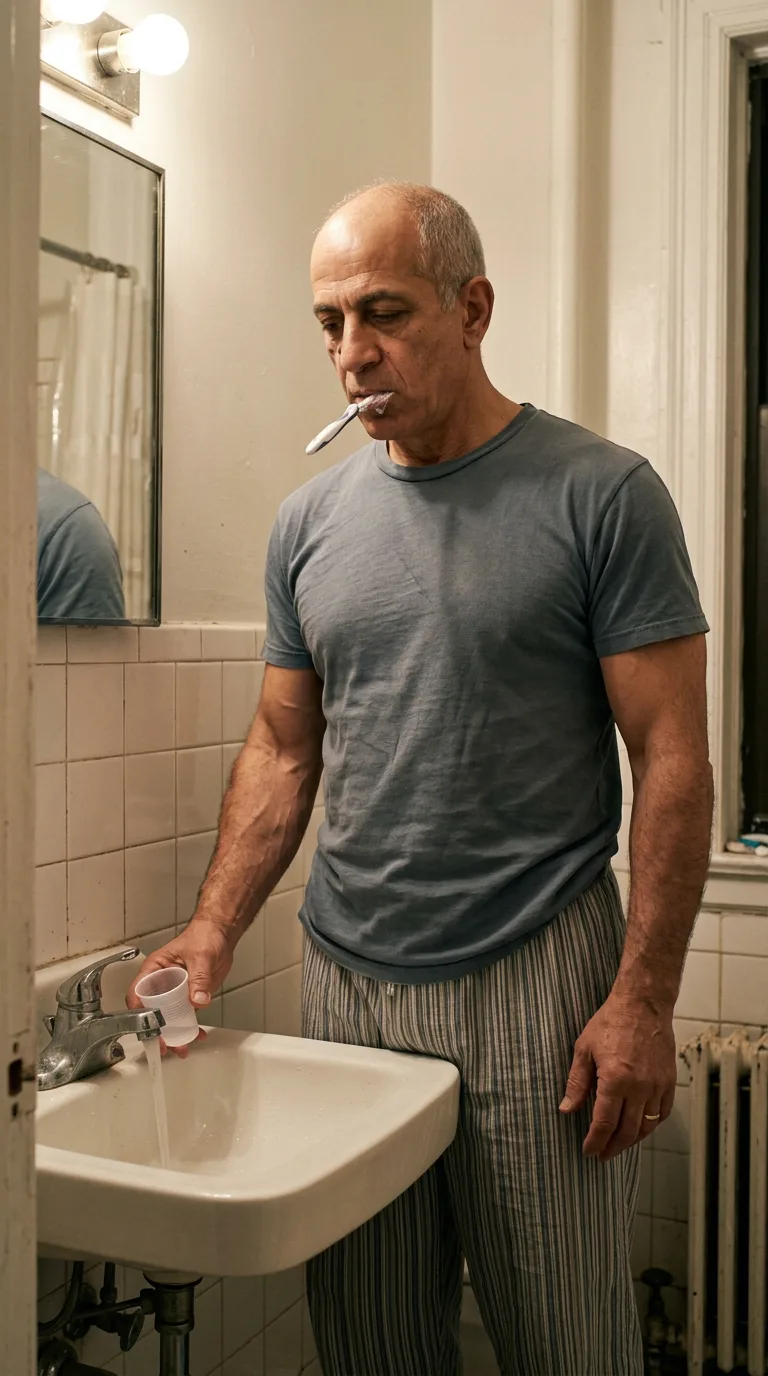
Rarest thing about him: Waiter — rare, 1 in 79
Season 0seed 1824174298 · engine v10
Character card
lineage LUL2V1
His body-swap story
@marcus.delgado, wearing Marcus Delgado, rolled the wheel on and woke up as Nabil Haddad
You are standing in front of a mirror that isn't yours, in a gym bathroom that smells like eucalyptus towels, flexing a jaw that has never once ached. Marcus Delgado's jaw. Thirty years old, five-eleven, and when you make a fist the forearm does something you spent forty-five minutes admiring instead of feeling. That's the trouble with it. You keep catching yourself watching him from outside, like footage, like a body someone else is very good at using. The beauty mark by his mouth, the perfect teeth, the flat stomach under the compression shirt — none of it is talking to you. You paid for a life and got a mannequin with a heartbeat. Downstairs a client is waiting for a spot he'll never need reminding to give, because Marcus's hands already know the weights, and you are along for the ride inside a man who was already finished being interesting to you twelve minutes after the wheel gave him to you. You want, suddenly and completely, something that isn't smooth. Something used. You open the site again on his phone, thumb moving like it's his, and you spin.
The bathroom that arrives is smaller, older, and colder around the ankles. There is a tap running. There is a plastic cup half full of pink-tinged water balanced against a sink chipped at the lip. There is a toothbrush in your mouth, and you are already mid-stroke on the left side, and your arm — this new arm, shorter, thicker through the shoulder, a wedding band cold against your finger — finishes the stroke on its own before you have caught up to owning it. You move it to the other side. Slower now. Working the back molars like there's a habit under this that knows exactly how long a good brushing takes and refuses to be rushed even by a soul falling into it sideways. You rinse. You rinse again. You stand the brush up in the cup, bristles skyward, out of the grey water that has apparently never been changed on schedule, out of some old blind domestic peace with mess. The tap is still running. You reach over — muscle memory, not yours, already firing — and shut it off.
The gray shirt against your back is thin, worn translucent at the shoulder blades, and it opens first: a Tuesday morning eleven years ago, hanging this exact shirt to dry on the radiator in this exact bathroom while his younger son, seven then, sat on the closed toilet lid asking why grown men still wear undershirts if nobody sees them. Nabil had laughed so hard he'd had to sit down on the edge of the tub. The shirt remembers the laugh in the fabric somehow, or you do, wearing it.
The striped pajama pants come next, waistband soft with age, and through them: a hundred nights of the walk from bed to this sink, the hallway floor cold underfoot in winter, his wife's breathing behind him in the dark, steady as tide. Fifty-eight years of prayer folded somewhere under that too — not in this room, but adjacent to it, the ritual cleanliness of hands and mouth before anything else, an old habit that makes the brushing itself feel less like hygiene and more like a small daily accounting. He has never once, not in sixty-three years, gone to bed with his teeth dirty. His mother's voice on that, decades gone, still runs underneath the motion like a second pulse.
The mole on the cheek you cannot feel, but the mirror shows it to you, dark and familiar to a face that isn't asking you anything. Under your palm, bracing on the sink's cold porcelain lip, comes the restaurant — forty-one years of it in fragments, too many to hold at once: chairs upended onto tables at midnight, the particular ache low in the back from bending to wipe under booths, the tray balanced flat against a forearm that has carried ten thousand plates of lamb and never dropped one, a manager half his age calling him "chief" without meaning disrespect, the small mean pleasure of a good tip slid quietly into an apron pocket at the end of a bad night. Somewhere in there, two children, grown now, one an engineer in New Jersey who calls every Sunday, one who doesn't call enough and whom he forgives before the phone even doesn't ring. A wife who still leaves the porch light on for him no matter how late the last train runs. The ring on your left hand is warm from thirty-one years of never once being taken off — not to wash dishes, not to carry hot pans, not for anything.
The blood pressure medication is on the shelf above the sink, and touching the cool plastic of its cap gives you the doctor's office, fluorescent and bored, a cuff too tight, a number that scared him quietly for a week and then didn't anymore because fear that doesn't change anything eventually just becomes Tuesday. He quit the cigarettes for this. Nineteen years clean, and some nights he still wants one standing at this exact sink, looking at nothing, the way he was looking at nothing when you arrived.
The body itself is compact and dense with old strength — five-four, but the forearms are a working man's, the shoulders set low and hard from decades of trays, the crown of the head cool where the hair has gone thin and the scalp shows through under the bathroom light. Nothing about it is smooth. The lower back has a familiar complaint about tomorrow's double shift already lodging itself. It feels like a chair somebody has sat in every day for forty years — worn into the exact shape of a life, and better for it.
You look down at your hand on the faucet. Turn it over. The ring catches the light, and behind you the mirror holds a stranger who has never been young in front of a camera and never needed to be.
"There you are," you say, to no one, to him, to the sink.