Mateo Ruiz Cardenas
Fictional. Generated by AI — not a real person, and no likeness of one is intended.
23, taxidermist in Nashville · rolled by @mateo.ruiz.cardenas · card — no film
History
who has worn him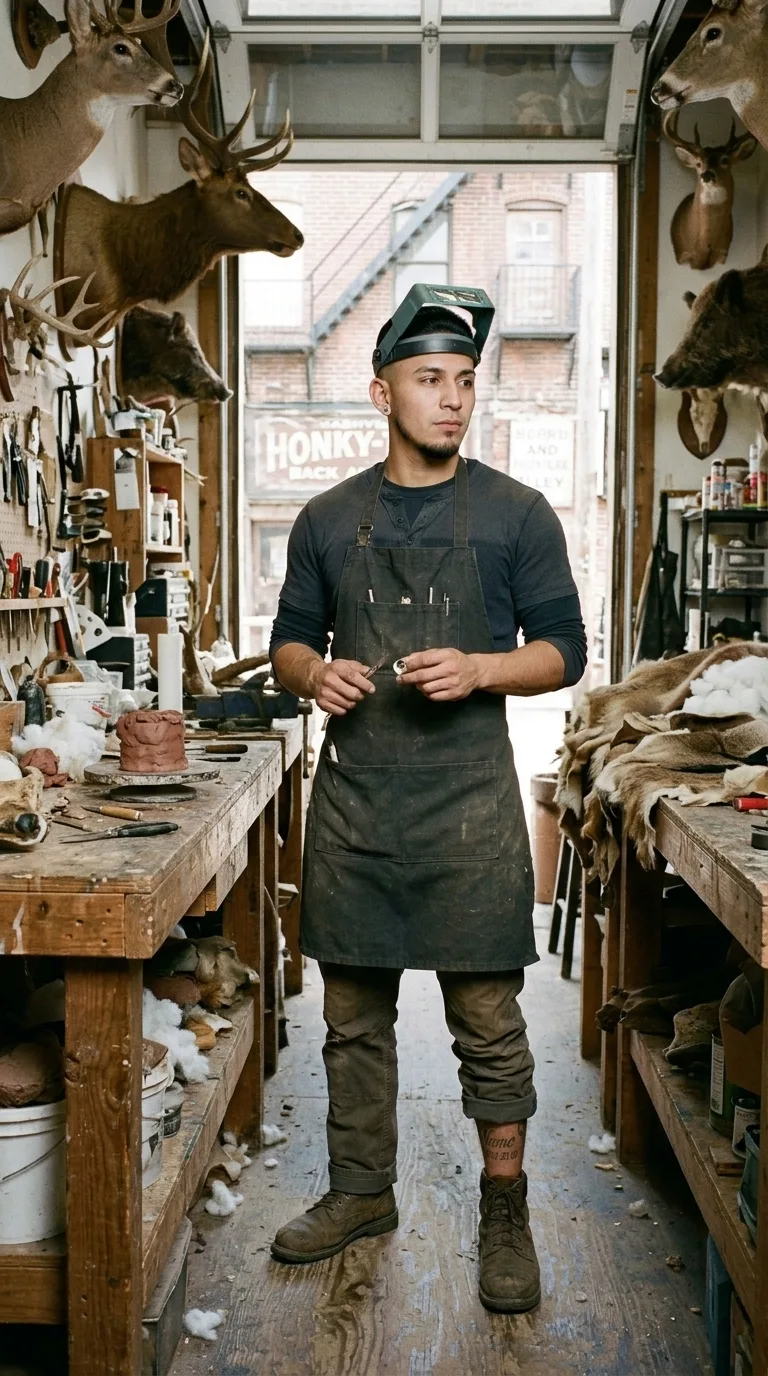
Rarest thing about him: Chinstrap — uncommon, 1 in 93
Face-off rating 1500 · not ranked yet
Season 1seed 1396099929 · engine v11
Character card
lineage KRRV1P
His body-swap story
@mateo.ruiz.cardenas, wearing Lamont Everett Rhodes, rolled the wheel on and woke up as Mateo Ruiz Cardenas, spent 3 minutes in him, then spun the wheel and woke up as Darnell Isaiah Whitlow
Four minutes ago you were Lamont Everett Rhodes, and Lamont's knees are still the first thing you are leaving. Forty years old, five-four, a housekeeper's back. You stand in the corridor of a Philadelphia hotel beside a cart of folded towels, holding a pillow slip you have already smoothed twice, and the reason you came back to the page is not something you would say to the cart. Lamont could not reach the top shelf of the linen closet. Eleven minutes in him and you had stood under that shelf on your toes, and you hated it, a small hatred, a petty one, and it opened the wheel again. You do not look at it closely. You pay. You spin. The towels go white and then there is no towel.
There is a bench under your ribs and a weight on your chest that is an apron. Something small and cold is pinched in your right fingers, a scalpel, and in your left a glass eye the size of a lozenge. Light comes in a wide doorway behind you, flat and midday. The air tastes of tanning chemical and cotton and old hide. Antlers crowd the wall. A rhythm breaks in your hands for half a second, one cut wrong, and you do it again slowly, and it is right, and you do the next ten the same way, checking each, on a job that has not needed checking in years.
The apron strap bites the back of your neck. Canvas, stiff with dried paste. You thumb the bib and he comes up through it: a morning in a small kitchen, a girlfriend's sleeve brushing his as she reached past him for the coffee, and him pulling the gray henley over his head, then the black long-sleeve under it, because the shop is cold before the day warms. He pushed the sleeves to the elbow with the heel of his hand, as always. He lifts the boots by the laces. You feel the habit of it, not the memory of it, his fingers knowing the double knot.
The boots hold you now. Leather gone soft at the ankle. Through the sole you feel the plank floor, and with it a different afternoon: the shop's first week, his uncle's old bench, the smell of the borax, and a deer he ruined and cried over in the walk-in where nobody could see. Twenty-three and ashamed of crying. He fixed the deer. He kept the bad ear in a drawer.
Your calf itches against rolled canvas, over the tattoo, a name and a date. You do not read it. Something comes anyway, hot and fast and not yours: a woman laughing in a parking lot, a Catholic church, a candle lit with a borrowed lighter, and the date is a day he does not speak of to the girlfriend who is kind to him. The woman who got away. It lands like a swallowed stone. The studs in his ears are cool, and when you tilt your head they tick against your collar.
He is strong. Your shoulders are wide and warm and eager to work, a body that has never once been small in a doorway. You are tall in it. The shelf, if there were a shelf, would be nothing.
You set down the scalpel. You lay the glass eye on the bench, and it rolls a little and stops, looking up at the ceiling. You turn your hands over. Brown, wide, unfamiliar, the nails clean under their dust. They shake once, and you let them.
You look up into the light of the alley door and say, "Okay. You're mine."
The neon across the way is still unlit. You do not know how long you get. You flex his fingers and wait to feel the wanting begin.