Mateo Escareño
Fictional. Generated by AI — not a real person, and no likeness of one is intended.
24, bartender in Atlanta · rolled by @grant.delahoyde · card — no film
History
who has worn him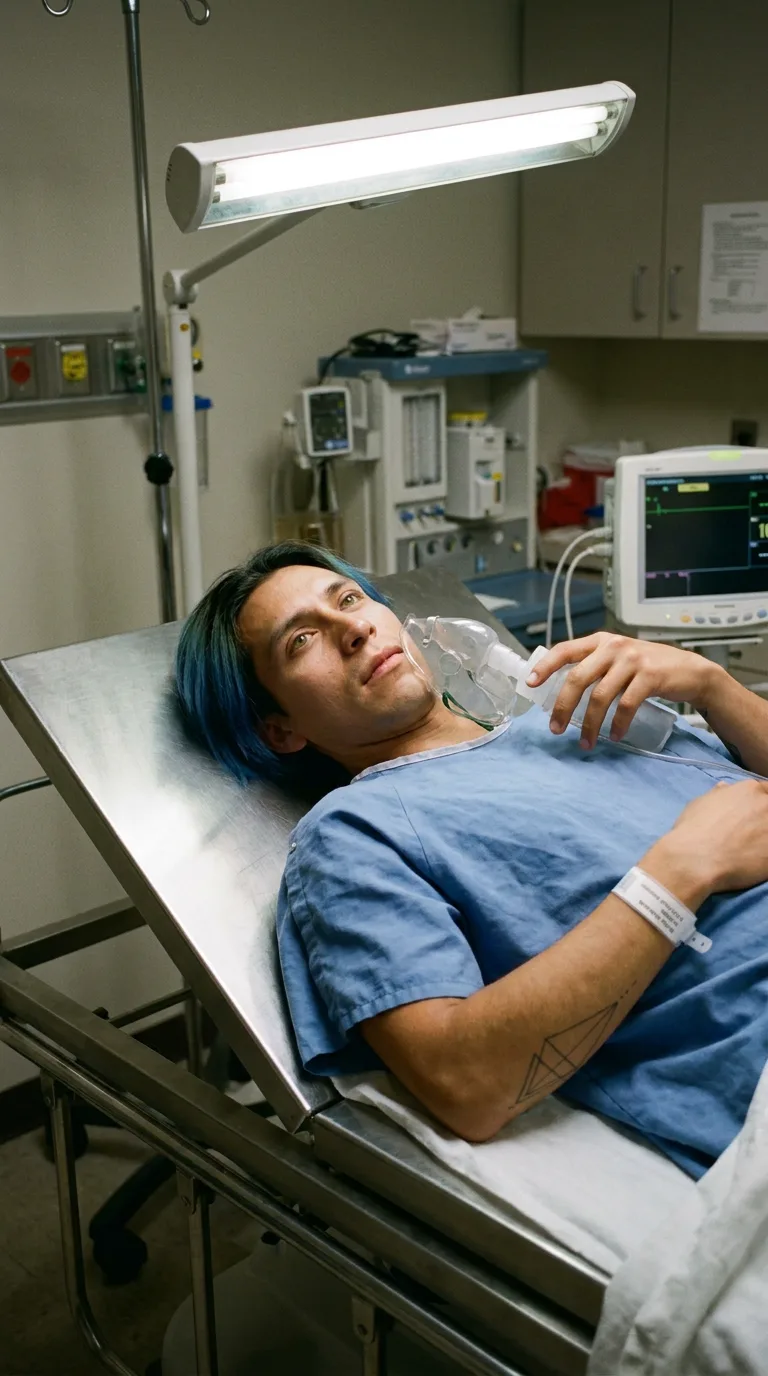
Rarest thing about him: Well off — $500k to $1M — epic, 1 in 274
Legacyseed 891197412 · engine v8
Character card
His body-swap story
---
You don't know him.
That has to be said first, because everything after it depends on it. There was no long watching, no window across a courtyard, no year of learning what he ate for breakfast. You did not choose him. You were somewhere without light or duration, in the part of the hour where the anesthetic goes and the person is supposed to go with it, and there was a mix-up — a chart, a wristband, two men wheeled through the same set of double doors within four minutes of each other — and one door that was meant to close stayed open, and you went through it because it was there.
So when you take him, you take him the way a hand takes a railing in the dark. Not greed. Balance.
---
The first thing is weight. He is 5'7" and you had forgotten what that was like, being close to the floor, the ceiling coming down to meet you instead of going up. Athletic — that surprises you. There's a spring in the calves, a tightness across the shoulders where the arms attach, the body of a man who has lifted crates of Jameson and bottles of tonic up from a cellar four days a week for six years and never once called it exercise. When you try the hand on the mask it comes away easy. It knows what to do about a thing near the face.
The second thing is the taste. There's the medical sweetness, the plastic, the aftertaste of gas. But underneath there's something older and dirtier that the anesthesia hasn't touched, an ashy bloom at the back of the throat, and your first act as him is to recognize it. You have been in enough mouths to know what a man's been doing. He was drinking last night. He was drinking the night before that. The liver in you is doing something patient and unhappy under the ribs. And there's no cigarette in the taste at all — nothing, not even the ghost of it, which means he never did, and you find that oddly clean of him, a small tidiness in a man who is otherwise not tidy.
The third thing is the arm. It's lying across his stomach with the palm up and there is fine-line ink on the inner forearm, a shape in thin black lines — triangles making a diamond, precise, done by someone with a steady hand. You look at it and the body doesn't tell you what it means. Bodies don't. They only tell you where things hurt. This is the trade you always make and you always forget you made it until the first minute: you get the machine and none of the story. You get the hands and not what they've held.
Above you the exam lamp is on its stalk, a long fluorescent tube throwing hard white down onto the steel bed. To your right the monitor is drawing the green line of your own pulse, which is not slowing down the way a man's pulse slows when he wakes up and everything is fine. Cabinets. A crash cart. A laminated sheet on the wall with a red-boxed warning and a lot of small print. Somewhere out past the curtain a phone rings twice and someone answers it in a voice already tired at eight in the morning.
And the wristband.
It's on the left arm, above the ink. Plastic, white, printed in that thin hospital font, a barcode at one end. You lift the arm to read it because reading it is the most natural thing in the world for a man who just woke up. You read it.
It says a name.
You read it again.
Here's what a man does, at this point. He frowns. He says *that's not—* and he sits up too fast and reaches for the call button and there's a small polite disaster, and forms, and someone from Risk Management with a soft voice, and by lunch he is in the right ward with the right band and a story he will tell at the bar for years, *and get this, they almost took out my gallbladder.* That is what a man does. You know it because you have been men. You have felt that pathway light up like the well lights coming on at four in the afternoon.
You don't take it.
You look at the printed name and you let the surprise arrive and you let it turn all the way over and go out, the way a match does if you don't do anything with it. Because it's yours. Not the name on the band — that's a clerical accident, that belongs to some fifty-eight-year-old with a hernia two rooms over. What's yours is the hand holding the band up to the light. Yours is the low ceiling, the blue hair in his eyes, the sour taste, the green line on the monitor. There is no way back out of him and no term on the lease and nothing on the other side of it that wants me, and I have done this in enough bodies to know what the first minute is for. It is for stopping. It is for deciding to be the man who is here.
So you stop being surprised. You put the arm down.
---
I learn him the way you learn a house you've been left in a will. By opening things.
His phone is in the plastic bag with his clothes and there is no passcode I can guess, so I learn him from the outside first, from the room they move me into, from the woman who calls him *Mr. Escareño* and then *Mateo* and then *honey.* Twenty-four. Blue over black, grown out three weeks past a dye job, the roots making a dark cap under the color. Green eyes, which no one comments on, which is how I know they've always been there.
Nine names in the phone log when it finally opens two days later — and one of them at 2:14 and 2:16 and 2:31 in the morning, three calls, none of them answered, all outgoing. I don't know who he is. There's no photo. Just a first name and a period after it, like Mateo couldn't decide whether to keep him and split the difference by making him punctuation. I sit on the edge of the bed in a suburban house at the end of a cul-de-sac in Atlanta, in air so heavy the walls sweat, and I hold the phone and feel his thumb want to press it. That's the body voting. That's not me.
I don't press it. Not out of mercy. Because I don't know what I'd say and I'd rather not be caught being someone else out loud on the first week.
The house is nicer than a bartender's. Down payment, a title in his name, an account with more in it than six years of pours can explain — an inheritance, or a settlement, or a grandmother in Marietta who did well and loved him best. Well off, quietly, in a way none of his coworkers know. He never brought it up. There is something in there I like, the not-bringing-it-up.
There is also a bottle of Buffalo Trace three-quarters gone on the counter and another in the cabinet over the fridge and one in the trunk of the car, which is the one that tells you the truth about a person. The body wants them at four in the afternoon with a physical insistence I have to sit down for. Whatever he was doing to himself, he was doing it with commitment. I get to inherit the wanting and not one single reason for it. That's the trade again.
Nothing to pray to. I checked, the way you check a coat for keys — no medal in the drawer, no book with a cracked spine, no habit in the hands when the pain gets bad. He believed in the well being stocked by five and the ice machine holding out and probably in whoever the period was. Fine. I've worn faith before and it was heavy.
---
Three weeks in, first shift back, and this is the part I'll keep.
The bar is empty. Chairs still up on the tables, front windows gone gold with the light coming down Highland, the whole place smelling of last night's citrus and the bleach they mop with. I'm behind the bar and I'm alone and I'm stocking the well — vodka, gin, rum, tequila, triple sec, the four-count of it — and the hands are going faster than I am. They know the depth of the speed rail. They know the bottle goes neck-out. They reach past me for the jigger I hadn't seen. His body is doing its job with me sitting inside it like a passenger holding a map upside down, and it is the single most peaceful ten minutes I have had in longer than I can hold in a head.
Then I stand up from the low shelf and one hand goes to the scalp. Not a scratch. A pass — palm flat, front to back, pushing the blue hair off the forehead and letting it fall again either side. He does that. He did that. I've watched the hand do it forty times in three weeks and every time I've been half a second late to it.
I catch it this time. Halfway through, palm on the crown of my own head, and I stop.
Because here is the thing nobody tells you about taking a body for good. You think the ghost is the man you replaced. It isn't. The ghost is the gesture. He left the house but he left the furniture, and I will be moving around it for fifty years — reaching for a shelf at a height I've never been, tasting a whiskey I never learned to want, running a hand over hair I didn't dye. He is not in here. I have checked. The rooms are empty. But every day at some hour the hand goes up over the scalp and for a quarter-second I am not certain who told it to.
I finish the pass. I let the hair fall. Then I turn my arm over on the bar and look at the fine black lines on the inner forearm, the little diamond of triangles, sharp as an architect's drawing, and I still don't know what it means and I never will, and there's no one alive I can ask without giving myself away.
Doors at five. I unlock them. I say hey to the first man who comes in and pull him a beer and he says *you look good, man, you look rested,* and I say thanks, and I mean it, because I am.
I'm Mateo Escareño. It's mine now. I stopped being surprised in the first minute, which is the whole trick, and everyone since has believed me.