Mateo Ernesto Salazar
Fictional. Generated by AI — not a real person, and no likeness of one is intended.
36, prep cook in Rural Texas · rolled by @wyatt.lindholm · card — no film
History
who has worn him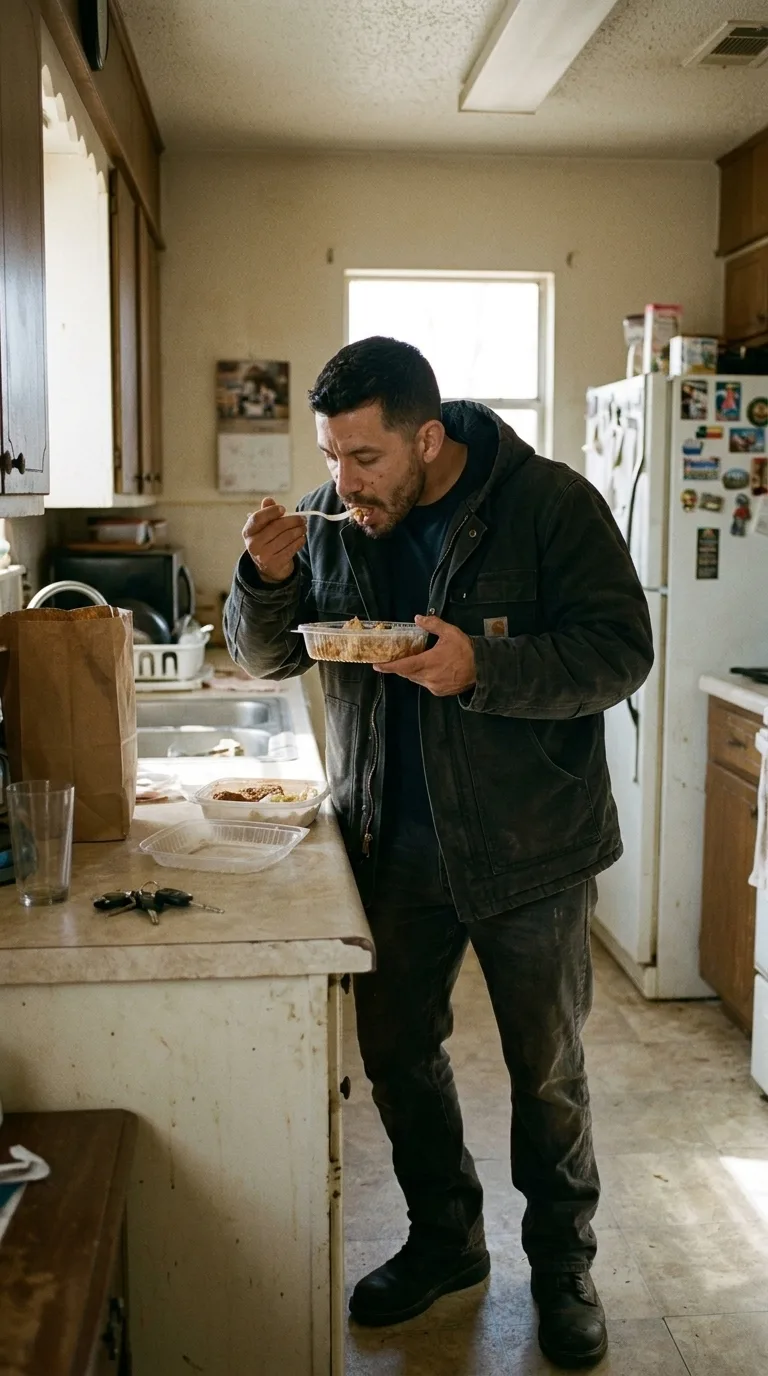
Rarest thing about him: Prep cook — common, 1 in 226
Face-off rating 1500 · not ranked yet
Season 1seed 1286871688 · engine v11
Character card
lineage K4WKNZ
His body-swap story
@wyatt.lindholm, wearing Evan Thomas Kilbane, rolled the wheel on and woke up as Mateo Ernesto Salazar, spent 6 minutes in him, then spun the wheel and woke up as Samir Yousef Haddad
You are standing in Evan Kilbane's apartment at midday, in his good legs and his clean twenty-two-year-old lungs, and you are bored of the wrong thing. He is fine. He is tall, he is easy, and he can draw a bracket on a napkin so that it holds. But there is a drawing on the table, a gear train he has been turning in his head all morning, and you cannot feel why it matters. You can feel only that he cares, and that the caring is his and not yours. Eleven minutes in him and you are still a guest at his funeral. The phone is open to the page. The wheel is a slow gray circle. You press.
The counter edge is against his hip, and the fork is already at his mouth. Warm rice is on your tongue. You taste cumin and chile and a little scorched onion, and for the length of one swallow you are simply a man eating. The coat is heavy on your shoulders, canvas gone soft, its lining stiff with cold. Light comes flat and white through the window. It is morning where he is. The kitchen is yellow and small, and there is a calendar on the wall.
Then the coat gives you the first thing. The collar rubs your jaw, and his hands know it. He took it off a nail by the back door an hour ago, in the dark, because the heater in the truck takes ten miles to wake. He pushed his left arm in first, always the left. He stood a moment with the zipper under his thumb. He was not sad. He was careful, the way a man is careful who has been told a number by a bank and does not trust it. He keeps his money plain and quiet. Nobody out here knows how much he has. The coat knows.
The fork is plastic and bends under your grip. His thumb flattens it by habit, and you get a kitchen with a steel table and white buckets. You get a boy at the next table, nineteen, chopping onions wrong. He shows him the claw of the fingers, the knuckle as a fence for the blade. He did it patiently, twice, and then a third time without a sound. He is proud of that and would never say so.
Your boots are heavy, and the floor is cold through them. The right heel is worn down, so you lean a little. The ache starts low in the back, that thirty-six-year-old ache of standing, and it sits beside the strength in your shoulders like two old neighbors. Your forearms are thick. Under the coat cuff, ink. You do not look yet. Your tongue goes to the back of your teeth, hunting for something, and the hunger is a smoker's. He quit. Six years. The wanting still comes at the end of a meal, a small hook, and you let it pass through you, his and not yours.
The keys on the counter are the last thing. Your fingers close on them and you get the gravel road, the washboard shaking the dash, barbed wire stitched along the fence line and the water tower standing at the edge of everything like a held breath. His mother's name was Lucía. A lot of that is gone, because the keys only give you the road, and the road is enough. You know the turns without being told. You know he drives them with the radio off.
You put the fork down, and your hand does it softly. You lift it and look. The fingers are blunt, with small white nicks across the knuckles, and swallows and a banner run up the forearm in faded red and green. They are good hands. They are somebody's.
"Well," you say, and his voice is lower than you expected, with gravel in it. "Look at that."
The rice is still warm. Nobody is coming to take him back. You turn the hand over, and somewhere far off, in a gray room, a wheel is waiting, and you cannot tell how long this one will fit.