Martin Fitzgerald
Fictional. Generated by AI — not a real person, and no likeness of one is intended.
65, chief executive in Chicago · rolled by @connor.waskiewicz · card — no film
History
who has worn him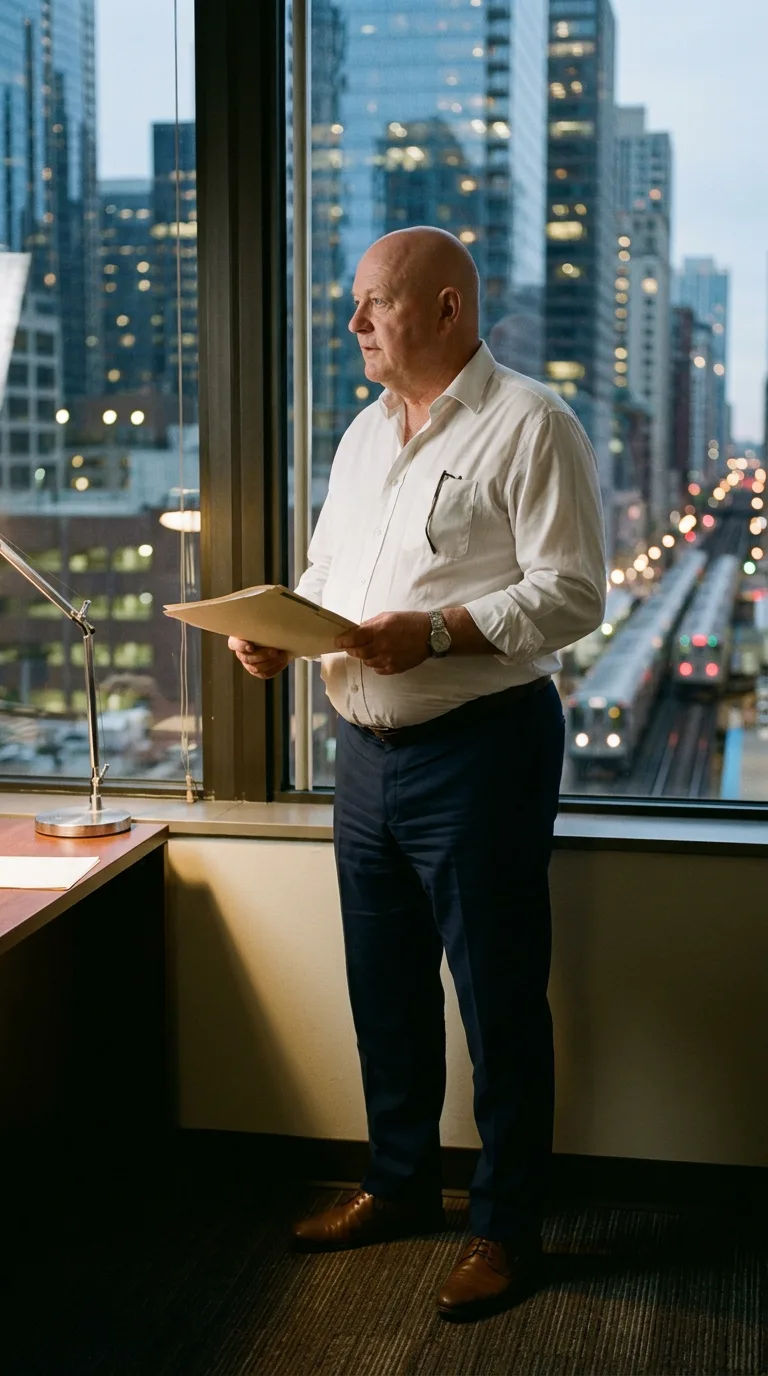
Rarest thing about him: Millionaire — $1M to $3M — common, 1 in 20
Season 1seed 2024794962 · engine v11
Character card
lineage 2NZHHJ
His body-swap story
@connor.waskiewicz, wearing Daniel Yoon, rolled the wheel on and woke up as Martin Fitzgerald, spent under a minute in him, then spun the wheel and woke up as Brian Kessler
The man I am, Daniel Yoon, is standing in a kitchen in Anchorage with a dish towel over his shoulder. The window over the sink is full of flat white morning. I have worn his body for less than a minute, and already I know it is a good one. The broken nose breathes fine. His knees do not complain. Down the hall a child's cartoon is playing, and none of it is mine. I put his coffee down untouched, because the cup is warm and the warmth is exactly the trouble. It is a perfectly finished life with nothing left in it to take. So I open the page with the wheel on it and pay.
The wheel clicks around. It stops.
Dusk, and I am standing up. I have been standing here a long time without knowing it. There is a folder open in my left hand and the thumb of my right is hooked under a page, mid-turn, and the turn comes out wrong. The motion stutters. I do it again, slowly, and it is correct. The ten that follow come out the same way, each page checked, on a job this body has not had to check in years.
Glass is in front of me, with a whole lit city behind it. Below the window a train slides along its elevated track, red and white lights going by in a long line. The floor is carpet under leather soles. A desk lamp stands to my left, its metal arm bent like a heron's neck.
The shirt gives me the first thing. Cotton against my back, a little damp between the shoulder blades. This morning he stood in a bedroom with the radiator ticking and did the buttons from the bottom up, because he always has. He rolled the sleeves twice, left then right, and felt vaguely pleased with the forearms, which are no longer what they were. The feeling is his: a small, private pride he would never have admitted to anyone. Then the glasses in the pocket press against my chest, and that is a kitchen in a brick two-flat under the tracks, a winter Sunday, him alone with the crossword, laughing at a clue. Nobody was there to hear it. He had stopped minding that around the fifth year.
The folder is the next key. The paper is soft at the edges, and under my thumb is a contract he has read six times. Dread rises behind it, quiet and old, because the signature at the bottom would close a company he built from a garage with two other men. One of them is dead. The other he has not spoken to since a lunch in March. Nobody knows he is going to sign. He has decided already, and only the hand has not caught up.
The watch is heavy on the wrist, steel gone warm. I get a night out, a big one, the kind he allows himself once or twice a month: a bar, a bad song, his own voice louder than he meant. He walked home under the tracks afterward, the whole street shaking overhead, and he stood there grinning like a boy and thought, there must be something larger than all this. Not God exactly. Something that notices.
The body underneath carries all of it. The gut sits soft and ordinary against the belt. My lower back has a dull ache from standing too long. My head is bare and cool, the scalp faintly slick, the jaw smooth from a morning razor. Sixty-five years of steady, unremarkable use, and nothing in it is broken.
I lift the hand off the page and turn it over. It is thick across the knuckles, ruddy at the edges, and steady, which is a surprise. It is a stranger's hand with the whole city in the glass behind it. I look up, past it, into the dark reflection of my own new face.
"Well," I say, in a voice that is lower than I expected. "Let's see what you were going to sign."
The train goes by below. I wonder how long before I want something else.