Martin Doyle
Fictional. Generated by AI — not a real person, and no likeness of one is intended.
61, teacher in Los Angeles · rolled by @connor.waskiewicz · card — no film
History
who has worn him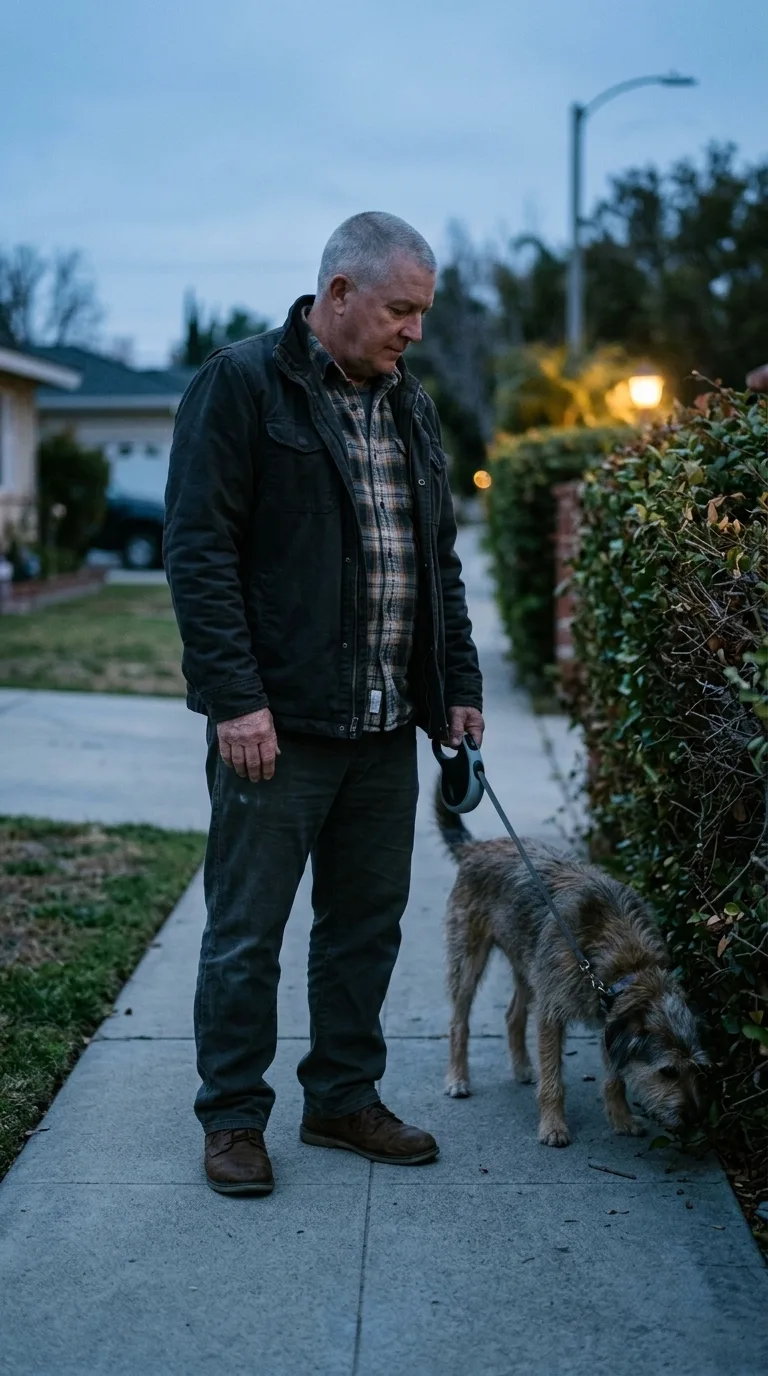
Rarest thing about him: Can't stand still — common, 1 in 51
Season 1seed 1249132907 · engine v11
Character card
lineage 2NZHHJ
His body-swap story
@connor.waskiewicz, wearing Patrick Dolan, rolled the wheel on and woke up as Martin Doyle, spent under a minute in him, then spun the wheel and woke up as Russell Kearney
You are twenty-six and five-foot-five, and you have been him for two minutes. You stand in a kitchen in San Francisco before the day has started, with a moustache you haven't gotten used to and blue eyes in the dark window over the sink. The kettle hasn't boiled. A rent notice is stuck to the fridge under a magnet shaped like a crab, and it isn't yours any more than the body is. You read it anyway, and your thumb knows the corner of the paper. Some other man's worry rises in the thumb and you let it go by.
Nothing is wrong with him. He's quick, his knees are good, and he sleeps well. But two minutes was enough to learn that he flinches at the phone, and that a bad month is sitting in his chest, waiting to be lived. You don't want a month. You didn't pay for a month. You want the next thing, and the wanting has come back the way hunger does, from nowhere, polite and total. You set the kettle down. You open the page with the wheel on it.
It turns.
Cold air comes first, and then the weight. Sixty-one years of it settle through your heels and into your lower back, a low ache that has clearly been there a while. You are standing still on concrete. The light is blue and nearly gone, a streetlamp is burning orange down the block, and there is a hedge close at your right. Something tugs at your right hand, and you feel it in the wrist: a plastic handle, a thin cord running out to a dog.
The dog has stopped. It has lifted its head out of the leaves and is looking at you, wiry and brown, ears pinned back. It knows. Your hand has stopped walking, and the cord has gone slack.
The jacket is the first thing to speak. Canvas, stiff at the cuffs, the collar worn soft. Your left hand finds the zipper pull and the cloth gives you a morning: the closet door sticking, the jacket taken off a nail because the radiator is dead, and a thought that is his, not yours: *forty degrees, he'll want the coat, he never wants the coat.* The dog is the *he*. The dog's name is Biscuit. You know it the way you know your own tongue.
The flannel under it gives you buttons. Your fingers have never done these buttons, yet they do them in memory, bottom to top because the top one is loose. You hear the ceiling fan going in a room with the blinds shut. A grandchild's drawing is stuck to a mirror. There are three children and none of them live close, and one of them stopped calling. He thought about that while he buttoned, so you do too, briefly, and it is a flat gray feeling without any edge.
Your free hand is moving without you. The fingers drum your thigh, then pinch the seam of the jeans, then tap the handle of the leash. They can't stay still. He has never in his life sat through a staff meeting without a pen to click. Under the nails there is old paint, and the knuckles are thick. The left forearm shows a faded anchor when the cuff rides up, and the right has a banner with a name worn too pale to read. Each tattoo brings a smell when you press it. Hot needle and rubbing alcohol, a shop in Long Beach, a man laughing, and him at nineteen, certain of everything.
The leash handle is slick plastic, and the thumb finds the lock button without asking. Press it and the cord stops. A hundred evenings come up through it. Hedge, hydrant, the same corner. A cigarette lit at the end of the walk, one drink in him and then another, and the smoke thin over the courtyard of his apartment. Then another memory, ahead of the walk: a woman's coat left on the back of a chair, and a key she put down on the counter very gently. That was recent. Your chest tightens on his behalf, and you recognize the feeling as nothing of yours.
The lanyard isn't on you, but your hand goes to your chest looking for it. A key ring, a school card. Thirty-some years of chalk and then markers, the empty classroom after the last bell, chairs upside down on desks, and one kid in the back row finally understanding something. It is the best afternoon you have ever been given. You stay in it as long as the second allows.
Your boots are cracked leather, wide at the toe, and the arches ache. The knees remember a bad stair. The belly sits where it sits, solid and warm under the flannel. The breath is slower than the last body's, and deeper.
Then the cold on your face, and the dog still staring.
You look down at your hand. The skin on the back is loose and freckled, and you turn it over and see the palm creased deep. The fingers close, open, and drum once. Yours, for now.
You wind the cord twice around the knuckles and look up at nothing, at the streetlamp.
"Come on, Biscuit," you say, in a voice with gravel in it. "Let's see how far this goes."
The dog doesn't move. You start walking anyway, and wonder how long until the wanting comes back.