Marcus Tillery
Fictional. Generated by AI — not a real person, and no likeness of one is intended.
50, construction foreman in Nashville · rolled by @connor.waskiewicz · card — no film
History
who has worn him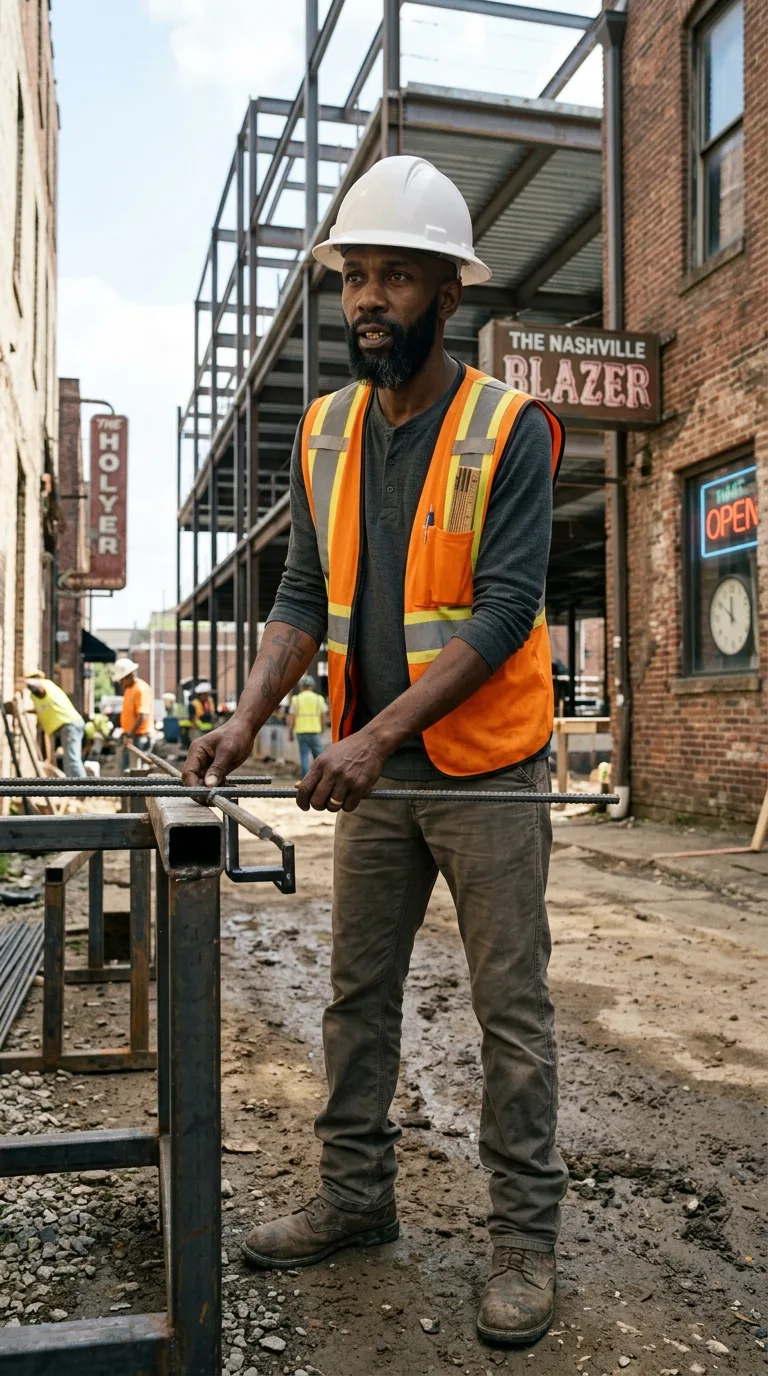
Rarest thing about him: A gold tooth — uncommon, 1 in 141
Season 1seed 1289912164 · engine v11
Character card
lineage 2NZHHJ
His body-swap story
@connor.waskiewicz, wearing Ray Calloway, rolled the wheel on and woke up as Marcus Tillery, spent under a minute in him, then spun the wheel and woke up as Daniel Kahananui
The first thing I do is stand in Ray Calloway's kitchen with his coffee going cold. Gray in his hair, a birthmark on his cheek, a body that carries its weight low and easy. I have been him for less than a minute, and I am already tired of the way he sits. He settles into things. He sits like a man who has never wanted to be anywhere else, and I have wanted to be somewhere else since the second the wheel dropped him on me. It isn't his fault. I pick up the phone and the page is there, the wheel on it, one slow tick of light going round. Afternoon in Kentucky, a Tuesday, a window full of hills. I press.
Rebar. Cold, ridged, steel against the pads of both hands, and the sun on the left side of my face. An alley, brick on one side, and the steel frame going up behind me like the ribs of something. Somewhere a neon sign is buzzing in daylight. My hands are mid-motion, sliding a length of bar along the rack, and the motion goes wrong. Half a second, the bar skews, my grip is a stranger's grip. I stop. I do it again, slowly, and it is right.
Then I do the next one, and I check it. And the next. Ten of them, each one checked, on a job this body has not needed to check in years, and the body lets me. It is patient with me, the way a man is patient with a new hire.
The vest first. Hi-vis nylon, stiff at the collar, a ballpoint and a folding rule in the chest pocket, and I feel the zipper catch, and it is this morning in a dim bedroom: his arm through the hole, a woman's voice from the bathroom saying the lunch is on the counter, don't forget it again. A laugh in his chest. He zipped it halfway, the way he always does, because the other half never matters until a boom swings.
The shirt, gray, soft, buttons at the neck, washed a hundred times. Her hands were in it once, straightening the placket, thumbs on his collarbones, and the feeling is not mine, it is a warmth so settled it has no edges. Twenty-six years. I have never had twenty-six years of anything.
The tattoo itches. Inner forearm, a cross and praying hands, and when I turn the arm the memory comes up out of it: a folding chair, a church basement, Pastor's hand on his shoulder, him at twenty-three and ashamed of the cigarettes, of the bottle, of what he'd said to his mother. He got the ink the week he quit. He still wants a cigarette at four in the afternoon, and I feel it now, a hook behind the teeth, and my tongue finds the gold canine and it is smooth and cold.
The ring. Plain, a little loose in the cold, tight in the heat. Two kids' voices overlapping at a kitchen table, one of them reading out a report card, and a pride that makes the chest hurt.
The boots are heavy and resoled twice. The ground is mud over gravel, and my knees know it, a dull fifty-year ache in both, the lower back tight as a drawn wire. He is thin, all cord and length, six feet of a man who has outworked his own frame. His hands are a foreman's hands, and they know the weight of the bar before I do. Down the block the men are calling to each other. They call him Marcus. Not boss, not Mr. Tillery. Marcus.
None of it is mine. I stand in it all the same, and it holds.
I lift my right hand from the rack and look at it. Dark, split at one knuckle, the ring bright. I turn it over. The palm is a map of work.
I look up and say, to nobody, in a voice with a gold tooth in it, "Alright, Marcus. Show me."
The sign buzzes. The bar is still warm where I held it. I don't know how long this one lasts, or when the wanting comes back, only that it will.