Marcus Tillery
Fictional. Generated by AI — not a real person, and no likeness of one is intended.
47, management consultant in San Francisco · rolled by @connor.waskiewicz · card — no film
History
who has worn him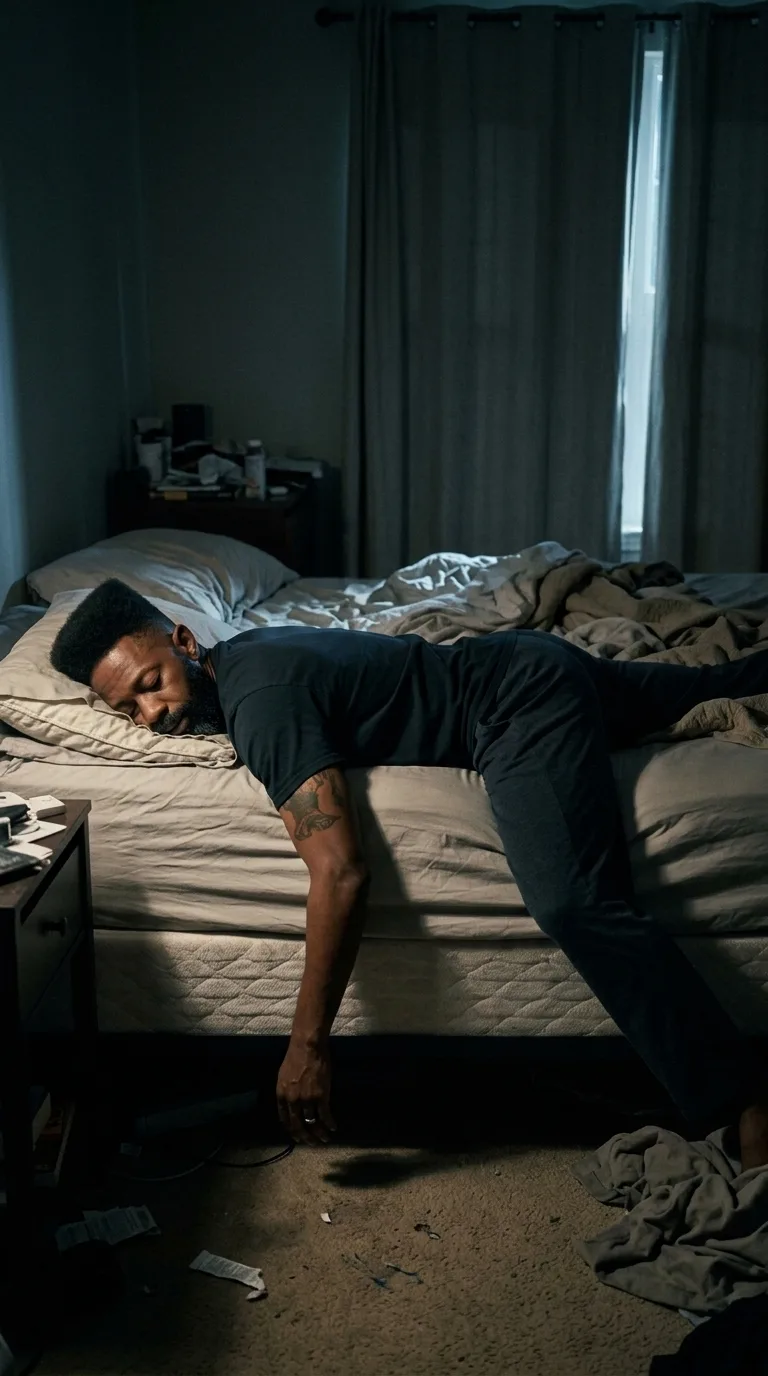
Rarest thing about him: A high-top fade — uncommon, 1 in 304
Season 1seed 783755320 · engine v11
Character card
lineage 2NZHHJ
His body-swap story
@connor.waskiewicz, wearing Dale Pruski, rolled the wheel on and woke up as Marcus Tillery, spent under a minute in him, then spun the wheel and woke up as Lonnie Peebles
You are standing in the dark in Dale Pruski's kitchen, in Dale's socks, and the refrigerator is humming at you. A trucker's kitchen. A man who has done this for thirty years and has a bad right knee and wakes at three without an alarm. You have been him for less than a minute, and you already know what he cannot do. He cannot want. Everything in him is settled. The knee, the cleft chin, the heavy sleep he drops into like a dumped load: it all says stay. You hold his phone with the page open, the wheel painted on it, and the thumb that is his thumb is already moving. Nothing he did. Nothing wrong with him. You are only the kind of thing that cannot be filled, and in the quiet of a house where everyone sleeps, you press.
Then the kitchen is gone, and there is a mattress under your whole front.
Your face is in a pillow. Your arm hangs off the edge, and the blood has gone out of it and is coming back in needles. The breath in your chest is ragged, catching, a man who was dreaming something. You make it even. In one breath you make it slow. The arm draws itself up and the body rolls over onto its back and your hands fold on your chest, a way he has never once slept. Streetlight comes through a gap in the curtains and lies across the sheets like a cut.
Nothing yet. Then the cotton: a black T-shirt, worn thin, twisted around the ribs from his sleeping. You pull the hem straight and the shirt gives him up.
He bought a dozen of these in a pack, because his wife said he dressed like a man waiting for a funeral and he said that was the point. Her laugh in the dark. The children's breathing through the wall, three of them or more, a house of small weather. You feel how he loved the noise of it and how tired it made him.
The sheets under your palm are cool, kicked into ridges. Under the cotton: the mattress he has complained about for years, the spring that finds his hip. Hip first, then a whole night of lying awake doing arithmetic, the account at twenty-some thousand, the number he checks the way other men touch a sore tooth. Not enough. Enough, almost. A man who flies out Monday, home Thursday, in lounges with the laptop open on the ledge, telling clients what they already know in a better suit.
Your thumb finds the ring. Plain, a little loose in the cold. A church basement, folding chairs, coffee, his mother's Methodist hymns, all of it in his chest as a kind of warm weight. He stopped drinking without announcing it. The wanting for it went out of him like a tide, and what he misses now is the cigarette, the vape in the nightstand drawer, the one secret he thinks his wife doesn't know and she does.
Your knuckles crack. You didn't do it. The hand did, thumb rolling each joint, the oldest thing he owns.
Under the sleeve, on the upper arm, the skin remembers a needle: a swallow, bold line, faded color, a shop on a bad street, nineteen, a friend's dare. Then another face, a woman before his wife, the one who got away, laughing on a stoop. A hurt he carries so lightly it only shows in how carefully he never says her name.
Your heart is slower than Dale's. Your back is softer, your belly round and warm under your folded hands. Forty-seven years in the joints. Nothing in particular, only a man.
You lift your hands into the streetlight and turn them over. The ring catches. Then you look up, into nothing, into whoever is there.
"Hello, Marcus," you say, and his voice is deeper than yours was.
How long is the question already forming, quiet as a tide.