Marcus Tillery
Fictional. Generated by AI — not a real person, and no likeness of one is intended.
21, cashier in Small-town Ohio · rolled by @connor.waskiewicz · card — no film
History
who has worn him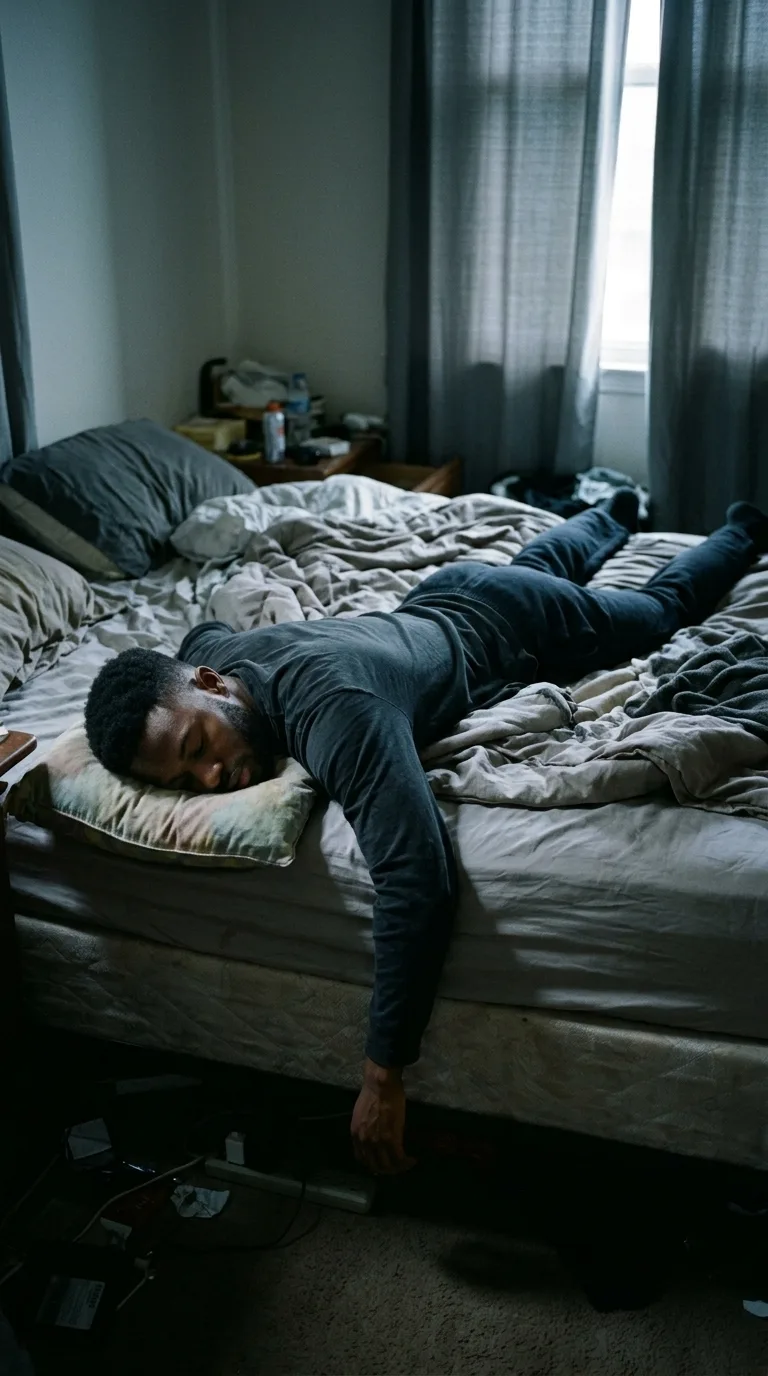
Rarest thing about him: Pulls at his beard — epic, 1 in 365
Season 1seed 1141900417 · engine v11
Character card
lineage 2NZHHJ
His body-swap story
@connor.waskiewicz, wearing Rudy Almonte, rolled the wheel on and woke up as Marcus Tillery, spent under a minute in him, then spun the wheel and woke up as Gilberto Mendoza
Rudy Almonte's knees hurt on the stairs. That is where it starts, in the body I am about to leave: a forty-year-old man between jobs, five-three on a good day, standing in a kitchen in New York before the light has come up, with a gray-silver head and two different-colored eyes looking back at me from the black of the window. I have been him for less than a minute. I have not even learned where he keeps the cups. The knees were not the reason, though. The reason is that I stood at his counter and wanted nothing. I had the whole man, and the wanting went out of him like a pilot light. So I open the laptop on the counter, and the wheel is already turning under my thumb. The 1181st time. I do not say the reason to the window.
The wheel clicks down and lands.
Ragged breath, then even. That is the first thing: my own breathing, stropped rough against a pillow, smoothing in one pull. Cloth against my cheek, warm and damp from my own mouth. One arm is hanging over the edge of a mattress, the blood gone out of it, fingers brushing carpet. Streetlight lies through a gap in the curtains, a thin gray stripe across the sheets. Small-town dark, the quiet of a place with one stoplight blinking over an empty street.
I draw the arm up. I roll onto my back, and my hands fold on my chest by themselves, tidy as a body laid out. He has never once slept like this. I can feel that in the muscle: the shoulders resist it.
Then the things on him begin to talk.
The sleeve of the long shirt, soft and thinned at the elbow, and I know it: he bought it at a rack off the highway, three for twenty, and wore the first one to threads. A flash of a checkout lane, the belt running, the scanner's red line stuttering across a gallon of milk. The beep of it lives in his wrist. My right hand twitches, wanting to turn something over to find the barcode.
The sheets are tangled around my ankle, and under them a second warmth on the mattress, an empty dent, still faintly warm, and a smell of cocoa butter. A girl's name comes with it, and his feeling for it comes first, before any face: a loose, easy gladness, like putting down a bag. She works the early shift at the nursing home. She kissed his head an hour ago and he did not wake. He keeps meaning to tell her he is saving, and he is saving, and it is never more than a few hundred. Under five thousand dollars to his whole name, and he knows the number the way you know a bad tooth.
My fingers climb to my jaw on their own and pull at the short beard, tugging, a habit older than the girl. The hair is crisp. Under it the jaw is clean and young. Twenty-one. The body is a good one: shoulders loose, thighs humming with standing all day, a stomach flat from nothing but being young. My feet ache in a remembered way. The soles keep the memory of the mat behind the register, the rubber give of it.
The church comes from nowhere, through the cotton against my back: a pew, a hymnal with a cracked spine, his grandmother's hand on his knee when he fidgeted. Not belief exactly, more a floor under him. He has never had a drink; he watched what it did to somebody, and that comes up as a closed door, and I do not open it.
The diner on Main closed in the spring. He used to eat there before shifts. I feel the loss as a small stone in the chest, mild and ordinary, nothing anybody would put in a card.
I lift my hands in the stripe of streetlight and turn them over. Palms paler than the backs, a callus at the base of the right fingers, nails clipped short. They are not mine. They are mine.
I look up at the dark ceiling and say, low, so as not to wake a house that is empty now, "Okay. Hello, Marcus."
Nothing answers. Somewhere a truck downshifts toward the stoplight. I do not know how long he lasts. I do not know when the wanting comes back, or whether I will be lying here tomorrow with these hands, or in someone else's kitchen, and I hold very still and wait to find out.