Marcus Odom
Fictional. Generated by AI — not a real person, and no likeness of one is intended.
38, aircraft mechanic in Small-town Ohio · rolled by @marcus.odom · card — no film
History
who has worn him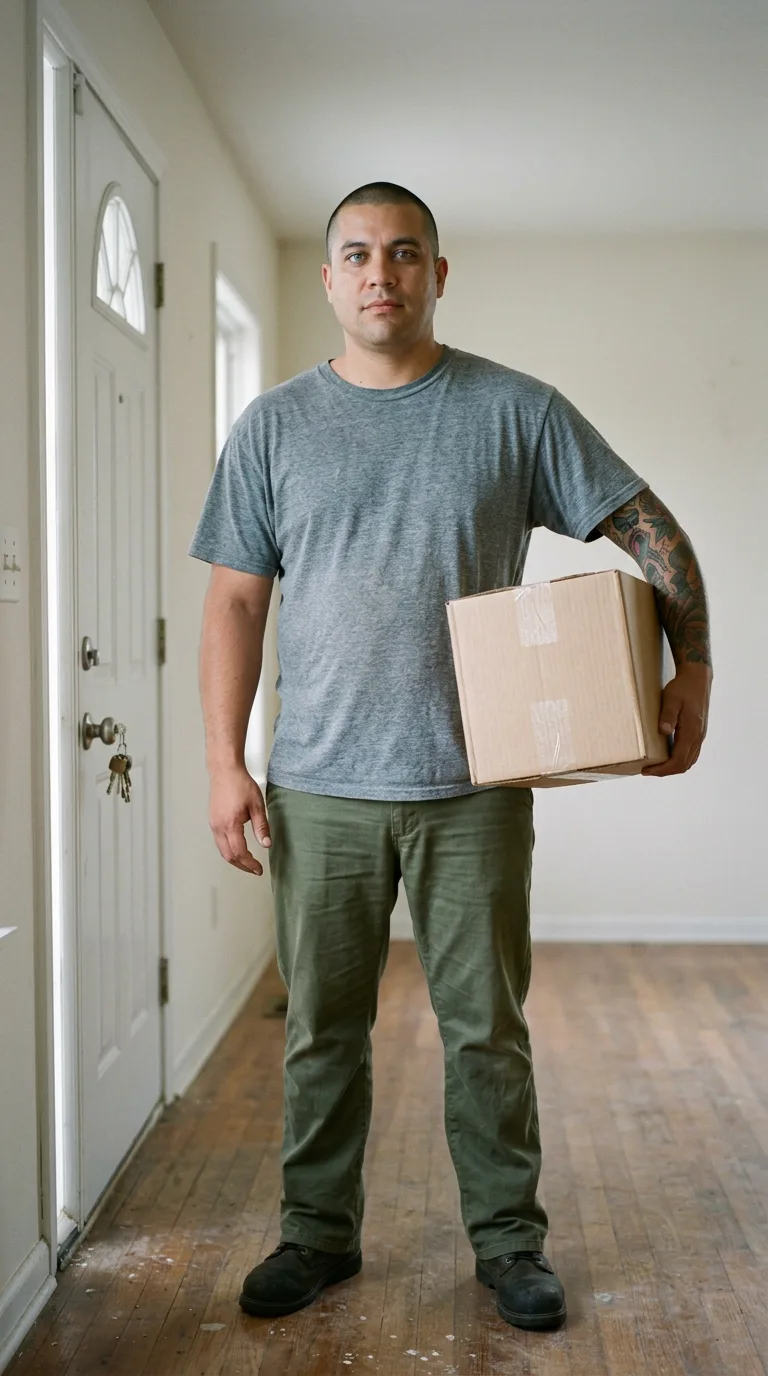
Rarest thing about him: Heterochromia — rare, 1 in 200
Season 1seed 331710268 · engine v11
Character card
lineage X78V79
His body-swap story
@marcus.odom rolled the wheel on and woke up as Marcus Odom — their first
The scroll had gone on long enough that your thumb stopped meaning anything by it. Wednesday, late, nothing worth watching twice, and the tab you'd opened four times that week and closed out of something like embarrassment was open again, and this time you didn't close it. Vessel.cards. A wheel on a gray background, plain as a raffle. You have wanted this since before you can date it — every story where someone wakes up behind a stranger's eyes, every thread at two in the morning asking if it could be real, and it was never real, and then it was a price. You paid it. You spun it not for a reason that needs more than this: you have always wanted to be someone else, completely, for real, and here was the door.
The wheel spins and there is no ceremony to it, no countdown, just a click like a turnstile —
— and you are bent slightly at the knees, weight coming off your hip, a box leaving your hands onto a hardwood floor that smells like old varnish and fresh paint. Late morning light through a bare window. A door still open behind you with keys hanging in it, throwing a small brass shine. You are not looking at any of it through your own eyes. You are looking at it through his.
The box goes down. That's the first thing his body knows to do and it does it without you, the knees and the low back taking the weight the way they've taken a thousand boxes, engine housings, toolboxes, a life spent lifting. You stand up out of it and the room tips very slightly with blood pressure and you feel, for the first time, what thirty-eight years of a body actually weighs like from inside: solid through the middle, a softness over muscle that used to be only muscle, shoulders that carry more than they used to carry easily. You don't move toward the keys. You walk the wall instead, and it's his walking, not yours — knuckles trailing the plaster, checking a corner where a cable jack should be, checking another where there isn't one, a man learning a room with his hands because the eyes haven't caught up to being awake in it yet.
The wall gives you nothing. The shirt does.
Gray cotton, thin at the collar from washing, and it comes up through your shoulders like a held breath let out — a woman's hands smoothing this same shirt flat that morning, not him dressing so much as being dressed while half-asleep, her voice saying take the good pillow this time and him saying there's a bed already, Rhonda, it's Tuesday's problem, and she'd laughed and it hadn't felt like laughing with an ex, because Rhonda is the one before, the one whose name still comes with a specific weight in the chest, ten years filed down to paperwork and a signature and a house that isn't this one. This one belongs to the woman whose hands smoothed the shirt. Denise. You get her name off the collar like a label. Denise had kissed his jaw at the door — freshly shaved that morning, blade dragged twice for good measure, because she likes it smooth and he shaves for her without being asked anymore, the way he used to shave for Rhonda and stopped noticing was for her too.
The green pants carry the hangar into the room — cheap dryer sheet over something that never fully leaves, jet fuel and hydraulic mineral oil ground into the seams no matter how many times they're washed. His hands know an open cowling the way your hands, whoever's hands those were, never knew anything: torque wrench, the particular give of a stripped fastener, the exact pressure before a bolt seizes. He loves it and has never told anyone that in those words. He tells Denise it's a job. It is more than a job. It is the one place his mind goes fully quiet, and lately the quiet has started to feel like the only rest he gets, because sleep doesn't come easy anymore and he doesn't examine why.
The sleeve gives you the most — right arm, wrist to shoulder, American traditional gone soft at the edges, a panther faded to bruise-purple, a rose that was red in 2009 and is rust now. Eighteen, in a shop two towns over, lying about his age and paying cash he'd saved from a summer of roofing. Adding to it every few years the way other men buy rounds. Rhonda hated it at first and then didn't. Denise traces it with one finger sometimes when they're on the couch not talking, like reading braille she already knows.
The pack of cigarettes in the front pocket — he's not touching them, but they're against his hip and that's enough — brings the taste of the first one this morning, out on the step of the old place before the movers came, watching the street with its one dead stoplight blinking yellow into nobody, thinking today's the day, finally, took long enough. He doesn't drink, hasn't in years, gave it up quiet and without a story attached, but the pack he can't put down, has tried twice, failed twice, doesn't try anymore.
Under it all, steady as a second pulse: a body that carries its weight low and easy, knees that complain faintly on cold mornings, hands stronger than they look, a mouth that when nobody's watching goes to the thumbnail without being told to, worrying it down to nothing. Not anxious, exactly. Just a thing the hands do.
You look down. His hand — your hand now, for as long as this lasts — is at his mouth already, teeth at the edge of the nail, and you stop it there, mid-motion, and turn it over slowly in the light coming through the bare window. Fingers thick, one knuckle scarred white and small from some forgotten slip of a socket wrench. A stranger's hand, and yours, both at once, and no telling which one is going to be true tomorrow.
You lift your eyes off it into the empty room, toward the door still holding its keys, and you say, out loud, to no one:
"Whose house is this."