Marcus Deshawn Feltrin
Fictional. Generated by AI — not a real person, and no likeness of one is intended.
18, retail sales associate in New Orleans · rolled by @connor.waskiewicz · card — no film
History
who has worn him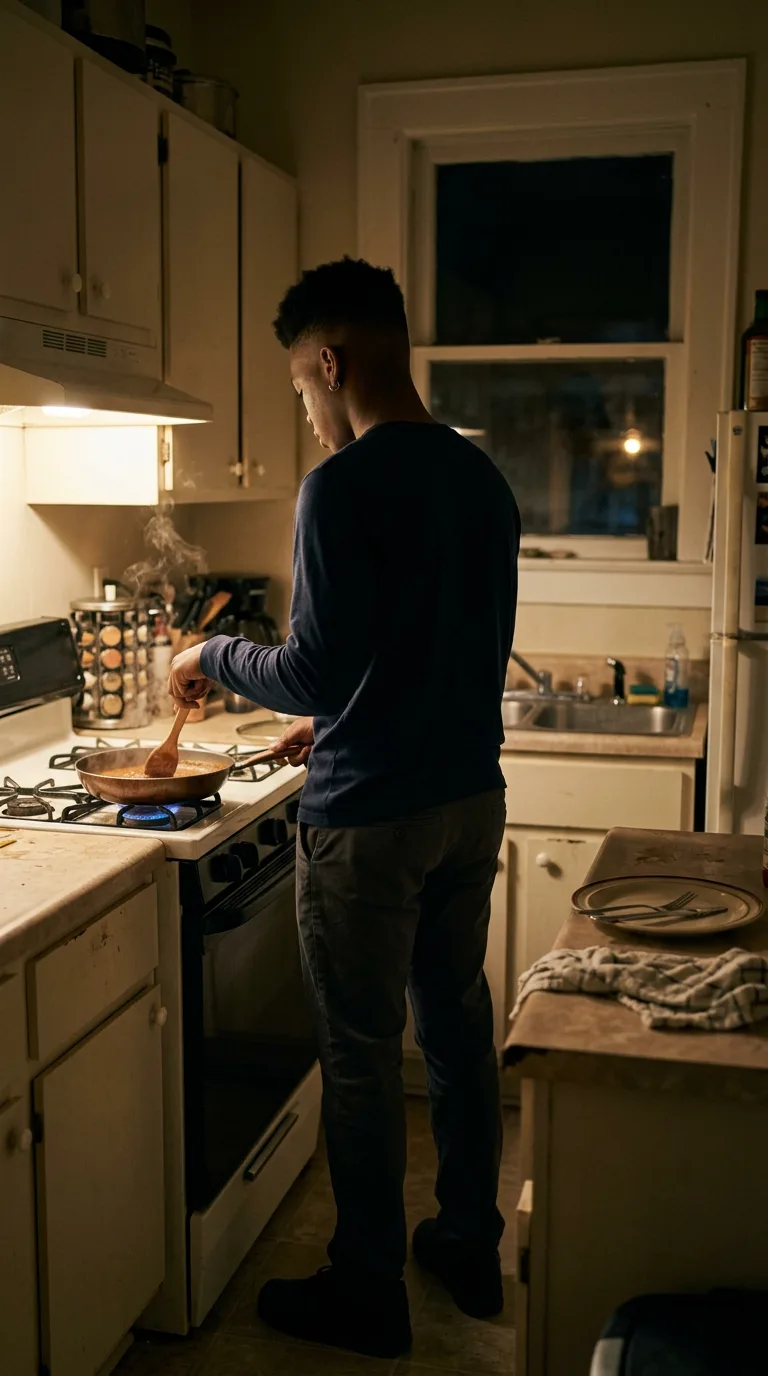
Rarest thing about him: One earlobe — common, 1 in 26
Season 1seed 608522277 · engine v11
Character card
lineage 2NZHHJ
His body-swap story
@connor.waskiewicz, wearing Cole Williams, rolled the wheel on and woke up as Marcus Deshawn Feltrin, spent under a minute in him, then spun the wheel and woke up as Ryan Petrocelli
---
Cole Williams has been you for three minutes, and already you can feel the shape of the problem: this body wants things you don't. It stands at attention out of habit, shoulders squared to a rack of duty whites you can smell starch on, and somewhere under the freckled skin there's a woman he was supposed to call an hour ago, and a chief who'll ask questions tomorrow that this body knows the answers to and you do not. Twenty-three years of Cole are sitting in this skin like sediment, and every one of them itches. You didn't spin to inherit a schedule. You open the site on his phone with his thumbprint, which works, obligingly, and the wheel is already spinning before the ache of wanting something else fully arrives. That's reason enough. It's always been reason enough, eight hundred and eight times before this one.
The wheel turns light into a face and the face becomes weight, and you are it: standing, mid-motion, a wooden spoon in your hand going one way in a pan of something red and thick, and then — because you arrive at an angle to him and not exactly inside his rhythm — it goes the other way instead. Steam. Gas flame. A kitchen the size of a hallway, lit low and yellow. You salt the pan without tasting it because your hand does it before you've caught up to owning the hand, and you set a second plate down next to the first one, and no one told you to, and you don't know why you did except that some undertow in him wanted it and for a second the undertow was faster than you.
Then the room comes in through what you're touching.
The spoon handle first — worn smooth on one side where a thumb has rested a thousand times, and it gives you: rice and gravy on a Sunday, a woman's laugh from a room you can't see, the specific unhappiness of a burned roux and starting over without complaint. His hands know a roux the way they know breathing, slow figure eights, patience learned from somebody standing behind him once, guiding his wrist. Grandmother. Gone three years now, and the grief sits in the wooden spoon like it's soaked into the grain.
The shirt against your back — long-sleeved, navy, worn soft — gives you this morning, evening really, before the shift: him pulling it over his head in a room one door down from this kitchen, the ceiling fan wobbling, a mirror with a crack in the corner he keeps meaning to replace. He'd stood in front of it turning a ring over in his fingers before he put it in the dish by the sink, the way he does every night before work because the store doesn't want jewelry on the floor except the earring, which he never takes out, which is his mother's idea from when he turned sixteen and she said a man could wear one hoop and still look like somebody's son.
The apron string, tied twice, a nervous habit — this gives you the store. Fluorescent light, a price gun heavy and grooved to his palm's exact grip, boxes of routers and streaming sticks he squares off obsessively because a straight shelf is the only thing in an eight-hour shift he gets to control completely. A manager who likes him. A register drawer he's never once come up short on. Nothing dramatic in it — a good employee, an unremarkable one, the kind who gets scheduled and shows up and doesn't complain, which is its own kind of remarkable if you've worn enough men to know how rare the not-complaining is.
The counter edge under his other hand — cool tile, humidity fogging the window over the sink — gives you her. Not a wife, not even quite a girlfriend by the end, but a year of something that had shape and weight, that ended in May with nobody exactly at fault, and he has cooked for one every night since with a kind of quiet, stubborn dignity that refuses to read as loneliness even to himself. Tonight the second plate went down next to the first without him deciding it, muscle memory older than the breakup, and that's the ache under all of this — a man who sets two places out of eighteen years of habit and hope, and eats alone anyway, and does not mind saying so, even to no one.
His body is eighteen and lean under the T-shirt, all long clean lines, no soreness in it yet the way there will be soreness in thirty years of shelves and price guns — just a faint good tiredness in the shoulders from a full shift, feet that know the particular ache of standing on linoleum eight hours running. Clean-shaven jaw, still faintly cool from the razor this morning. The hoop in his ear is a small constant weight he has stopped noticing at all.
You look down. Your hand — his hand — is still holding the spoon, sauce dripping slow off the wood, and you turn it, knuckles catching the stove light, the way he does without thinking when there's a ring there and there isn't one tonight, so the fingers just close on nothing instead, searching.
"Didn't even notice I set two plates," you say, out loud, to the empty kitchen, in his voice, and it comes out sounding like it's still his question and not yours — how long, this time, before the wanting turns over again like that spoon and starts going the other way.