Marcus Delgado
Fictional. Generated by AI — not a real person, and no likeness of one is intended.
42, tailor in El Paso · rolled by @colin.hasbrook · card — no film
History
who has worn him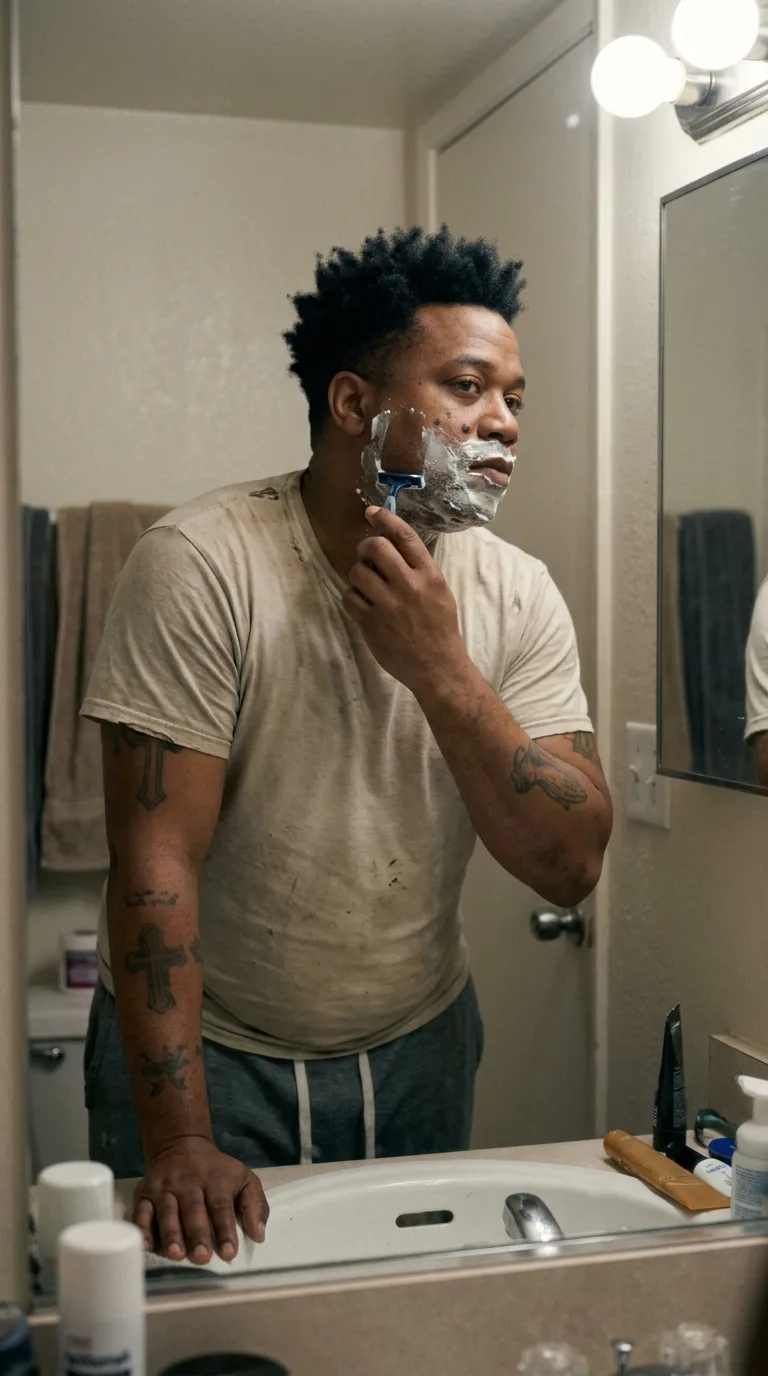
Rarest thing about him: El Paso — uncommon, 1 in 44
Season 0seed 1815707445 · engine v10
Character card
lineage 2NZHHJ
His body-swap story
@colin.hasbrook, wearing Trent Ostergaard, rolled the wheel on and woke up as Marcus Delgado, spent under a minute in him, then spun the wheel and woke up as Dale Hutchings
Trent Ostergaard's hands smell like paint thinner and it is not even noon. Forty-four minutes in this one and already you know the whole shape of him: bald by razor, beauty mark under his left eye, a house painter's forearms, a bank account with three hundred dollars in it and rent due Friday. He is standing in the cab of a truck that isn't his, and the AC is broken, and somewhere in the last three-quarters of an hour you understood that this life is thin all the way through — nothing in the freezer, nothing in the calendar, nobody who'd notice past a day or two. There's no reason to grieve leaving him. You barely arrived. You take out the phone that is technically his employer's and you go to the site with the thumb that already knows the motion, like it's done this six hundred and forty-four times before, which it has, in different hands every time.
You pay. You spin.
The mirror is not your mirror and the face in it is not a face at all yet, just a jaw with foam sliding off it in a diagonal, one cheek shaved clean and one still lathered white, and the razor is already moving before you have a self to move it. Up the throat, along the jaw, no hitch at the corner of the mouth where — you don't know yet that this is where he always hesitates, but the hand knows, and the hand does not hesitate. The second half of the face gets done faster than the first ever does. You are standing at a sink with warm porcelain against soft stomach, weight low and settled in a way the last body never carried it, and steam is fogging the corner of a mirror clipped in a bathroom too small for the man in it.
The razor touches down into the water. That's the first thing you're holding — cheap plastic, three blades, dulling — and it opens like a door.
*He bought a twelve-pack of these at the Walgreens on Yarbrough because the good ones, the ones his abuela used to say a man should use, cost eleven dollars and he has a daughter who needs cleats.* The memory arrives with no announcement, just sits down inside you fully formed, his feeling and not yours — a small practical tenderness, worn smooth from use. You feel where his other hand rests flat on the counter, thick fingers, the calluses along the pads that come from pins and shears and not from labor exactly, a different kind of hard-won.
The shirt is next — not on him yet in the mirror-memory, but you feel the ghost of it, an off-white undershirt gone soft gray at the collar from washing, and putting it on this morning comes back sleeve by sleeve: raising the right arm first because the left shoulder clicks if he doesn't, a habit from some old injury nobody ever paid to look at. Under it the ink comes alive at the touch of cotton against skin — the cross on the forearm he got at nineteen, three days after his mother's funeral, in a shop on Alameda that doesn't exist anymore. The praying hands on the other arm, done nine years later, steadier lines, the year his son was born. He remembers the sting of that one less than the pride of it, sitting in the chair thinking about a name he hadn't chosen yet, a face he hadn't seen.
The sink under his palm gives him the house — turquoise stucco, chain-link gone silver with sun, the particular white of El Paso light that has no mercy and no shade to it, the kind that shows every seam in a jacket before you've even basted it. The shop comes next, unbidden, riding in on the smell of foam and drugstore soap: the cutting table by the window, the half-made jacket waiting on the dummy like a patient man, chalk dust on his forearms that he never fully washes off. He loves the shop more than he loves almost anything that isn't a person. He built it slow, on nothing, on referrals and a good eye and the stubbornness of a man who watched his father get paid nothing for the same skill in a factory in Juárez.
There's a girlfriend in there too, arriving through the smell of her shampoo he must keep in this bathroom, though you can't place the bottle — Vanessa, warm and a little impatient with him, good for him in the way that scares him some nights. And under her, older, quieter, an ex-girlfriend's name that still catches on something when it surfaces — Priscilla — not longing exactly, just a door he keeps shut and dusted. And under all of it, brightest, a boy's voice on a phone saying *Papi, watch this,* and the pure, uncomplicated ache of missing a kid who is fine, who is just at his mother's this week, who Marcus will see Saturday. That one comes with a physical weight, low in the chest, that has nothing to do with the dad-bod softness of him and everything to do with love doing ordinary damage.
None of this is dramatic. None of it needed to be. He is a man with $61,000 saved who has never smoked, never drunk past a few bad nights in his twenties before he decided against it for good, who doesn't pray though the ink says otherwise, who irons his own shirts and hems his own trouser cuffs and thinks about his son's cleats before he thinks about himself. There is nothing here you had to go looking for a reason to want. That is, itself, a kind of reason.
You lift your face from the mirror's edge, the last of the foam gone, both cheeks clean, and you look down at the hand holding the razor — thicker fingers than you had ten seconds ago, a pinprick scar on the thumb pad that isn't yours and now is.
You turn the hand over once, like checking it for size.
"There you are," you say to the mirror, to no one, to the six hundred and forty-fifth face that was never going to see this coming.