Marcus Delahaye
Fictional. Generated by AI — not a real person, and no likeness of one is intended.
55, trucker in Atlanta · rolled by @brian.okafor.lynch · card — no film
History
who has worn him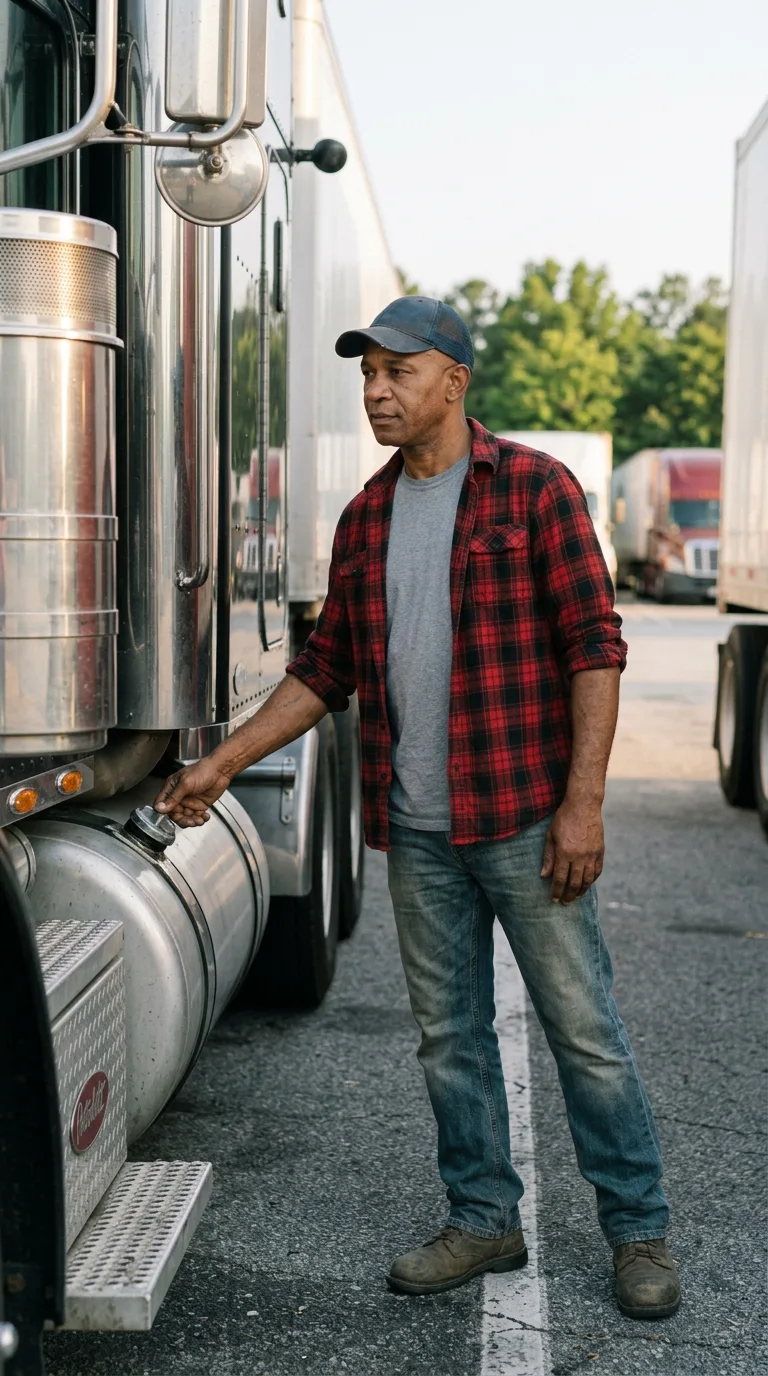
Rarest thing about him: Living with a partner — rare, 1 in 17
Season 0seed 998324245 · engine v10
Character card
lineage 79CGDV
His body-swap story
@brian.okafor.lynch, wearing Devon Ashby, rolled the wheel on and woke up as Marcus Delahaye, spent 1 minute in him, then spun the wheel and woke up as Dale Nunatak
You are standing in a hallway in Los Angeles at eleven at night, and you have been Devon Ashby for forty seconds, and already it is not enough.
That is the whole reason, if you are honest with the part of you that is still deciding: not the camera bag on the floor, not the coldness of the apartment you have never seen in daylight, not even the young, muscled body you are wearing like a coat that fits too well to feel like a costume. It is that you know already, the way you always know within a minute, that this one is going to be fine. Just fine. A guy who takes pictures of other people's weddings and complains about his rent. Sixteen men behind you and this one already feels like a rerun. Your thumb finds the phone in Devon's pocket before Devon's own habits do, and you open the site out of something that is not quite boredom and not quite hunger, something closer to the itch of a hand that wants to crack its knuckles.
You spin.
You are gripping a fuel cap.
It is cold and it is textured under your palm, ridged steel, and your arm is heavier than it was a half-second ago, the muscle in it settled and thick through the forearm in a way that has nothing to do with a gym, and your knees have gone stiff in a way that says decades, not minutes. Something in your lower back twinges when you shift your weight. Behind you, diesel is idling low, patient, a sound like a held breath. The air is warm already though the light says it shouldn't be — heavy, wet, a green smell under the fuel smell, Georgia at first light in the middle of summer. Your hand does not let go of the cap. It knows this cap. It has known this cap ten thousand mornings.
The shirt is what opens first — flannel, unbuttoned over a gray tee, and the second your attention lands on the collar you get a flash of a Sunday, a closet, a woman's hand smoothing the same collar down against your chest and saying *you look like somebody's daddy in that, and good, 'cause you are.* Renata. The name arrives with the flash, unbidden, warm. You are living with her. Fourteen years now, since the kids were near grown, since his first wife took the youngest and moved to Macon and it had hurt in a way he doesn't let himself remember whole, only in pieces, only through things — and one of the pieces comes now, through the cap, through the cold ridged steel: his hand on a different truck, years back, gripping too hard, jaw tight, listening to a phone call in a lot much like this one. That one passed. This one is easier. Renata doesn't ask him to be anything he isn't already.
The cap again — this time it gives you this morning. Four-fifteen, dark still, the trailer's running lights the only color in the lot, and him doing the walk-around on legs that complain a little more each year, checking tires he's checked a thousand times, hearing his own heartbeat a little high in his ears the way it's been lately, the doctor's voice saying *blood pressure* like it's a verdict. He doesn't drink anymore — gave it up somewhere in his forties without much ceremony — but the tin in his back pocket is there, worn soft at the corner, and when your hip brushes it you get: a taste, tobacco going numb along the gum, dawn light on a hundred identical rigs, and under it all the particular peace of nobody needing anything from him for one more hour.
The boots under you are broken to the exact shape of feet that have stood on running boards and gravel and church parking lots after Sunday service, singing under his breath something with *hallelujah* in it, meaning it. He believes in something that watches. He has never once thought to wonder if something is watching him from inside.
His hands know this cap without his eyes needing to check — that's the sentence that comes clearest, the closest thing to how it feels to be him: forty years of trucking condensed into fingers that don't need instruction. So when the wheel drops you into that hand mid-turn, the hand does the wrong thing for half a second — flinches, releases too early — and then, caught, corrects, slow and deliberate, like a man relearning his own name. The next ten turns you check every one. The cap has never needed checking. It doesn't know that yet, and neither does he, and he never will.
You let go of it last, reluctant, the way you'd let go of a hand.
You turn yours over in the thin early light — broad, weathered, a callus along the second knuckle that isn't yours and now is — and something in the fingers wants to crack itself out of old habit and you let it, one two three, and you look up past the chrome and the idling trucks toward a horizon just starting to lift out of gray.
"Long way from L.A.," you say, to no one, in a voice that isn't yours yet either, and it already sounds less like a joke than you meant it.