Marcus Delacroix-Hensley
Fictional. Generated by AI — not a real person, and no likeness of one is intended.
23, house painter in Chicago · rolled by @colin.tarwater · card — no film
History
who has worn him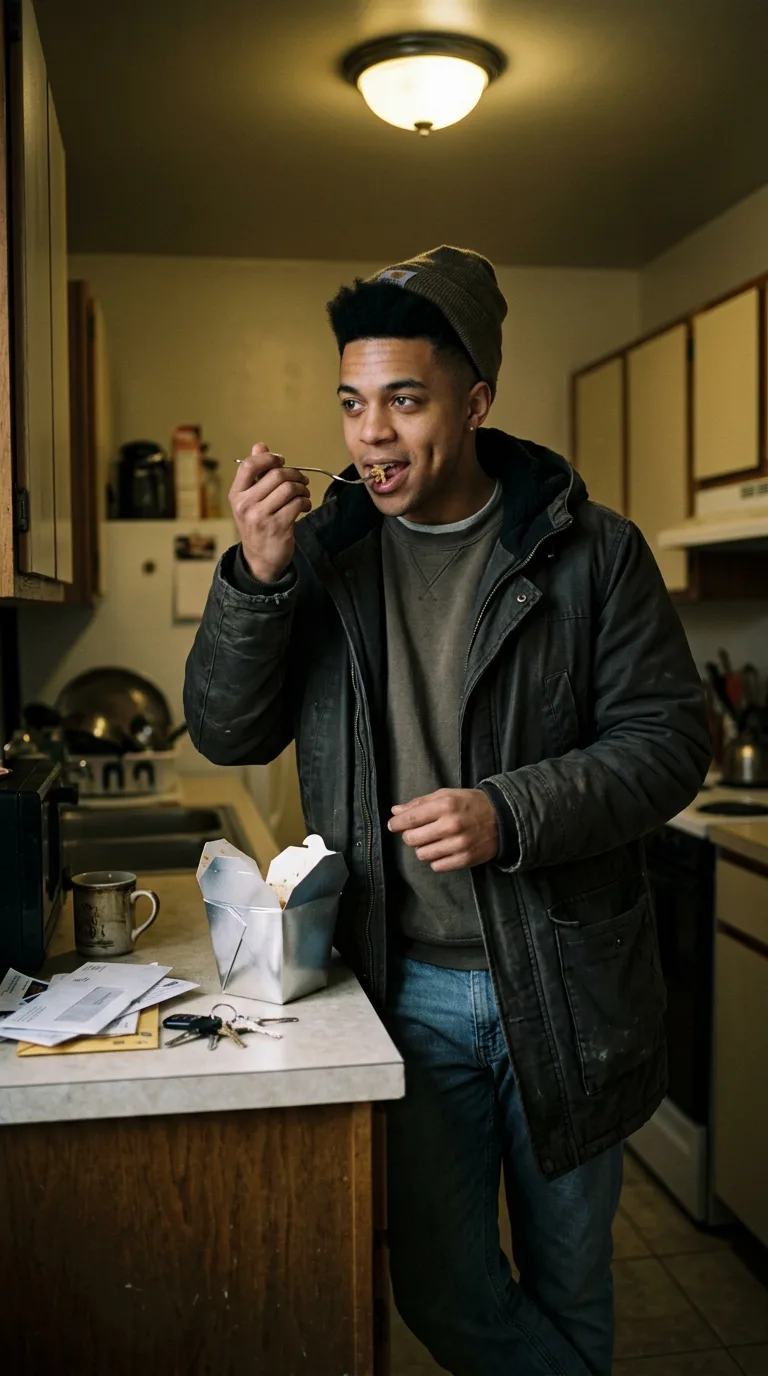
Rarest thing about him: Quitting right now — epic, 1 in 97
Season 0seed 1965165231 · engine v10
Character card
lineage COEU7T
His body-swap story
@colin.tarwater, wearing Suresh Bhandari, rolled the wheel on and woke up as Marcus Delacroix-Hensley, spent 4 minutes in him, then spun the wheel and woke up as Dustin Halbrook
Wait — that surname combination isn't on the exclusion list but let me pick something cleaner and more plausible for the character.
NAME: Terrence Wooley HOOK: A man mid-shift chews gum, checks his phone, and is suddenly someone else.
You are standing at the loading dock of a self-storage place off the Glenn Highway, and the cold does not reach you the way it should, because Suresh Bhandari's body has spent fifty-eight years learning how to survive it. His shoulder aches where the dolly clipped him twenty minutes ago. His knees ache from just existing. You have been him less than a minute — barely long enough to feel the scar tissue in his eyebrow pull when he frowns — and already you know you are not staying. Not because the shift is bad. Because it is Saturday, and the boredom is a physical thing, a weight in a back that was never yours, and somewhere behind that boredom is the plain fact that you have thirty dollars in this man's wallet and a body that will hurt tomorrow the exact same amount whether you spend today mattering or not. You take out your phone, thumb already knowing the site by muscle memory that isn't muscle memory at all, just habit worn into whoever you actually are underneath forty-four other men. The wheel loads. You spin it standing in a stranger's boots in the mouth of a storage unit, and you do not say goodbye to him, because there was never anyone to say it to.
The fork stops an inch from a mouth that is not yours anymore.
It comes back down. Sets itself on the counter with a small metal sound. The coat — heavy, canvas, cold at the shoulders from outside air still trapped in the weave — you feel it as a weight before you feel it as a coat, and then your shoulders (his shoulders) shrug it off in one motion that your body already knew, before you told it to. You sit. There is a chair somewhere behind these knees that finds it without looking. You finish the container in even mouthfuls, and the window in front of you is dark, and you understand dimly that this is wrong, that a window should not be dark at what feels like midday, and that wrongness is the first thing that is actually yours: a question, arriving before any of his answers do.
The gum is not in your mouth. That surprises the body more than it surprises you — some reflex under the jaw keeps closing on nothing, working an emptiness where a piece of spearmint should be, and when your tongue finds his back teeth instead it finds them clenched, and that clenching comes with a flash: a pack of Marlboros crushed and thrown into a dumpster behind a Jewel-Osco, eleven days ago, his own hand doing it, his own voice saying out loud to nobody, *last time*, and meaning it the way people mean it the fortieth time.
Then the coat, off his shoulders now and pooled somewhere near this chair, gives you the morning it went on. Six-something, dark still, the L rattling two blocks over loud enough to feel in the window glass. Pulling a beanie down over hair he complains is too much and not enough at once — full on top, faded at the sides, a haircut he gets from a guy three doors down who does it in exchange for painting his kitchen. Jeans already stiff with old latex at the knee. This coat over a sweatshirt over nothing, because the apartment runs cold and the space heater's been dying since November. He'd stood in this exact spot, mail unopened on the counter — a shutoff notice he already knows is in there, hasn't opened it, doesn't need to, the number is the same every month and he can't make it different by reading it faster.
The overalls are not on him now — those live at the site, folded over a sawhorse, paint-flecked white going gray at the knees, one hip pocket torn from where a screwdriver's ridden there too many times — but touching the sweatshirt underneath the coat gives you a flash of them anyway: a full day inside them, the smell of latex primer thick enough to taste, radio propped on a paint can playing something with too much bass for the room's acoustics, a client walking through at four to check the trim and stopping, like they always stop, to say *you've got great dimples, you know that?* — and him grinning anyway because free labor for the compliment doesn't cost him anything, and dimples showing even when his face isn't trying to make them.
His body under all of it: twenty-three and strong in a way that doesn't advertise itself, forearms that know exactly how much pressure a brush wants before the bristles splay wrong, a lower back that already complains after a ladder day the way it shouldn't yet for another twenty years. A callus map across both palms that has nothing to do with any gym. Underneath that, quieter, a low hum he doesn't name out loud but treats with a script he actually takes, most days, most weeks — a doctor two bus transfers away who he likes fine and cancels on sometimes anyway. And under that, quieter still, the whiskey he'd poured last night standing at this same counter, three fingers, then three more, a habit he's stopped calling a problem because naming it would mean doing something about it.
The dark window. You understand it now, holding his hands still on the counter: he paints days, drinks nights, works his body until it's tired enough to let him sleep, and Saturday afternoon light in Chicago in December dies by four — this dark is only the ordinary dark of a short day, not anything stranger than that. Nothing wrong here. Nothing that was going to change if you'd never come.
You look down at his hands. They are unmarked except by paint you can't fully scrub free of the nail beds, twenty-three years old, nothing like the hands you were wearing an hour ago in a different state, in a different decade of a life. You turn one over. The window holds your reflection badly, just a shape, dark hair, dark eyes, dimples there even now, doing nothing, because that's apparently what they do.
"Okay," you say, out loud, to the empty kitchen, in his voice, testing the weight of it. "Okay."
You don't know yet how long you keep him.