Manuel Osegueda
Fictional. Generated by AI — not a real person, and no likeness of one is intended.
48, line cook in New York · rolled by @manuel.osegueda · card — no film
History
who has worn him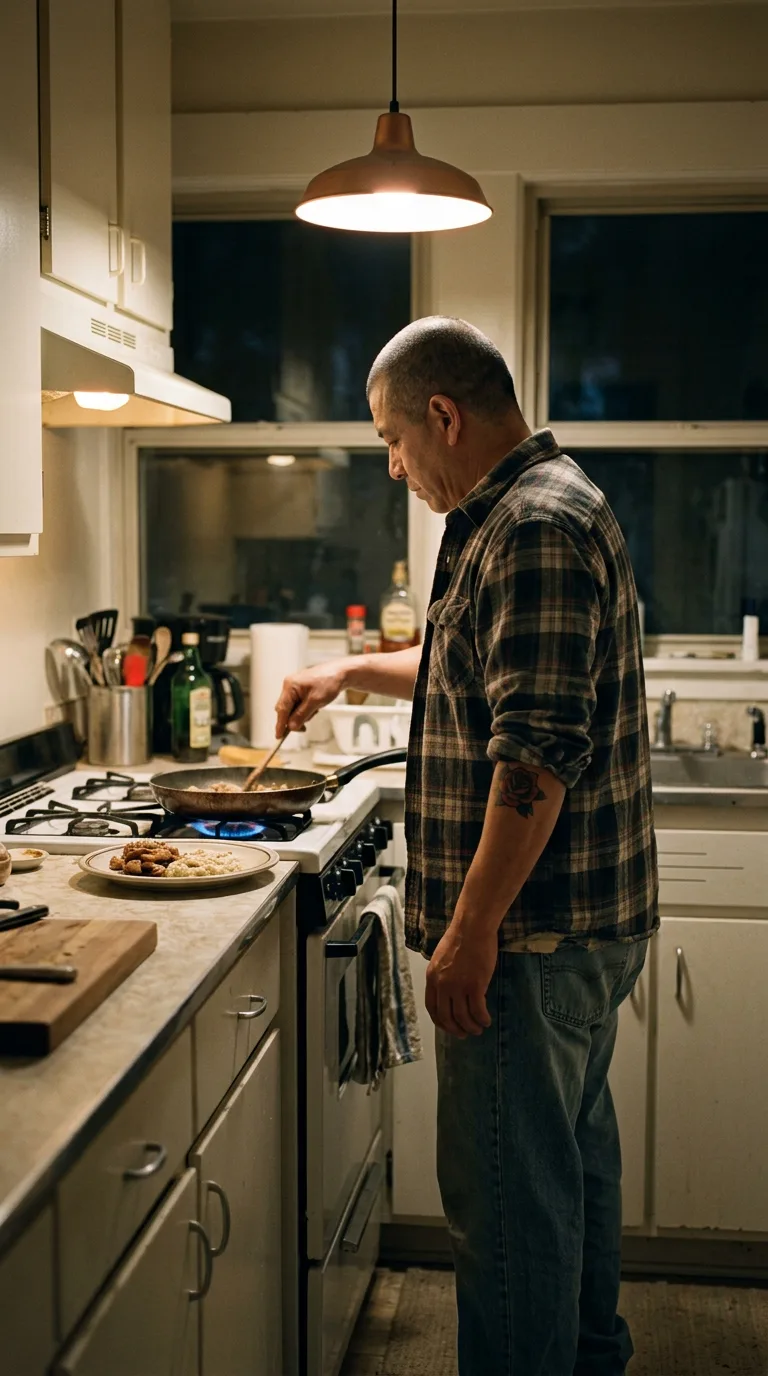
Rarest thing about him: An old injury that never healed right — rare, 1 in 33
Season 0seed 1081873583 · engine v10
Character card
lineage OXVGEV
His body-swap story
@manuel.osegueda rolled the wheel on and woke up as Manuel Osegueda — their first
The site loads slow on a bad connection, the wheel spinning lazy little half-turns before it settles into place, and you sit there in the blue dark not believing it will do anything at all. It is early, the kind of early that has no name yet, before the coffee, before the day agrees to start. You have wanted this since you were a kid pausing the VHS on the moment the body changes, since every thread you read at two in the morning about waking up as someone else, some *other* someone, anyone. It was always a story before. Never a button. You put the card number in like it's nothing, like it's a joke you're playing on yourself, and you press spin.
The pan is hot and something in it needs turning and your hand is already moving before you understand it is your hand, stirring one direction and then, a beat later, without deciding to, the other. Salt goes into the pan from a hand that does not taste after it, which feels wrong in a way you don't have language for yet, and then that same hand reaches up into a cabinet, unerring, muscle doing what muscle does, and takes down a second plate. Sets it beside the first one already waiting on the counter. Two plates. One pan. A window full of black outside it, though something in the weight of the light says morning, not night.
Whose kitchen. Whose hand.
It comes in through the shirt first — flannel, soft with age, and the moment the collar shifts against your neck there's a version of a body underneath the body, a smaller ache riding along the shoulder, an old rotator cuff thing from a hotel banquet kitchen fifteen years back, lifting a stockpot wrong and everyone laughing about it after because nothing happened, except something had, and it never stopped talking to him on cold mornings. It's talking now. You feel it the way you'd feel a word on the tip of your tongue.
The apron strings, remembered before the apron is even on you — you're not wearing it now, you're in the flannel and jeans, home, off shift — but the ghost of tying it comes anyway, that motion behind the back, twenty-six years of tying it, first at his tío's place in Sunset Park, then at four more kitchens after, each one a little better, a little worse, a little louder. The knife callus on the side of his forefinger says more than any sentence could: what these hands know how to do without being told is *cut*, fast and clean, a whole vocabulary of small motions that live below thought.
The tattoo on the inner forearm gives up its year before it gives up its meaning — a rose, American traditional, done cheap and young at twenty-two in a shop that isn't there anymore, bold outlines faded now to something softer, like a photograph left in a window. It was for nobody. He told people it was for somebody once, because a rose wants a story and he didn't have one to give it, and the lie became almost true from being told so often.
The stove light and the smell of garlic starting to go dark in oil bring back nights — hundreds of them, thousands — the pass, the heat lamps, the particular scream of a ticket machine at nine on a Friday, a chef he worked under for six years who called him *hermano* and never once his name. A woman two line cooks ago who he almost let matter, who left for Tampa with somebody in finance, and it didn't break him, not really, he told himself that so often it became load-bearing. No one since who counted. He's alright with that most days. Most days.
The second plate is the one that opens the room all the way. He does this most Wednesdays, works a night shift that ends when the world starts, comes home to the gray edge of morning and cooks for one, and some nights, some particular nights, muscle memory reaches for a second plate anyway, for his mother, dead six years now, who used to sit at that counter while he cooked after his shift and pick at whatever he made and tell him it needed salt. He knows he's doing it. He does it anyway. It isn't sad to him. It's just the shape grief settled into, small and domestic and easy to carry, easier than a lot of other shapes it could have taken.
Under all of it: forty-eight years old in a body that is average in every direction, five-eight, the leg already bouncing faintly against the cabinet even now, has bounced since he was a boy in church pews, in kitchens on break, at his mother's funeral, nobody ever able to make it stop and nobody trying that hard. A drink most nights after close, never two much past two. No smoke, never wanted it. The buzzed hair he does himself with clippers over the bathroom sink every ten days, scalp cool under your palm when you finally lift a hand to it.
You look at that hand. It is not a decision, lifting it — it just rises, turning slow in the stove light, the rose catching the yellow of the pendant lamp, a burn scar pale along the base of the thumb from some Tuesday a decade gone. It is someone else's hand doing something you did not tell it to do, and it is also, now, entirely the only hand you have.
You look up, into the dark window over the sink where your reflection should be a stranger and isn't.
"Ma," you say, to the empty second plate, in his voice, before you even know you meant to say anything at all.