Lionel Whitaker
Fictional. Generated by AI — not a real person, and no likeness of one is intended.
42, professor in Detroit · rolled by @connor.waskiewicz · card — no film
History
who has worn him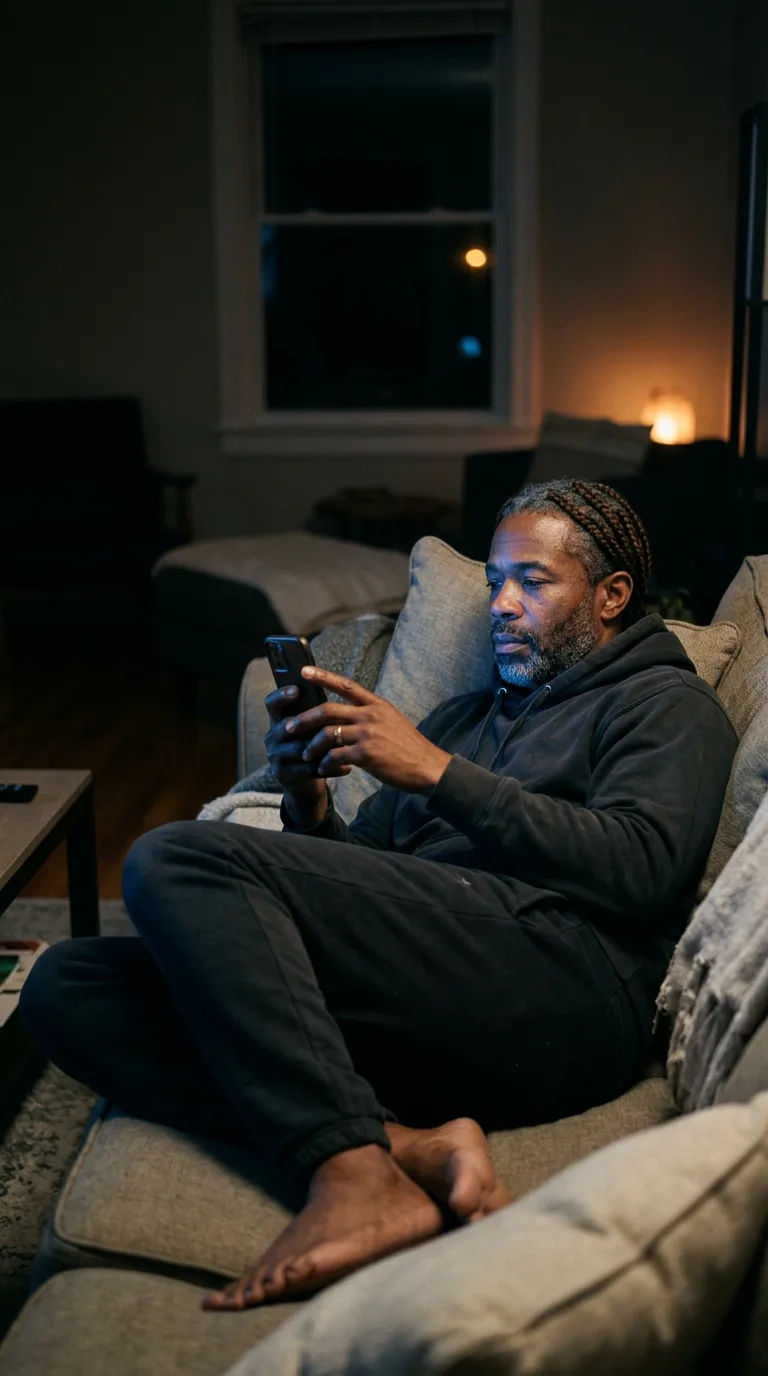
Rarest thing about him: Box braids — uncommon, 1 in 312
Season 1seed 826738538 · engine v11
Character card
lineage 2NZHHJ
His body-swap story
@connor.waskiewicz, wearing Vincent Truong, rolled the wheel on and woke up as Lionel Whitaker, spent under a minute in him, then spun the wheel and woke up as Thomas Brannigan
You are standing in a kitchen in New Orleans with a glass of water you don't want, in a man sixty-five years old, and the knees are the whole story. Vincent Truong's knees. They have been talking to you since the moment you got them, a low gravel in every step, and the belly he carries sits forward of him like a thing he is walking behind. The scar through his eyebrow itches when you think. You have been him for less than a minute and already you know the worst of it: nothing in him is wrong enough to be interesting. He cannot do anything. There is nothing he is missing, and nothing he is good at. Outside the window the street is dead and wet, and the house breathes its sleeping breath around you, and the thing that sent you back is only this, the sound of a man's whole life being quiet.
You set the glass down. The phone is already in your hand, the page already open, the wheel already turning.
Then the room is gone and the dark is a different dark, and your thumb is moving.
It is moving faster than he moved it. You feel that first: a thumb on glass, the cold slick of it, a feed streaming past things he had stopped for, and you flick them away without reading. Blue light on one cheek. You are on your side, on a couch that gives under your hip, a throw blanket's fringe against your wrist, and the leg, the right one, is bouncing. You did not tell it to. It bounces under you like it has a pulse of its own, heel against cushion, and you let it, because it is his, and it is the first thing of his that you know.
Your breath comes deep. The chest is bigger than the last one's, and easier; there is no stone of belly in the way. Forty-two years, and the body is simply working. The back is loose. The shoulder aches a little on the side you are lying on, the way a shoulder does after a day of holding itself up.
The hoodie is soft at the cuffs, pilled, washed a hundred times. You pull the sleeve down over your knuckles and it comes: a morning, his hands, a closet door. Not a morning for this hoodie. The tweed jacket, the herringbone, he is taking it off a hanger with two fingers, the green sweater already on, and he is thinking about a student's paper, the third paragraph, the one that nearly works. The jacket's shoulders settle on him like a hand. The satchel strap bites the collarbone, the leather gone smooth where it always sits. He is late, and he is not worried, and he likes being a man who walks into a room and the room rises to meet him. Then it's gone, and the cuff is just a cuff.
Your thumb stops. The ring is under the edge of the phone, cool, plain, a little loose in the cold. You turn it with your thumb and it opens like a door.
A woman's laugh in a kitchen, her back to him, a wooden spoon, steam. His wife. He loves her in a way so settled it has no edges, like weather in the house. The feeling floods your chest, warm and enormous and not yours, and you hold very still and let it pass through you like a stranger's song.
And under it, deeper, where the ring turns a second time: another woman, years back, on a porch in the rain, saying his name like it was the last thing she would give him, and him letting her walk down the steps. He has never said so. He thinks of her in the dark, on his side, with the screen close. That is what he was doing. You feel it in the thumb, the scroll that was never reading, only waiting.
The floorboards under the couch's feet are cold; the bare sole of one foot finds the rug's edge. The room smells of a candle burned down, of cedar, of the lamp's warm dust. A church hymn, his grandmother's hands in his hair, the first braid pulled tight, the old ache of it in the scalp now as you lift your hand and feel the plaits fall loose against your ear.
Beard, close and rough under your palm. Brown eyes you cannot see. A man doing well, in a house on a wide brick street under a low gray sky, nobody awake.
You hold the phone away. You turn your hand over in the blue light, the palm creased and warm and steady, the ring catching. His hand. It does not shake. You lift your eyes.
"Hello, Lionel," you say, and his voice is deeper than you expected, and kind.
The leg is still bouncing. You wonder how long before you want something else.