Lionel Peoples
Fictional. Generated by AI — not a real person, and no likeness of one is intended.
50, landscaper in Phoenix · rolled by @frank.dombrowski · card — no film
History
who has worn him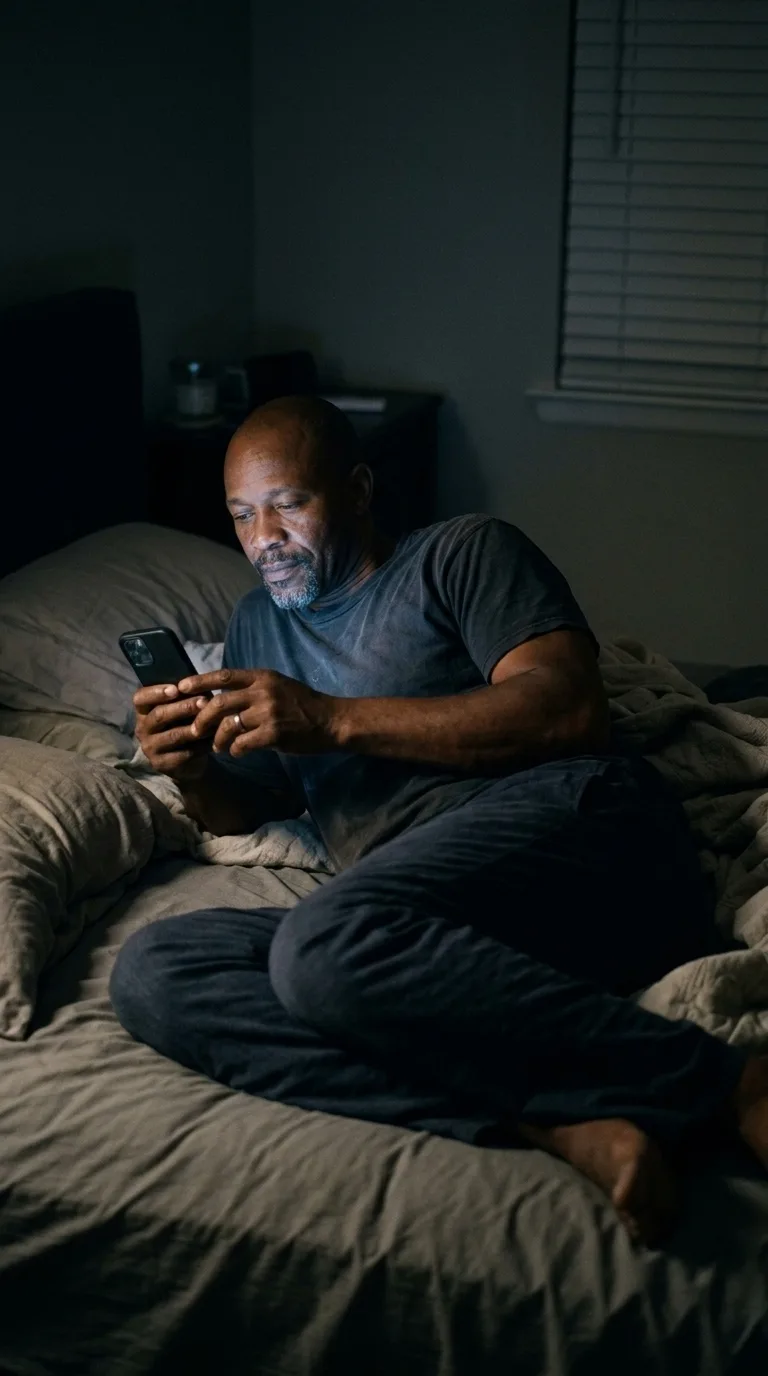
Rarest thing about him: A tic — a hard blink, a throat clear — uncommon, 1 in 147
Season 1seed 1043893696 · engine v11
Character card
lineage Q2CSHL
His body-swap story
@frank.dombrowski, wearing Colin Gallagher, rolled the wheel on and woke up as Lionel Peoples, spent 4 minutes in him, then spun the wheel and woke up as Ramón Escobedo
You are eighteen and you are standing in a refrigeration van's cold dark, or you were, a minute ago, in Colin's body, in the middle of a Philadelphia night with the whole house asleep. His mother's television murmured through the floor. You sat on the edge of his bed with his freckled hands hanging between his knees, and what sent you back was small. He was eighteen. His knees did not ache, and neither did anything else, and you kept waiting for it to mean something. His whole life lay out ahead of him like a shop floor, and you could not stand it. You wanted weight. You wanted someone who had already become what he was going to be. So you opened the page with the wheel and paid, and the wheel turned, and Colin's hands let go of the phone.
Now there is blue light on one cheek.
You are on your side in a bed that is not the bed, with a phone six inches from your face and a thumb stopped mid-scroll. The room is dark. Slatted blinds, a gray line of streetlight. Beside you a woman breathes slow and deep, turned away. Your chest is wide and slow and your breath comes up from lower than Colin's did. The thumb wants to move. You let it. It flicks, faster and steadier than whatever it was doing before, past a ballgame clip, a church notice, a photo of somebody's grandbaby, and you do not stop on any of it. Your eyes are dry. You have forgotten to blink, and then a hard blink comes by itself, a tic, and a small clearing of the throat that you did not choose.
The sheet is cotton, washed thin. It brings the first thing. A Saturday, years back, this same sheet new and stiff, a woman laughing as she fought a corner onto the mattress, and the feeling is not yours: a plain, wide gladness, a man who cannot believe his luck is this ordinary. Then it is gone.
The T-shirt on your back is soft as cloth gets, gray at the collar. His hand remembers pulling it on in the dark so as not to wake her, and a longer thing follows: three kids in a hallway on a school morning, a fourth shoe missing, his voice low so it would not become shouting. The pajama pants are loose at the ankle. Under them the knees are stiff, and the lower back has a dull wire of ache from the day's lifting. Fifty years of it. Your shoulders are heavy with a strength that was built, not given.
The wedding band is warm against the phone's edge. It gives you a courthouse, or a church, a pressed suit, his mother in a hat crying openly, and under it the quiet fear of a man who had almost nothing and had asked anyway. Nothing to his name still. He did not mind. He mowed other people's lawns in a hundred and ten degrees and came home to this.
Your thumb finds the glass again. In the corner of your eye the blinds, and behind them the heat that has not left the dark yet. Gravel. Saguaros standing like men with their arms up. His mouth tastes of last night's coffee. Your jaw is rough where the goatee runs; your chin, when you touch it with your tongue's attention, has a deep cleft you can feel from inside.
You put the phone down on the sheet. You hold up your left hand in the blue, turn it over, and the ring catches. The palm is thick, callused across the base of the fingers where a mower bar sits. It already knows how to do things you do not.
You look up, into the dark, and say, low, so as not to wake her, "Well. Hello, Lionel."
Somewhere the wheel is still there, one tab away. You do not know how long this lasts. The wanting is quiet tonight. It will not always be.