Liam Sheridan
Fictional. Generated by AI — not a real person, and no likeness of one is intended.
27, refinery operator in New York · rolled by @connor.waskiewicz · card — no film
History
who has worn him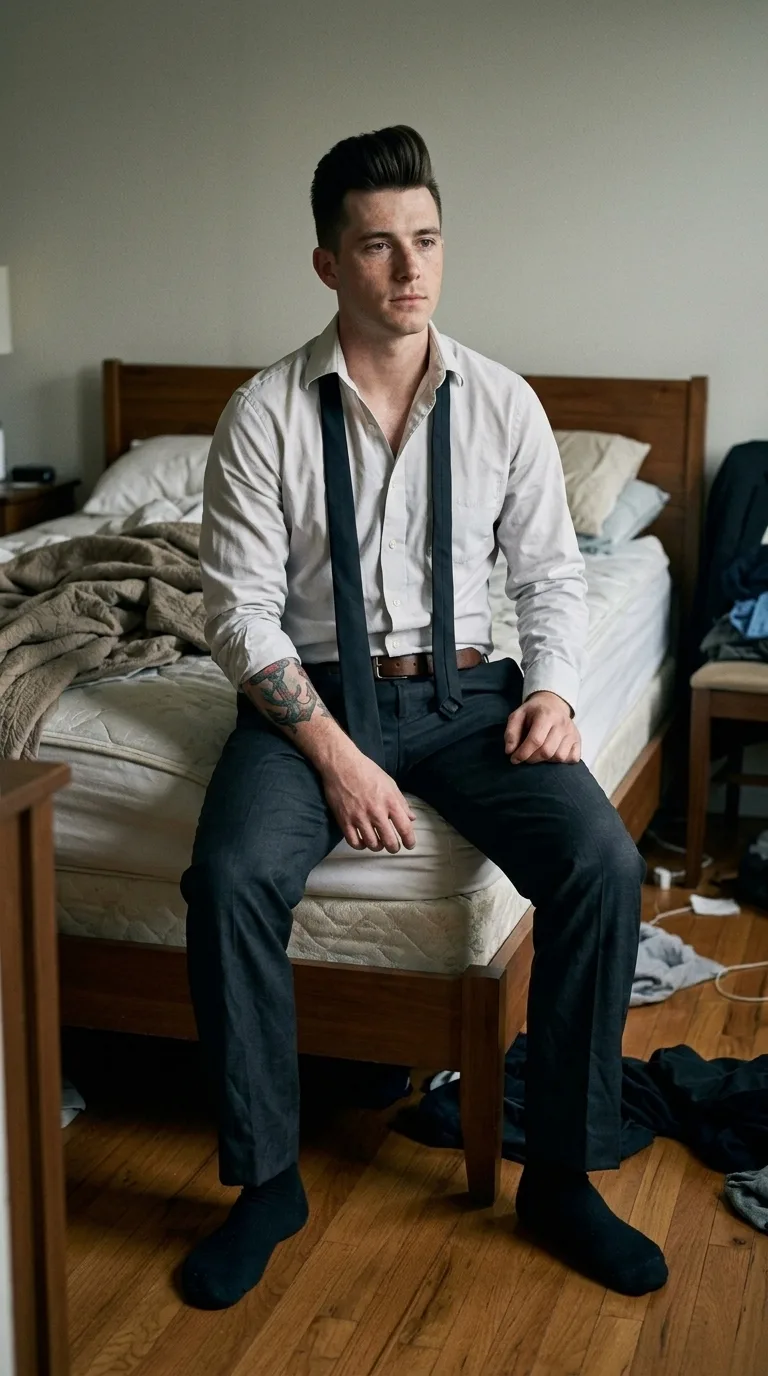
Rarest thing about him: Refinery operator — uncommon, 1 in 2,035
Season 1seed 1735622255 · engine v11
Character card
lineage 2NZHHJ
His body-swap story
@connor.waskiewicz, wearing Anil Donnelly, rolled the wheel on and woke up as Liam Sheridan
You have been Anil Donnelly for less than a minute, and already the knees are the problem. Sixty-four years of them. You stand at his kitchen window in Pittsburgh with the light not yet up, a mug of his tea going cold on the sill, and every time you shift your weight something in the left one grinds like a drawer with grit in it. He was kind, the way a good retiree is kind. His wife's reading glasses are still folded on the counter. None of that is why you are here. You came back to the page because you pressed on the belly and the belly was only a belly, and the quiet in this house was a quiet you could not get a grip on. You wanted a body that wanted something, and this one only remembers. So you open the page with his thumb, and the wheel is already turning.
Then you are sitting down.
The edge of a mattress under you, the frame hard against the backs of your thighs. Your right hand is rising toward your collar and stops, flat against your chest, and under the palm there are ribs, a whole clean cage of them, lifting and falling quick and young. Your breath goes all the way down. Nothing grinds. You are at the foot of a bed in a room gone grey with the hour before anything starts, and the shirt is wrong by one button, you can feel the pucker of it, and a tie hangs loose around your neck like two dark streamers.
The shirt gives you the first thing. The cotton is cool and a little stiff against your shoulder blades, and it lets go of a morning: his hands, this hand, thumbing buttons upward in the dark of a different week, a shirt he ironed badly on the bed because the board is broken. He hates this shirt. It is the one he wears to the union hall and to funerals, and he is dressing for neither today; the plant requires a tie for the audit, and he resents it the way you resent small humiliations that pay. Sleeve by sleeve it comes: the left cuff first, the little plastic button he has to pinch twice.
The belt buckle is cold through the cotton, and it gives you the rest. Brass worn smooth. A father's, handed over in a driveway in Staten Island, nothing said. Your fingers know the notch he always uses.
Under your palm the heart thumps, and the freckled skin of your own cheek prickles when you tighten your jaw. It is smooth. He shaved it an hour ago, nicked nothing, and the memory comes with a sting of aftershave and the radio low. The hair is stiff and lifted on top of the head, held by pomade that smells of vanilla and something like a barbershop. A chair, a barber named Sal, a joke about it being a lot of hair for a man who works near fire.
You look at the inner forearm. The anchor sits there, bold black lines, red and green gone soft with years. Your thumb finds it without being asked and the tattoo pulls up a whole night: nineteen, a shop on Coney Island, a dare and a friend who left for Texas and stopped calling. It stung worse than he admitted. He has never told anyone he almost walked out before the shading.
Your knuckles crack, both hands, all on their own. Wide pops, easy, a habit like a tongue on a tooth. Under that, the quiet tiredness of a night shift body, work in the shoulders, the flare on the unit at two a.m. a bright orange pulse he can feel on his face. Wet stoop, sodium light, a pouch of nicotine tucked behind his lip on the walk to the train. He has twelve thousand dollars to his name and a landlord who knows it. He is lonely in a way that does not think of itself as loneliness.
You rise. The legs do it in one motion, no negotiation. You lift both hands in front of you and turn them over, the anchor sliding under the dim window. They are strong and strangers to you.
You look up, and you say, to whoever is there, "Look at that. Nothing hurts."
And somewhere past the rib cage, already, a small clear question you cannot silence: how long this one holds before the wanting comes back.