Lester Whitaker
Fictional. Generated by AI — not a real person, and no likeness of one is intended.
56, accountant in El Paso · rolled by @connor.waskiewicz · card — no film
History
who has worn him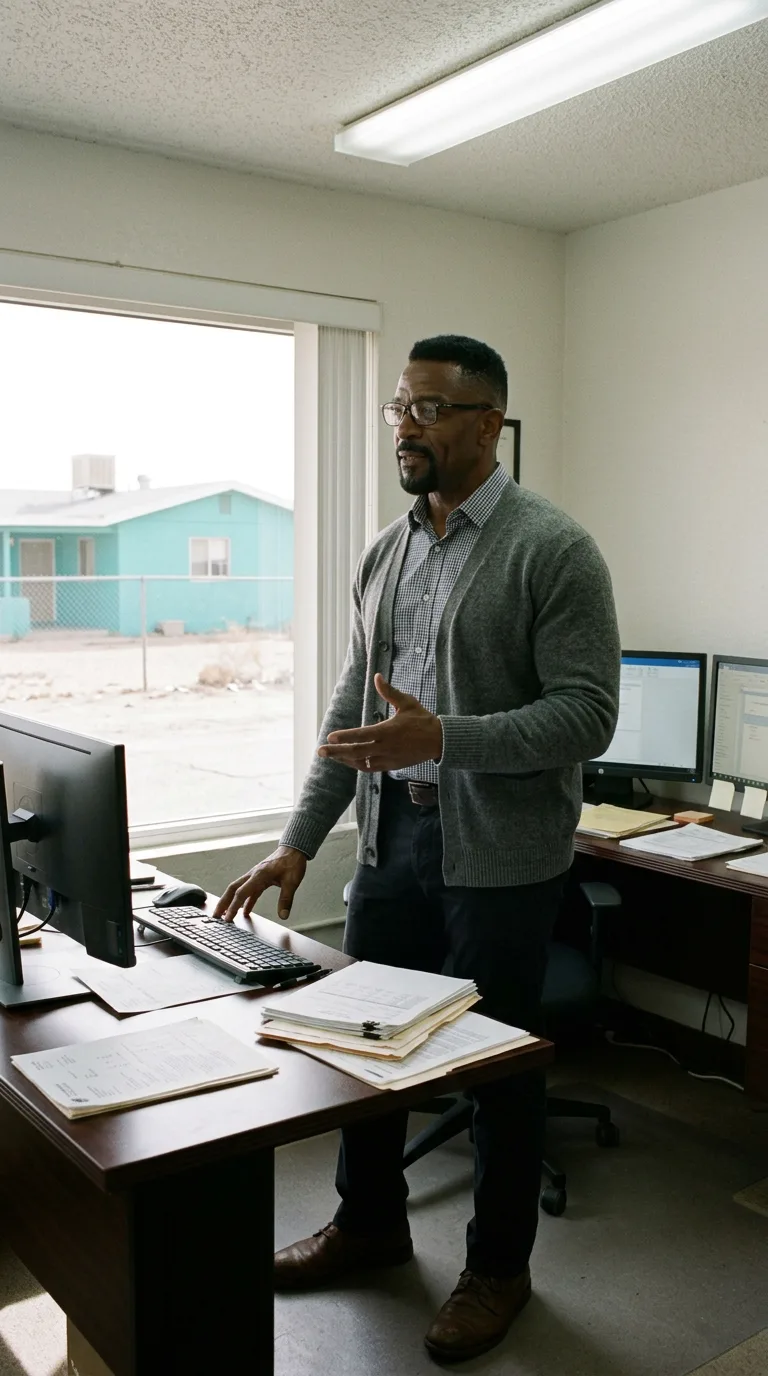
Rarest thing about him: El Paso — common, 1 in 44
Season 1seed 1639046511 · engine v11
Character card
lineage 2NZHHJ
His body-swap story
@connor.waskiewicz, wearing Amir Hakimi, rolled the wheel on and woke up as Lester Whitaker, spent under a minute in him, then spun the wheel and woke up as Jesse Trumbull
You are in Amir Hakimi's boots, in a garage bay that smells of cold diesel and hot coffee, and the thing that sent you back is in your left hand: a torque wrench, set to the number the man before you always set it to. You have been him for less than a minute. It has been long enough. His knees know a winter you do not. The gap in his teeth whistles when you breathe through it. He is fine, a good body, and none of that is the point. You stood there with the wrench and felt nothing at all. The wheel is the only thing left that makes you feel like you are about to be somebody. You put the wrench down on the bench and you pay.
The arrival is a hinge swinging. Fluorescent hum. You are standing, one palm flat on a desk, your other hand turned out in the air as if you were mid-sentence to someone. A pen is between two fingers of the hand on the desk. You hit a key wrong. Then you do it again slowly, correctly. Ten more keystrokes follow, and you check each one, though nothing in him says this job has needed checking in years.
Now the things start to speak. The pen first: its clip under your thumb, click, click, and you are him at nineteen in a lecture hall, clicking through a calculus final, his mother's voice in his head saying *careful, careful, they will look harder at you*. The click is nerves. It has been nerves for thirty-seven years.
The cardigan is wool and slightly too warm for the window light. It gives you the morning: his arms going into the sleeves one at a time, the girlfriend in the doorway of the bedroom saying the gray one, not the brown, and him doing the buttons from the bottom up, the way he always does, so they never end up crooked. The checked shirt under it was ironed by him, because he likes the hour of it. The belt goes to the third hole now; it used to be the fourth. Her hand fixed his collar and stayed a second on his chest.
Then the ring on his finger, and a stranger's ordinary happiness: a daughter at a kitchen table, years ago, and him showing her how to balance a checkbook, her disgust at the whole idea, the two of them laughing until she cried. You can feel how much of him that is. Your chest tightens with a grief that is his and not yours.
Under it all the body is honest. The shoulders are strong, a gym habit he keeps up out of stubbornness, and there is a dull ache low in the back from the chair. The glasses sit warm on the bridge of your nose. When you smile at nothing, deep dimples pull in on both cheeks, and you feel them like a stranger's fingers. Through the window there is a turquoise house behind chain-link, white dust, and light so hard it hurts.
You lift your hand and turn it over. Brown palm, steady, a pen in the fingers. Then you look up.
"Well," you say, quietly, to the room. "Hello, Lester."
The pen clicks once under your thumb. You wonder how long you get to keep him, and whether tomorrow he is still the one standing here.