Lamar Whitfield
Fictional. Generated by AI — not a real person, and no likeness of one is intended.
50, maintenance technician in Dallas · rolled by @dustin.yazzie · card — no film
History
who has worn him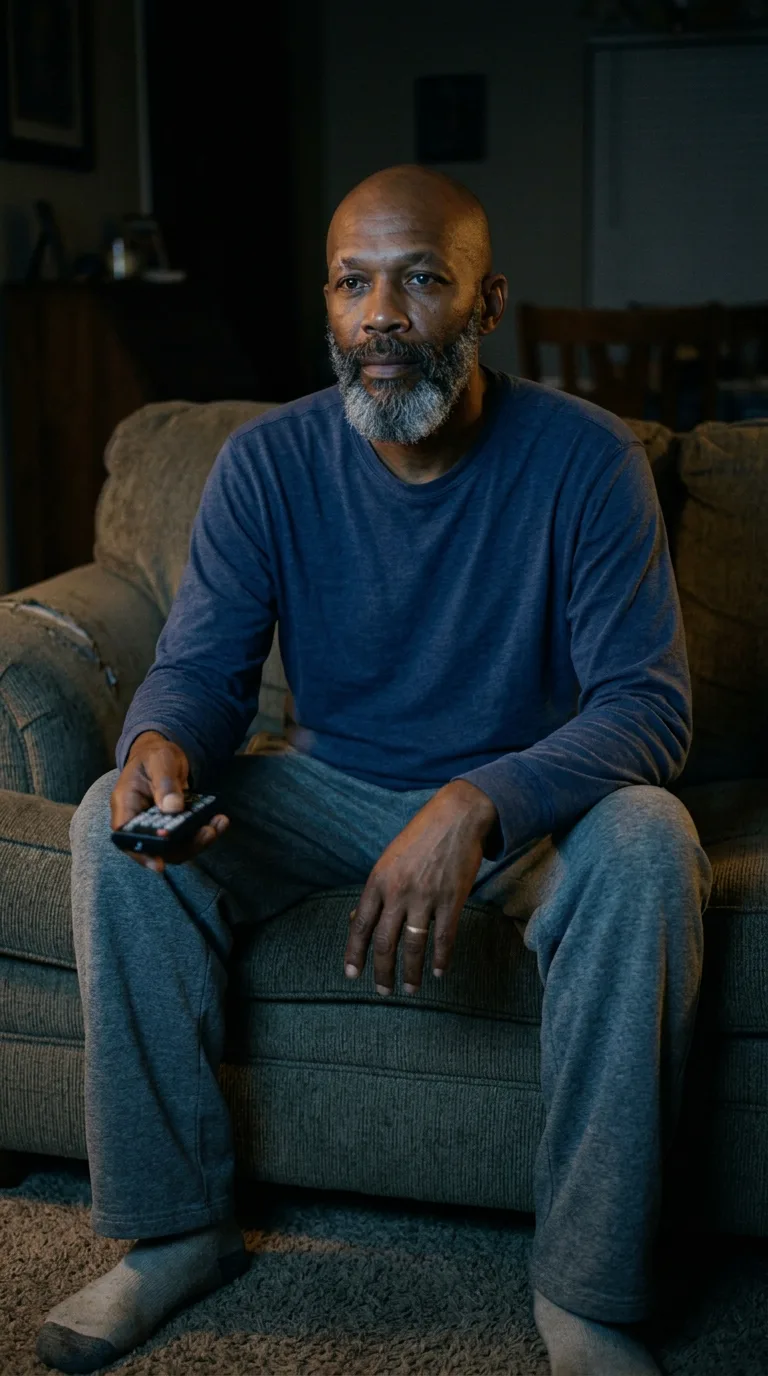
Rarest thing about him: Historically Black Protestant — common, 1 in 25
Season 1seed 1873784163 · engine v11
Character card
lineage OZ80W3
His body-swap story
@dustin.yazzie, wearing Martin Doyle, rolled the wheel on and woke up as Lamar Whitfield, spent under a minute in him, then spun the wheel and woke up as Efraín Camacho
You are standing in a stranger's kitchen in Queens, in Martin Doyle's boots, and the lazy eye has been wrong for forty seconds. It slides when you turn your head. It hands you two half-pictures of the refrigerator and will not agree on either. You wanted a man who could do something. This one can only stand there being tired in a body that is wrong at the edges. There is a bad knee you did not ask for, and a beard that wants combing. You pay again. The page is open. The wheel is already moving, and you let it.
Light. The television goes white and you are inside the white, sitting up straight, spine suddenly stacked, the remote set down on the couch arm by a hand that is now yours. The room is dark and smells of fabric softener and old coffee. On the screen a laugh track breaks, and you do not laugh.
Then the couch. The corduroy ridges are under your palm, and the left arm is worn through where a thumb has picked at it, and that picking comes up through your fingers. It is a Sunday, and a woman's voice says *you're going to wear a hole in that thing*. She was right, and he kept picking anyway. It was the last year of the marriage, and the quiet in the house felt like a held breath.
The sweatpants are soft and gone thin at the knee. Under them the knee itself is stiff, a day of ladders in it. Fifty years sit in the lower back, a low heat. The belly is soft over strong forearms, and the shoulders still remember lifting. The socks are damp at the heel. Through the carpet comes a morning, years back: a boy of nine standing on this rug in a too-big tie, saying *Dad, which way does it go*, and Lamar kneeling to loop it. His hands knew the knot. It was the best minute of that whole year. The feeling in it is pride, so large it embarrassed him.
The shirt is the dark blue long-sleeve, and he put it on tonight after a shower, slowly, one arm and then the other, because the work shirt hung on the door smelled of other people's ceilings. He thought of nothing. He thought of the church on Sunday, of his mother's hymn, "I Need Thee Every Hour," humming in his chest while he pulled the cuffs straight.
Your thumb finds the ring finger. There is a band of smooth, paler skin where gold used to sit, and under the pad of the thumb the old habit rises: *turn it, turn it.* He did that for twenty-two years, and for two more after the gold was gone. The grief in it is not sharp. It is a worn place, like the arm of the couch. Your knuckles want cracking and you let them. They go off one by one like small shots, and the relief is his.
You lift the hand. It is broad, brown, and callused at the base of the fingers. You turn it over in the television light and the palm is stranger than any face. Then you look up, at the dark glass of the window where the screen shows you a bald man with a salt beard and a scar through one brow, and you say, quietly, to him, to nobody:
"Well. Hello, Lamar."
The laugh track swells again. You do not know how long he lasts. The wanting is already stirring somewhere under the ribs.