Lamar Everett Pinckney
Fictional. Generated by AI — not a real person, and no likeness of one is intended.
65, landscaper in New York · rolled by @sione.taufa · card — no film
History
who has worn him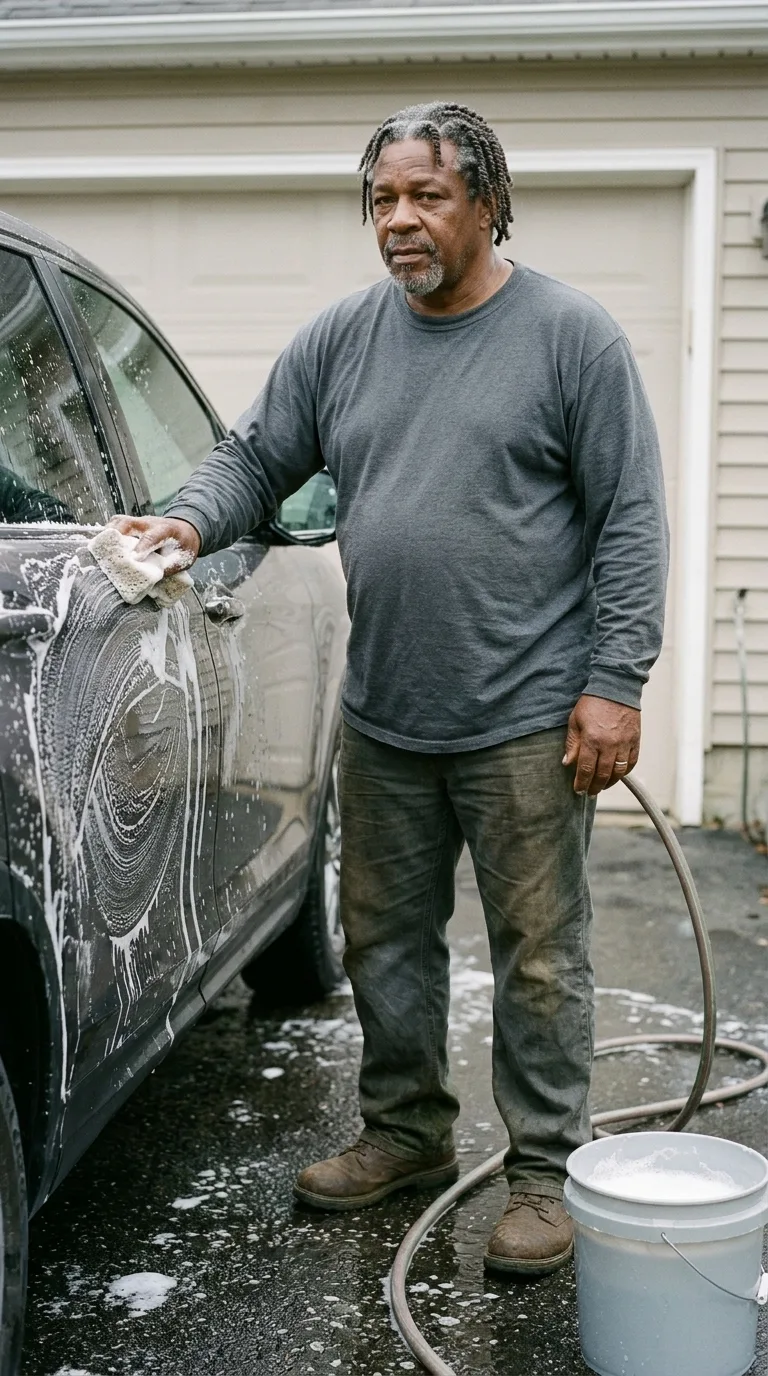
Rarest thing about him: Twists — rare, 1 in 393
Face-off rating 1500 · not ranked yet
Season 1seed 1079593152 · engine v11
Character card
lineage 8ZQHYV
His body-swap story
@sione.taufa, wearing Jesse Ray Corbin, rolled the wheel on and woke up as Lamar Everett Pinckney
Jesse Ray Corbin's knees hurt, and that's the first thing to know. Twenty-four, and the knees ache from eleven hours of clutch and brake in a rig that smells of other men's coffee. I sit in the sleeper outside a truck stop off I-85 with the phone warm in his skinny hand, the scar through his eyebrow itching where I keep touching it. He has been mine for less than a minute. He is fine. He works. But Atlanta presses on the windshield at this hour, and none of it is for me, and the page with the wheel is already open. I did not come here to be someone's son. I want the next one. I press.
Then a driveway. A hose runs somewhere near my boot, the water cold through the leather, and my right hand is already moving, a sponge in it, soap sliding down a car door in wide arcs. Halfway down the panel my grip shifts on its own: thumb tucked, wrist turning small circles. Behind me, for the first time all afternoon, no swirl marks appear. I don't see that. I feel it, a rightness in the wrist.
The weight comes next. Sixty-five years of it, settled low, a belly firm as a sack of seed, thighs like fence posts. My back reports in, a bar of ache across the kidneys, and under it the strength of a man who has lifted mowers into trailers since before Jesse's mother was born. The air tastes of wet asphalt and dish soap.
The shirt is long-sleeved, soft and gray at the cuffs, and the cuffs brush my wrists. The sleeve gives me a morning. A kitchen, early. His arm goes into the sleeve before the other, always the left first, because she used to hold it open for him, years ago, laughing that he dressed like a man boarding a bus. Now nobody holds it. He pulls the cotton down over his belly himself and stands a second in the quiet. Her name is Odessa. The name arrives with a hurt so familiar it has worn smooth.
The jeans are stiff with old grass stain and wet at the knee. They give me the trailer at the curb in a different yard, the mowers chained down, and the first lawn of the day, a white man's lawn, and the white man standing at his window with coffee, watching. Pride in that, and fatigue. Three children, grown and scattered: a daughter in Charlotte who calls Sundays, two sons who call when they need something. Money stays thin. Five thousand in the bank on a good month, and he does the arithmetic anyway, every night, over a drink or two, never three.
The sponge is rough and wet in my fingers. My thumb goes to my mouth. I stop it with a jolt. The nails are bitten to the quick, a habit that comes on when he is not thinking, and I feel the old worry beneath it, a bill, a boy's voice on the phone.
The ring is warm against the next finger. I turn it with my thumb and a church comes up: a wooden pew, a hymn, Odessa's gloved hand in his, a sermon about the rock and the sand. He believed it then. He believes it now, mostly, in the cold part of the night, kneeling by the bed on those bad knees.
I lift the hand. Look at it. Wide, dark, soap-bright, scarred across the knuckles, bitten at the tips. Mine, for now. I turn it over. A bead of foam runs down the wrist into the cuff.
I raise my eyes to the garage door, the hose, the wet shine of the car.
"Well," I say, in a voice like gravel in a drum. "Look at that."
The panel gleams, and it's already getting hard to tell how long the wanting will stay quiet.