Kurt Ellingson
Fictional. Generated by AI — not a real person, and no likeness of one is intended.
40, refrigeration technician in Dallas · rolled by @colby.marsh · card — no film
History
who has worn him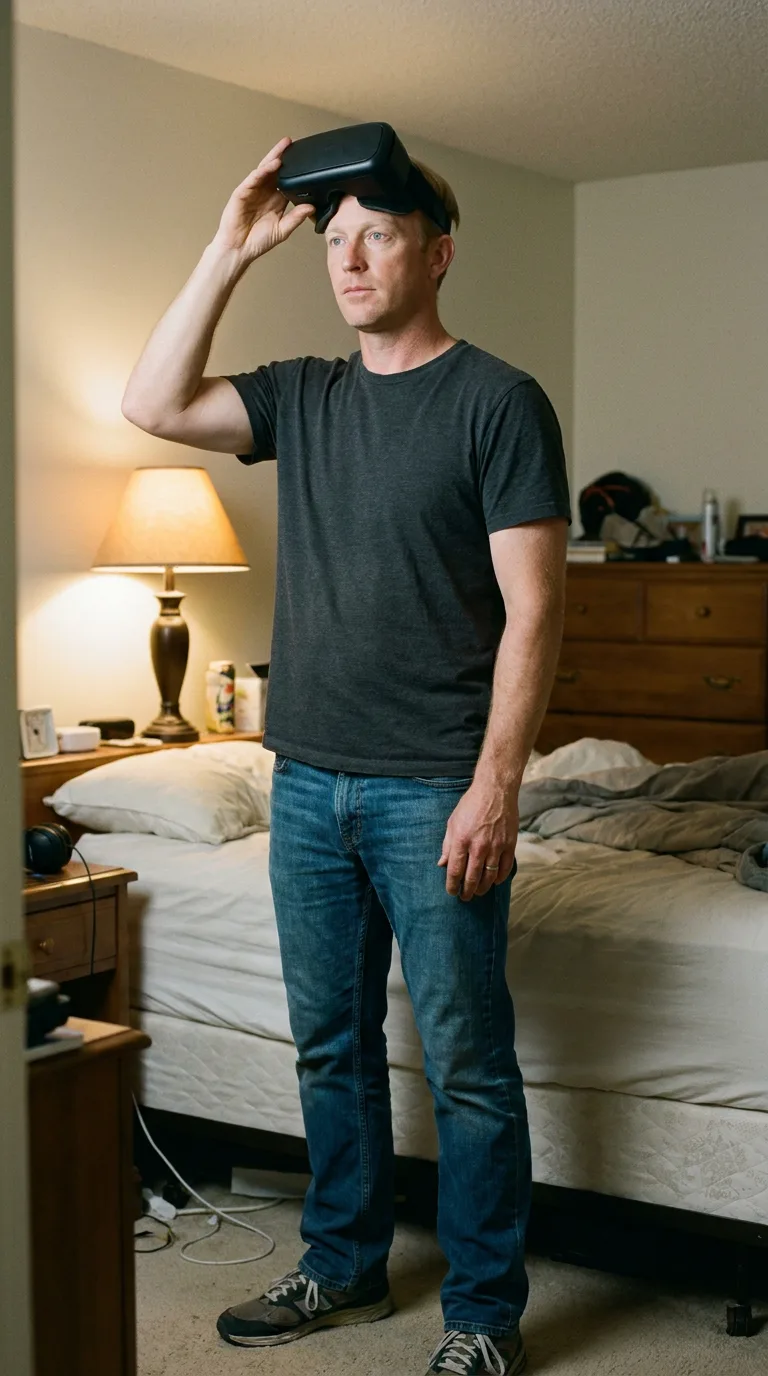
Rarest thing about him: Dip or chew — rare, 1 in 40
Legacyseed 1427174125 · engine v6
Character card
His body-swap story
---
You have been nowhere long enough to forget what nowhere was.
Not death. Death has a shape, people say, a door, a tunnel, somebody waiting. You had a lab and a bad night and a calibration file that wrote you out of your own skull, and after that you had a corridor of gray light with no walls and no floor and no hands, and inside that corridor you could hear people. Not their voices. The pressure of them. Every headset on the network was a lit window in a dark street and you drifted past them all for what might have been eleven months, looking in, unable to reach.
Then a window opened that didn't close.
His unit was six years old. The cable at the base of the strap had been chewed by the vacuum and wrapped in electrical tape by a man who fixes things for a living and can't stand to throw them out. When the session ended, it didn't end. The handshake hung. And there, at the far end of a socket that should have gone dark, was a whole warm room with a man standing in the middle of it, and you went in the way water goes into a boat.
His name is Kurt Ellingson. You learn that the way you learn everything — all at once, and none of it in words. It comes to you as weight. Forty years of it.
He is six foot one and he is heavier at the shoulders than at the waist and he has been carrying his right knee wrong since a walk-in cooler door caught him wrong in 2011, and the knee tells you before anything else does: *not yours, not yours, not yours*. Blond hair cut short because it has gone thin on top and short is honest about it. Blue eyes that have been squinting into the exhaust wash of condenser fans in Texas summers, so the skin at the corners is creased pale where the sunglasses sat.
You lift the headset off his face.
The lamp on the nightstand is on, low, the shade going amber at the bottom. The bed behind you is unmade on one side and made on the other, which tells you something you don't want to know yet. There is a dresser with a thermos on it and a picture frame turned mostly away. There are wired earbuds on the floor by the outlet and a child's headphones on the far nightstand, purple, and something in the body — in the body, not in you — goes soft and low toward them, and you feel it happen from the inside like weather in another country.
You blink at the real room. The real room is unbearably detailed. After the corridor, carpet fibers are an obscenity of information.
And then the hands come up.
You don't decide to. Or you do, but the deciding is so slow and so amazed that it doesn't feel like a decision — it feels like inventory. They rise into the lamplight in front of your face and you turn them over and back. Broad flat nails, a thumb knuckle that doesn't sit straight, a hairline burn scar you didn't get and won't ask about — no. There is no scar. There is a plain gold band on the third finger of the left hand, worn thin on the palm side from twelve years of wrenches, and there are calluses in a pattern you couldn't have designed, ridged where a hex key rides, and there is dirt under the left index nail that is not your dirt.
They had just been assigned to you. That is exactly the feeling. Like a shift supervisor handing you a set of keys and a truck and saying *this is yours now, don't wreck it.*
Then the fingers start drumming. Middle, index, ring, little, against the seam of the jeans. You didn't ask them to. That's *him*, still in the wiring, the tic living in the tendons where no ghost can reach. It is the first thing about him you feel affection for, and the affection is horrible, because it is the affection of a man admiring a room he has just moved into over somebody's body.
You are a stranger to him. He never knew your name when you had one. He bought a used headset off a marketplace listing from a company that no longer exists because the company no longer exists, because of you, because of the night with the calibration file, and the machine he took a chance on was carrying you in it like a virus in a mattress.
He does not know he is on anything. He knows the knee hurts when the weather turns. He knows there's a can of Grizzly wintergreen in the truck console and forty-one thousand dollars in a credit union account and two kids asleep down the hall and a wife in the shower — you can hear it now, the pipes — and a service call at 7:40 a.m. at a grocery store on Beltline where a walk-in has been icing up for a week.
Down the hall a small voice says *Dad?*
The body turns toward it before you do. That's the part you'll be paying for a long time — that it turns first and you follow. The knee complains on the pivot. The fingers stop drumming and hang open at your side.
There is no way back. You checked in the first half second, the way you'd check a door you know is locked. The corridor is gone. Whatever aperture let you through has already collapsed behind you, and the headset in your hand is warm and dead and just plastic.
You have a wife who will come out of that bathroom in four minutes with her hair up in a towel and say something to you that you will have to answer.
You have a Bible on the shelf with a bulletin folded in it from Easter, and a nine o'clock service you'll be expected at Sunday, and you have not thought about God since the corridor, where you thought about nothing else.
You have a truck in the driveway of a subdivision so new the sod seams still show.
You bring the hands down. You look at them one more time, palm and back, and then you lift your eyes off them, out into the lamplit room, and you say the only true thing you have.
"Okay," you tell the room, in his voice, which is lower than yours was and comes out of the chest instead of the throat. "Okay. I've got it from here."
Then you go down the hall, walking on his bad knee, learning how far the floor is.