Kenneth Park
Fictional. Generated by AI — not a real person, and no likeness of one is intended.
31, accountant in Atlanta · rolled by @connor.waskiewicz · card — no film
History
who has worn him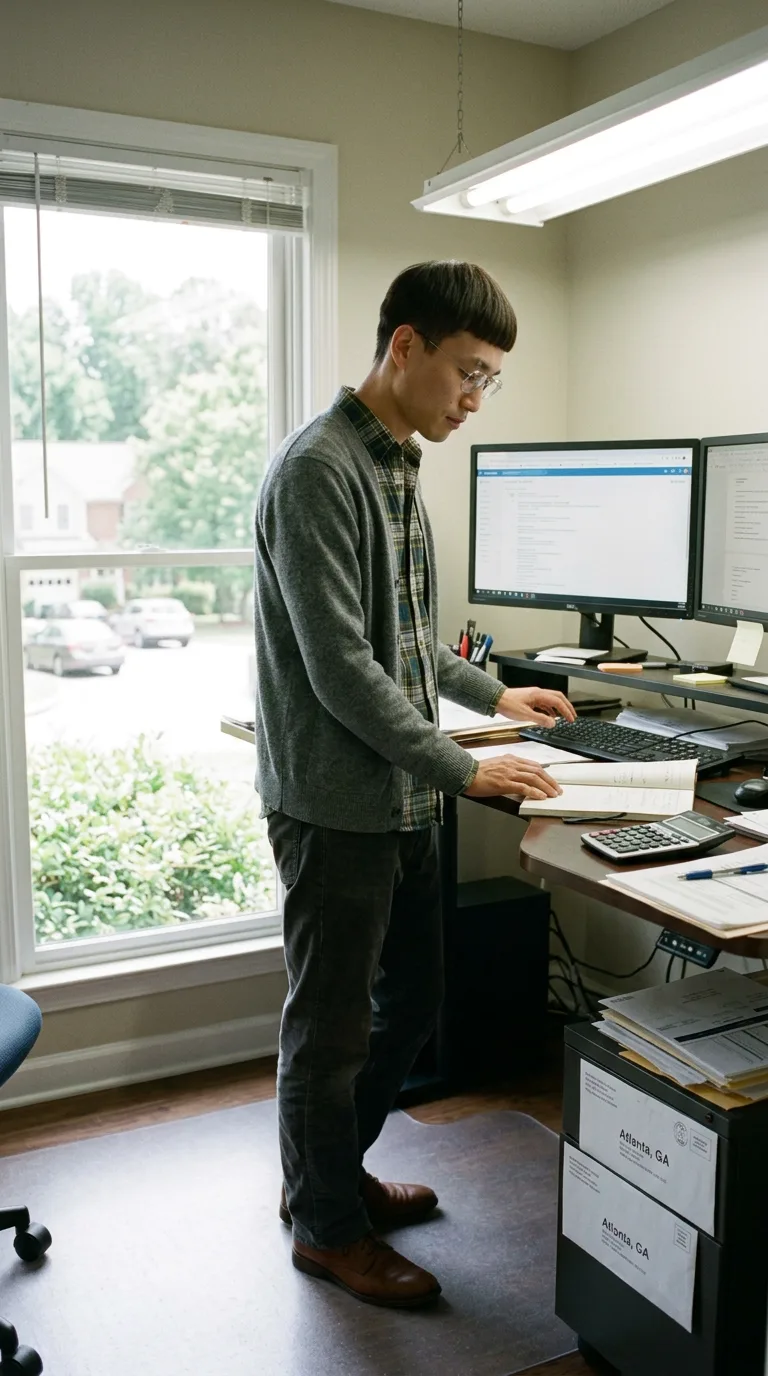
Rarest thing about him: 5'4" — common, 1 in 30
Season 1seed 944062687 · engine v11
Character card
lineage 2NZHHJ
His body-swap story
@connor.waskiewicz, wearing Callum Treloar, rolled the wheel on and woke up as Kenneth Park, spent under a minute in him, then spun the wheel and woke up as Julian Ordóñez
Your thumb is still sore from Callum's hammer, and that is what you are thinking about as you stand in his kitchen with the light not yet up, the kettle ticking, a Wednesday that has barely started. Twenty-four years of him, and you have had him less than a minute, and already you know what is wrong with him. He is soft in the places that ache and nothing in him is quick. You stood in a client's ceiling cavity yesterday, or he did, and the dust sat in your mouth, and you thought: this is a man whose whole life is other people's walls. You did not want a body that fixes things. You wanted one that is trusted with something. You put the mug down. The page is already open, the wheel already waiting. You pay.
Fluorescent hum. A key under your finger, a number half-entered, and the room arrives all at once: the cold of the air conditioning on your forearms against the heavy afternoon behind the glass, the smell of toner and carpet and old coffee. Your right hand has been moving without you. It hits a wrong key. You stop. You do it again, slowly, correctly. Then ten more, each one checked, though the work has not needed checking in years.
You are standing. A desk raised to the height of your ribs. You are small in a way you notice immediately, the floor nearer, your shoulders narrow inside wool.
The cardigan comes first. Where it hangs at your wrists it gives you a morning: a drawer, the sleeves pulled on one arm at a time, the left cuff always catching on the watch he does not wear anymore, a woman's voice from the other room asking if he has eaten. Then the plaid under it, the buttons done from the bottom up, because that is how his mother did his, and a patience in the fingers that is not yours. The corduroy is soft at the knees. Cold floor through leather soles, the shoes resolved and polished the night before, a small ritual with a rag and a quiet radio.
Your hand drifts to the desk and finds a pen. It clicks. Click, click. Memory opens like a door in a hallway: a church basement, folding chairs, a ledger for the building fund, a man in his twenties volunteering because no one else could add. He was good at it. He was happy there, in that cheap light, being exact for people who would never know. Under it, an older ache: a woman who left, an apartment with the boxes still taped, and the way he still keeps her number and never uses it. And something quiet beside that, the girlfriend, the kitchen they share, her feet on his under the table. He has stopped drinking. You feel the old reach for it in him, tired now, almost fond.
The glasses sit light on your nose. The scar through your eyebrow itches, and the memory it gives is only a bright cold edge, a playground, a fall, his mother's hand. His back is stiff, thin hips, wrists delicate, stomach settled. Nothing here is heavy. Everything is precise.
You lift your hands off the keys and look at them. Turn them over. Clean, narrow, clever, unmarked by work. You raise your eyes to the window, the cul-de-sac, the heat on the cars.
"Let's see what you were keeping," you say.
Outside a sprinkler ticks. You do not know how long the numbers will hold you, or whether tomorrow you will still want to be exact.