Kenji Watanabe
Fictional. Generated by AI — not a real person, and no likeness of one is intended.
47, park ranger in Boston · rolled by @tyler.iverson · card — no film
History
who has worn him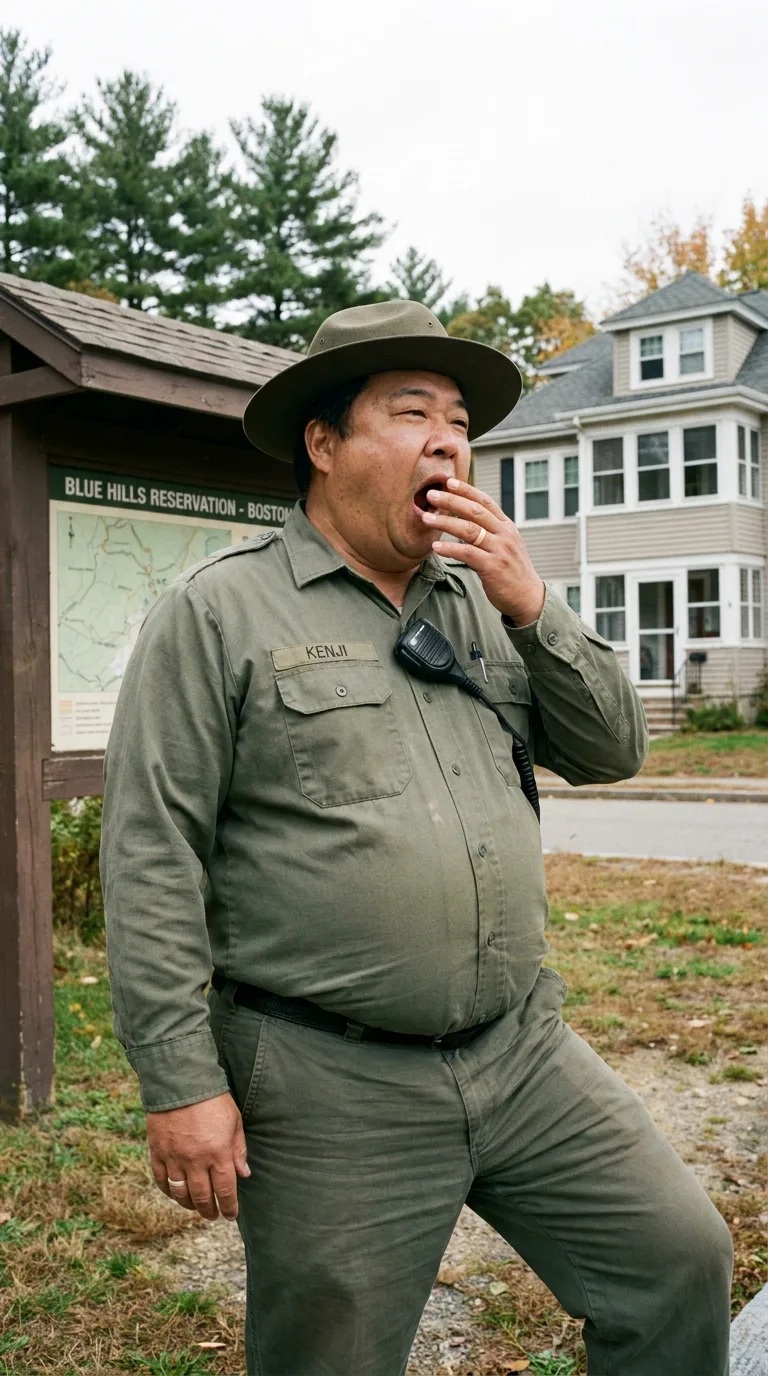
Rarest thing about him: Park ranger — uncommon, 1 in 128
Legacyseed 2037368446 · engine v8
Character card
His body-swap story
---
You lived on the second floor and he lived on the first, and for nine years the only thing between you was a stairwell that smelled like other people's dinners.
You knew his mornings before you knew his name. The storm door with the bad spring — bang, and then bang again, softer, because he always caught it the second time and eased it shut like an apology. Six-fifteen. The porch boards under him. The yawn, always the yawn, huge and unembarrassed, one hand up over his mouth as if there were anyone out there at that hour to be polite for. Then the walk to the Corolla with the trunk that didn't latch. Then nothing, until dark.
You were not his friend. You were the person he nodded at. He shoveled the front walk twice without being asked and never mentioned it. When the pipe burst in the ceiling he stood in your kitchen in his undershirt holding a flashlight for the plumber for an hour and a half and turned down the twenty dollars you tried to hand him, and you understood then that he was not being kind to you specifically. He was like that toward the whole building the way a load-bearing wall is like that toward a house.
You watched him lose everything in slow motion through a floor.
The wife first — you heard the register of the arguments change over one summer, from two people going at it to one person explaining and one person not answering. Then the moving truck in April, and the way he stood on the sidewalk with his hands at his sides while she did the loading, because she wouldn't let him touch anything. Then the kids in shifts, weekends, three of them and then sometimes two and then sometimes one, sitting on the porch steps looking at their phones while he brought out juice nobody asked for. Then the band off his finger. He didn't take it off cleanly, either. It sat in the dish by his door for a week and then it was gone and he had that pale stripe on his hand for months afterward, and it was still there, faint, the last morning you saw the hand belong to him.
He had nothing. You know this because you heard him on the phone with the insurance company, the pharmacy, the ex, the pharmacy again — patient every time, saying *I understand, I understand, so what's the number then* — a man doing arithmetic he'd already done. Test strips. The metformin. Three kids. A ranger's salary. He didn't drink much, didn't smoke, didn't pray. He didn't have the consolation of thinking any of it was arranged.
And still: six-fifteen. Storm door, bang, bang. Yawn.
That's the part you couldn't get past. That's why it was him and not the shouter in 3F or the kid with the drums. You have wanted a great many things in your existence and most of them were beautiful, and none of them held. What you came to want, watching that stairwell, was the thing you couldn't build out of any material available to you: a man who gets up on a cold overcast Tuesday with nothing coming and no reason to and goes anyway. You wanted to know what that felt like from inside. Whether it was courage or just a rut so deep the man in it could no longer see over the edge.
Nobody knows how you got in. Not the priests he didn't believe in, not you. There was no door. There was a want with nowhere to put itself and a body being careless with itself in the doorway.
He was in his uniform, hat on, radio clipped, standing at the trailhead sign by the lot with the pines up behind him and the big grey house across the road — the one whose porch light stayed on all day — and he had nothing in his hands and nothing behind him but the mirror of the map case, his own shape doubled in the plexiglass over BLUE HILLS RESERVATION. He yawned. Enormous. Eyes squeezed shut, mouth wide, hand up over it. It went on. You could see the flat black comb-over lift a little where the hat sat on it.
He finished. He rubbed one eye with the heel of that hand.
And stopped, with the hand still raised.
Here is what nobody in the parking lot could have told you: the last thing he thought was about the second youngest. Something about a form, a school form, sign it by Friday. Halfway through the thought there was no more of him.
The hand comes down.
Everything is loud. That's the first fact — the pines aren't quiet, they're a slow enormous rushing, and there's a truck on the road and a jay and blood in ears and a heart doing work, a lot of work, and the whole apparatus is *heavy*, it's a thing you have to hold up, and the hips take it and the knees take it and the lower back files a complaint. Cold air in the nose, wet leaves and cut grass and diesel and, underneath, the sourish warm smell of a man's own body in cotton. There's a tightness across the belly where the shirt buttons pull. Something rubbing at the back of one heel. And a thirst — not dramatic, just there, a dryness at the back of the throat like a small light left on, which you will come to know, over the years you will spend in this, as the sugar.
The eyes go to the mirror. Straight there — not decided, just gone there, the way water goes down.
You look at him. It. The plexiglass gives you back a broad face under a flat-brimmed hat, brown eyes, the hard part in the black hair, the heavy shoulders. Nine years of nodding at this in a stairwell and you never once looked at it properly. He was tired. He was so tired. It's in the pouches under the eyes and the set of the mouth and it's *in you now*, it's not something you're observing, it's the floor you're standing on. You lift the hand — his hand, your hand — and there it is: the pale band where the ring was, thinner than the skin around it, the shape of a promise that got taken off in stages.
You wanted to know if it was courage or a rut.
It's neither. It's that the alternative is to stop, and stopping is not a thing this body knows how to do at six-fifteen. It just goes. There's no engine of meaning under it at all. There's just a man who said *I understand, so what's the number then*, and got in the Corolla, and did it again.
You turn the hand over. The palm's rough at the base of the fingers. Somebody's initials are gouged into the sign post by your knee.
Friday. The form. Second youngest. It surfaces in you like something you left in a coat pocket last winter, and it's yours now, all of it — the three of them, the ex who still matters and always will, the strips and the pills and the four thousand dollars that is everything you own. No way back. No term on it. You wanted in and you got in and the door isn't there anymore.
The radio on your chest crackles somebody's location.
You clear your throat and it comes out lower than you expected, a stranger's voice from inside a familiar chest, and you say, to the man in the plexiglass, the only thing that seems true: *okay.*
Then you walk to the trailhead the way he walked to the car, because that's what the legs do, and above the lot the pines keep on with that long grey sound, and the porch light across the road stays on all day, and nobody in the whole city notices that a load-bearing wall has been replaced overnight by something that only wants to be one.