Karim Haddock
Fictional. Generated by AI — not a real person, and no likeness of one is intended.
65, delivery driver in Los Angeles · rolled by @connor.waskiewicz · card — no film
History
who has worn him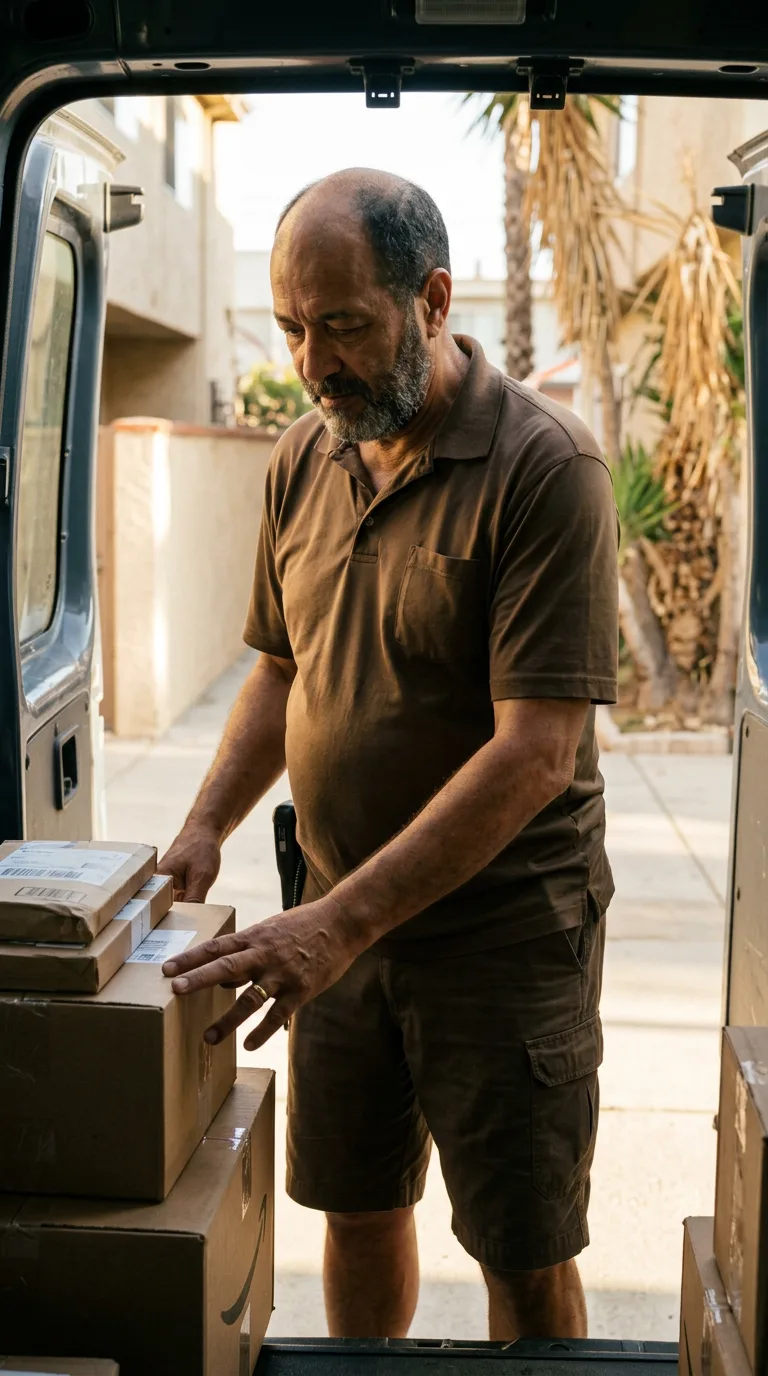
Rarest thing about him: Middle Eastern — common, 1 in 650
Season 1seed 702292220 · engine v11
Character card
lineage 2NZHHJ
His body-swap story
@connor.waskiewicz, wearing Alonso Vargas, rolled the wheel on and woke up as Karim Haddock, spent under a minute in him, then spun the wheel and woke up as Daniel Yoon
Four fingers. That's the first thing, and it's why I'm here. Alonso Vargas's right hand has a thumb and a stub and one good finger, and for one minute I've stood at a fryer in Eastern Kentucky, the afternoon going gold through the window, trying to lift the basket by its handle. It slips. A girl behind me says "Alonso, you good?" and I say yes in a voice that isn't mine, with a mouth that has to be coaxed into its vowels. He is fifty-eight and the hand is a rumor of a hand. I couldn't do it. I was handed a body and the body couldn't do the one small thing in front of it. So I put the basket down, and the page is already open in my head, the wheel with its slow ticking, and I pay, and I turn.
The light changes first. Hot, low, white. Then weight: a lot of it, carried in front, and a long frame over it, taller than the last one by a head. A cardboard edge under my palm. My left palm, flat on a box, and on the fourth finger a ring.
Something in the rhythm broke a half second ago. I feel it in the arm, a motion done wrong, and then the arm does it again slowly, correctly, and then ten more, each one checked, a job that hasn't needed checking in years. Scan, turn, lift. The arm checks itself against nothing. I let it.
The box under my hand is rough, and the roughness opens something. Not mine. A garage floor, early, the van's engine ticking as it cools, and a man's thumb pressing a label flat because his father once told him a crooked label is a disrespect to the person waiting. Fifty years of that thumb.
The shirt sticks to my back with sweat, brown cotton gone soft from washing. It gives me the morning: a small room, dark still, a prayer rug folded away, the knees complaining as he stands, then the shirt off its hook, one sleeve and the other, the buttons at the collar left open because the neck has thickened. His wife said something from the bed, half asleep, about water, take water. He took it. He always takes it. He drank none of it before noon and doesn't mind.
The leg is bouncing. I didn't tell it to. The right knee, quick and small, a tick he has had since he was a boy in a classroom, and it stops only when he sleeps. Beneath it the pavement radiates through boot soles. Behind my ribs something old and tight, the want of a cigarette he quit eleven years ago, the memory of a lighter's click against the van's bumper, his daughter's voice on a phone saying Baba, please. He quit for that voice. I feel the quitting like a stone he still carries in his pocket.
The scanner at my hip has a worn grip, and it hands me money: a number, small, always small, the rent, the dentist he keeps postponing, the way he does the sum in his head at red lights and gets the same answer. Nothing to his name. A wife, a daughter, a ring, a route. His back aches low and steady. His hands are thick and sure and entirely whole.
I lift them. Ten fingers, brown, the knuckles thick, the ring dull gold. I turn them over. They are so complete it hurts a little.
I look up past the van's open door, at dry palms and stucco and the late hard sun, and I say it quietly, to whoever is listening:
"All of them. You've got all of them."
The knee keeps bouncing. Somewhere under the ribs the wanting is asleep, and I don't know for how long.