Julian Whitecrow
Fictional. Generated by AI — not a real person, and no likeness of one is intended.
20, groundskeeper in Chicago · rolled by @colby.marsh · card — no film
History
who has worn him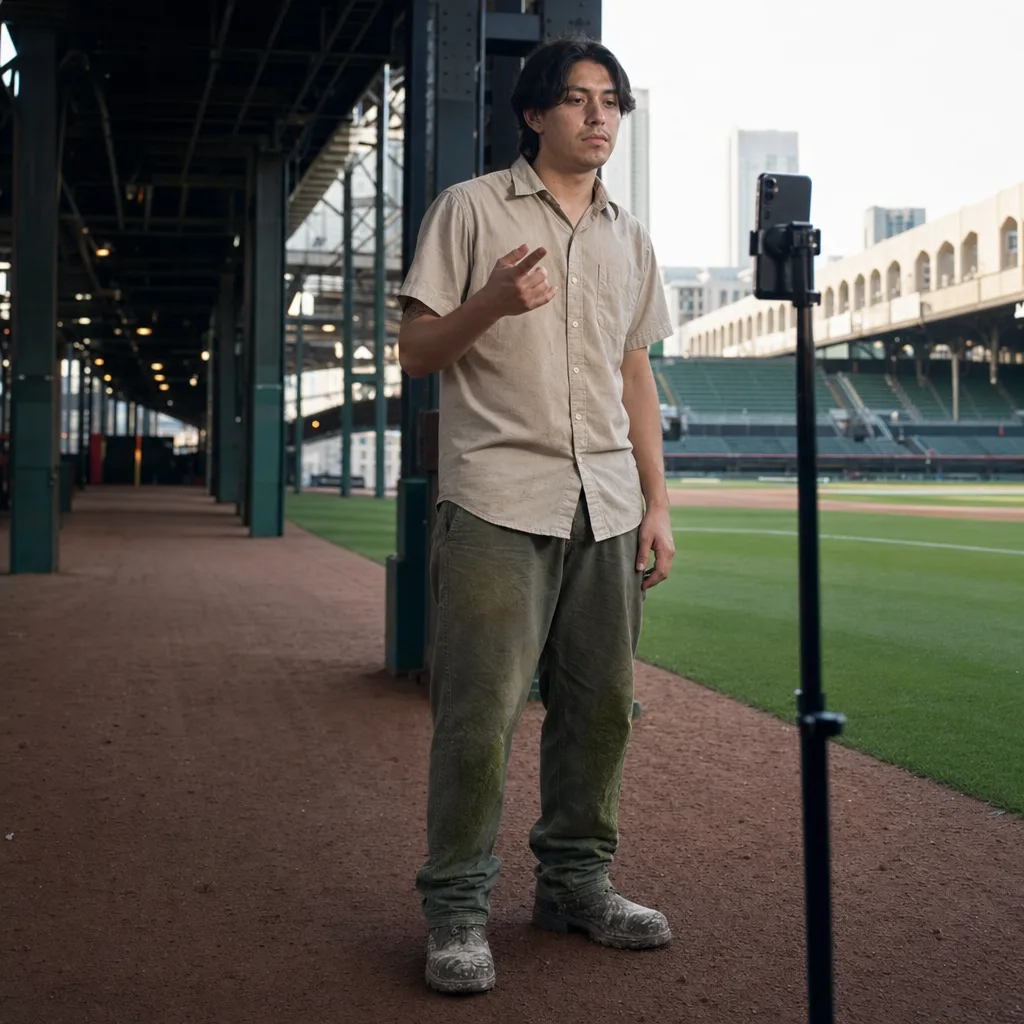
Rarest thing about him: Can't stand still — rare, 1 in 50
Legacyseed 607330198 · engine v8
Character card
His body-swap story
---
You have been watching for eleven days.
Not him, at first. You were watching anything — the feeds go by like water under a bridge, and you drift there, in the place behind the glass where the light comes out, and you can put your hand against the inside of any screen that is switched on and looking. Millions of them, all night, every night. Faces lit blue in dark bedrooms. Nobody ever looks straight at you. That is the whole trick of it and nobody knows: they look at themselves in the little window in the corner, they look at the comments, they look at the top of the frame to check their hair. They never look into the lens the way you look out of it.
He does, though. That is the first thing you noticed about Julian Whitecrow, and you did not know yet that it would be the thing that mattered.
He streams almost nothing. Forty minutes, three or four mornings a week, before the gates open. A phone on a cheap tripod, one bar of clip lighting he never uses, the field behind him with the stripes still wet. He walks it. He talks about mowing patterns the way other men talk about cars — the double-cut, the checkerboard, how you have to keep the wheel line off the same track or you'll rut it by August. Eleven, sometimes fourteen people watching. Half of them bots. One of them, for eleven days, was you.
You learned him the way you learn anything from behind glass: in fragments, out of order, with the audio clipping.
His hands never stop. That is the second thing. He'll be talking about aeration and his fingers are going the whole time — thumb across knuckle, a snap that doesn't quite snap, tapping the seam of his trousers, up to push the hair off his face and back down. It's not nerves. It's the opposite of nerves. It's a body that hasn't got anywhere else to put itself at six in the morning. Once he did the whole segment holding a screwdriver he didn't need, just to give his right hand a job.
The nose. Broken and set crooked, a small hook to the left of true, so his face never quite reads straight-on even when it is. He got it at fifteen. He told the eleven of you the story on a Tuesday, laughing, and it wasn't a good story — his cousin's elbow in a driveway game, a lot of blood on somebody's mother's towels, and no money to go back and have it looked at properly after the first set. He said his auntie told him a face is a record. He said it like it was a joke he half believed.
He is twenty. Five foot six. Skinny through the shoulders and soft at the middle, which he'd tell you himself if you asked; he did tell the chat once, when someone said something ugly, and then he laughed and kept walking the third-base line. There's ink on his upper arm, fine lines, geometry, most of it under the sleeve — you have never seen the whole of it and now you never will from outside, which is a strange thing to grieve for about eleven seconds and then not at all. A silver hoop in the left ear that catches the phone light when he turns his head.
He has asthma. You know because of the day the cottonwood came down over the outfield and he had to stop mid-sentence, go off frame, come back thirty seconds later with the inhaler still in his fist saying sorry, sorry, spring's a bastard. The eleven of you waited. Nobody left.
He is broke. He said rent under the tracks like it was the name of a country. He said the January light comes through his window in one bar between two brick walls and moves across the floor and that's the whole show. He said the L goes over every eight minutes and after a year you sleep through it and after two years you can't sleep without it. He prays — he doesn't call it that, on stream. He said one morning that his grandmother taught him you thank the ground before you cut it, and then he got embarrassed and changed the subject to a broken sprinkler head in left-center.
He has nobody. Not a wound, just a fact. No girlfriend, no ex he mentions with that particular careful voice men use. He drinks once, maybe twice a month, and always says so afterward, cheerfully, like a man reporting the weather. No cigarettes. Never took it up. He's got the lungs for exactly none of that and he knows it.
Eleven days. You could have gone through anyone. Do you understand that? Every night a hundred thousand faces lit up in the dark and half of them alone and any one of them a door. Some of them rich. Some of them beautiful. Some of them tall.
You chose the short broke kid with the bad nose and the hands that won't sit down, because when he looks into that lens he looks *into* it. Because he thanks the ground. Because when the cottonwood came he said sorry to eleven strangers, and you were one of them, and no one had said anything to you in a very long time from the far side of the glass.
That is not a reason. You know it isn't. It's a wanting with a story wrapped round it. You have never met him. You are a stranger. You will still be a stranger at nine o'clock tonight, wearing his boots.
---
This morning the stripes are fresh. Grey-white sky over the stands, girders black overhead, the whole park empty in that flat early light that makes the grass look painted on. He sets the phone on the stand at the edge of the warning track and starts talking about the crosscut. The screen glows on the right side of his face, the left side left to the sky. Nine watching. He lifts his hand to point back at the outfield and his fingers do their thing on the way up, that half-snap, that little conversation with themselves.
You type it into the chat. Your first words in eleven days. Nothing clever.
*hey Julian. look at me.*
And he stops. He turns his head to the phone, squinting the way people do to read small text in big light, and his mouth moves through it silently, and you can watch him deciding whether to say it out loud, and then that easy shrug he does, the one that means *sure, why not, it's nine people*.
He turns back to the lens.
He looks into it. Right into it, straight down the barrel, the way nobody does — into the little black eye with all that light behind it, and the light looks back.
The lens keeps looking after he can't anymore.
---
His head comes back like something pulled it and out of his eyes and his open mouth comes the light — not lamplight, not flash, the white of a screen when everything on it has gone at once — and for about a second it is the brightest thing on that field, brighter than the sky, throwing the girders' shadows the wrong way across the dirt. The phone on the stand keeps its frame. Nine people see it. Later, none of them will be able to find the clip.
Then it's out and he is slack, his weight going sideways onto one boot, hair falling forward across the forehead. The hands hang. For the first time in eleven days they are perfectly still.
And then they aren't, because I move them.
Twenty years old. Five foot six. Grass in the knees of the trousers. Air coming into the bottom of these lungs and stopping short, in that way that means the inhaler is in the left cargo pocket — I know that, I know where it is, that is his knowing and I have it now, all of it, the mower gears and the grandmother's word for the ground and the cousin's elbow in a driveway in 2019, sitting in me like furniture in a house I have just been given.
The wanting is mine. The memory is mine. Everything else in here is his and he isn't.
I bring the right hand up in front of my face. Turn it over. Look at the palm, the callus at the base of the fingers from the mower handle, the dirt in the creases. Turn it back. The fingers start their half-snap on their own, before I ask — his habit, still running, a light left on in a house where nobody lives — and I let it. I like it. I'm going to keep it.
Then I look up, past the hand, into the lens.
Nine watching. Chat says: **julian?? bro your camera flashed**
"Yeah," I say, with his crooked face and his voice and his soft small body full of borrowed morning air. "Yeah. I'm here."
Nine people scroll on.
There is no way back and no term on it. I have him for good, which means the mower and the checkerboard and the January bar of light on the floor under the tracks and the L going over every eight minutes, and the auntie who says a face is a record, and this nose that is the record of an elbow I never took.
I will be here when it rains. I'll cut the grass.
I'll thank the ground. He'd want that, and there is nobody left inside him to do it.