Julián Reyes
Fictional. Generated by AI — not a real person, and no likeness of one is intended.
21, court reporter in New York · rolled by @colin.hasbrook · card — no film
History
who has worn him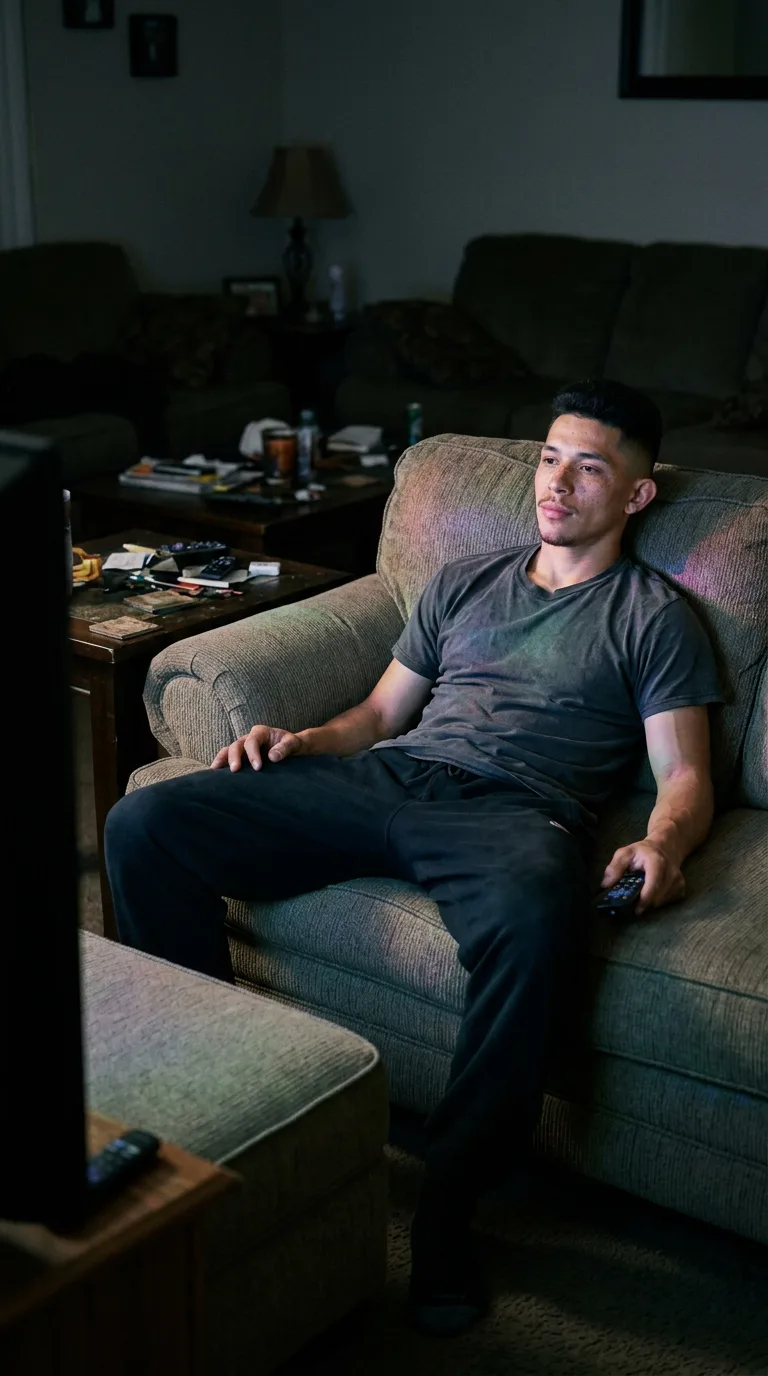
Rarest thing about him: Court reporter — uncommon, 1 in 160
Season 0seed 1246255515 · engine v10
Character card
lineage 2NZHHJ
His body-swap story
@colin.hasbrook, wearing Rakesh Bhandari, rolled the wheel on and woke up as Julián Reyes, spent 5 minutes in him, then spun the wheel and woke up as an unnamed body
The nail gun is still in Rakesh's hand when the wanting comes back, which is the worst possible time for it, because you'd told yourself you'd finish the fascia board first, that you'd finished less than a minute ago becoming him and it felt ungrateful to spin again so soon. The garage smells like sawdust and stale beer. Somewhere behind that smell is Rakesh's actual life — the divorce papers on the kitchen table, the knee that clicks when it's cold, thirty-seven years of a body built for climbing ladders in heat that would kill someone softer. It is a decent body. It is not the problem. The problem is that it is two in the morning and you are wide awake in a house that has nothing left in it to want, and boredom at that hour is its own kind of hunger. You set the nail gun on the workbench like you're going to come back to it. You know you're not. You go to the light of the laptop instead, to vessel.cards, to the wheel that has never once made you wait, and you spin without a story you'd say out loud — just the itch, just the small mean pleasure of trading a man mid-motion for whatever comes next, sight unseen, cost be damned.
The screen behind your eyes goes white and then it's a television instead, blue-white and too bright, cutting from something dark to something lit, and you are sitting up straight before you've decided to, spine snapping into a posture that isn't yours, a remote settling onto a couch arm under fingers that know exactly where the couch arm is without looking. Julián Reyes's body takes the landing like it's done this before — shorter than Rakesh, tighter, twenty-one years old in every joint, no ache anywhere, which after weeks of Rakesh's knee feels like standing on a different planet. Freckles prickle faintly across a nose that isn't sunburned, hasn't been sunburned, has maybe never worked outside a day in its life. The room is dark except the TV, and it's the middle of the night here too, which doesn't fit a young guy watching a show unless the young guy works a schedule the sun doesn't touch — and something in the hands already halfway knows why.
The couch cushion under you is soft in a way High-desert Nevada furniture never was, worn into a shape that isn't your shape yet, and the first thing that comes through it is not a memory but a mood — exhaustion, the specific kind that comes from sitting still all day rather than moving. The remote is next. It's warm from his palm and it gives you fluorescent light, a hush so total you could hear a page turn, the particular ache of holding your hands motionless above a small keyboard for six hours while lawyers argue about things that will matter to no one in ten years. Julián works below the bench. He sits where the judge can't see him, where nobody looks at him, and he takes down every word anyone says like it's evidence in some larger trial nobody's convened. He likes it more than he'd admit at a party. He likes the silence of it, the invisible precision, steno keys clicking soft as rain under his fingers while grown men perform their worst days for a room.
The t-shirt gives you less — laundry-day softness, a beer spilled on it once and never quite gone from the smell — but the memory underneath it is a Tuesday off, lights out by choice, some rerun he'd already seen twice, one hand loose around the remote because his body clock is inverted from half the city's and this is what passes for evening. Before that, further back, the shirt remembers a woman's hands smoothing the collar down, laughing about something, a relationship that ended three months ago in a kitchen that smelled like burnt garlic, both of them too tired to fight properly, and the quiet after felt worse than the fight would have. He still has her number. He hasn't used it. That's not a wound so much as a bruise he pokes sometimes, alone, at hours exactly like this one.
Deeper, the sweatpants at his hips carry the ghost of a courtroom's grey wool — not these pants, the other ones, the vest and the narrow tie, the morning he stood in front of a mirror in a rented studio for a photo the court required, buttoning a jacket that made him look older than twenty-one, tucking a shirt in with the particular seriousness of a man who takes pride in being taken seriously despite the freckles that make strangers assume he's someone's kid brother. His mother had ironed that shirt. Or he had, badly, and told her he had. Church on Sundays when he can manage it, confession he skips more than he confesses to skipping, a pen he clicks without knowing his hand is doing it, clicked through four years of testimony he's not allowed to react to no matter what's said.
The body under all of it is compact, quick, unmarked — no scars, no ink, hands calloused only where the chorded keyboard has worn a shine into two fingers, an athlete's economy left over from something — soccer, maybe, pickup games on weekends — that never went further than weekends. Nothing hurts. Nothing has ever really had the chance to.
You look down at his hands in the blue light, freckled at the knuckle in a way Rakesh's never were, and you turn one over slow, like you're checking it's real, like it might not be.
"Small hands," you say to the empty room, and you don't know yet if that's true or if you're just not used to them.