Julian Ordoñez
Fictional. Generated by AI — not a real person, and no likeness of one is intended.
29, between jobs in Detroit · rolled by @connor.waskiewicz · card — no film
History
who has worn him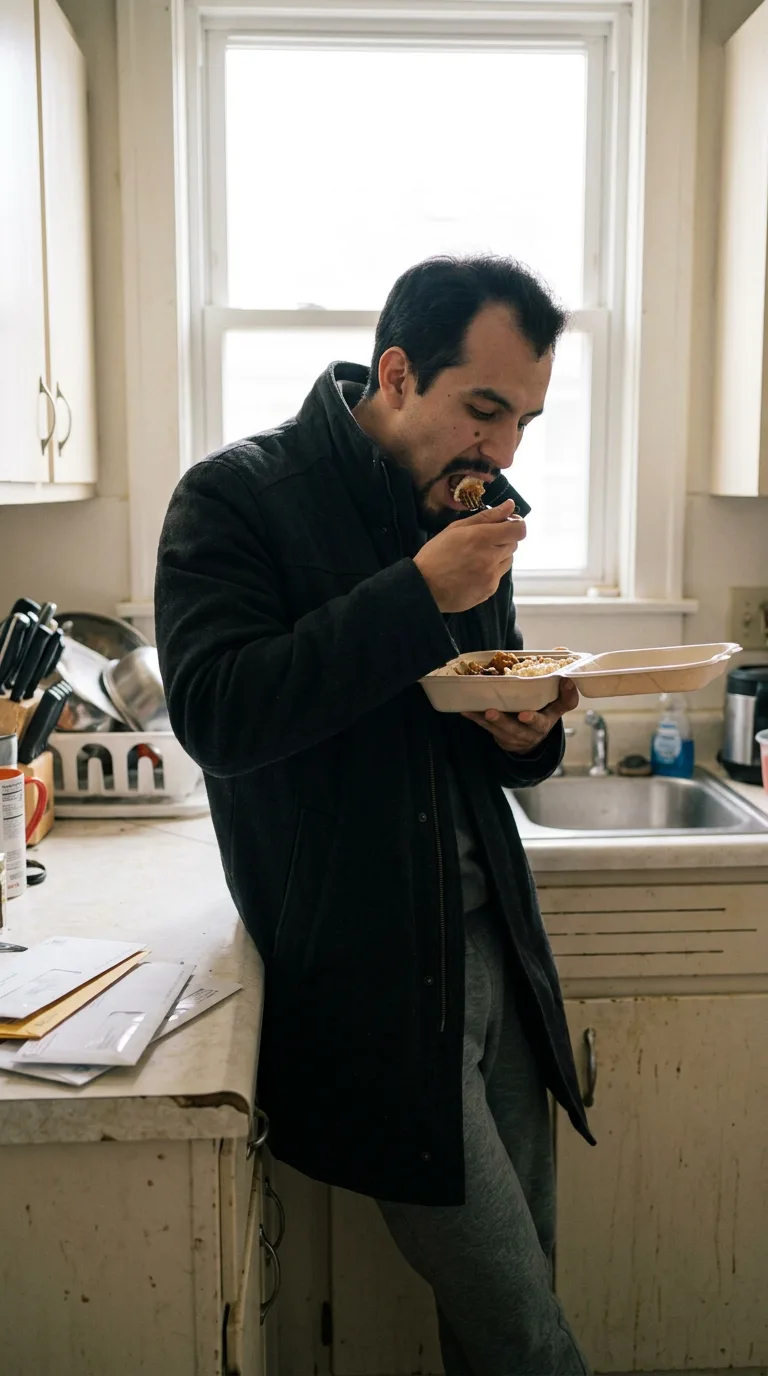
Rarest thing about him: Turns a ring over in his fingers — common, 1 in 26
Season 1seed 1913713216 · engine v11
Character card
lineage 2NZHHJ
His body-swap story
@connor.waskiewicz, wearing Russell Tennant, rolled the wheel on and woke up as Julian Ordoñez, spent under a minute in him, then spun the wheel and woke up as Samir Haddad
You are standing in Russell Tennant's kitchen in Los Angeles, and the morning is going on without you. Russell is fifty-four. His knees complain on the stairs and his belly sits against the counter like a second, patient man. He has been yours for less than a minute. You came out of the last spin into his reading glasses and his half-finished coffee, a spreadsheet of load calculations open on the screen. Every number meant something to him. None of them means anything to you.
That was the trouble. A body that works is not the same as a body you want. His job was a language you could not speak, and his phone kept lighting with people who loved him on terms you hadn't earned. You stood there with his thumb on the glass and felt the old hunger come back, thin and bright. You gave him up on a Tuesday, over a cooling cup, and you are not proud of it.
The page loads. The wheel turns.
Then cold air, and a fork halfway to your mouth. The window is a white slab of sky. Rice and something fried sit in a foam container balanced on your left palm. There is a coat on you, heavy wool, still buttoned against a house that has no heat worth the name. The fork stops. Your jaw has already begun to close on nothing.
You are lighter than Russell. Your knees are quiet. Your back is straight against the counter's edge, and your stomach is mostly empty, so the food smells like an argument you are about to win.
The coat's collar scratches your neck, and the wool brings the first thing. A morning. His hands pulling the coat from a hook by a door, the lining torn at one pocket. He had told himself it was a good coat for interviews. It had been to three, and the last one went quiet after a handshake. The wool carries that quiet, a flat gray weight in the chest, and he had walked home anyway, because walking was free.
The fork is cold in your fingers. Your thumb finds a worn place on the handle and a flash comes with it: a long table, a girl laughing at him over the rim of a glass, years ago. Her name is just out of reach and the ache is not. He still checks her page on bad nights. You feel the exact angle of his shame about that, and it is not yours, and you carry it anyway.
Under the coat is a gray hoodie, soft from washing. It gives you the morning in sleeves. His left arm went in first, then the right, the cuff catching on the ink inside his forearm, fine lines of triangles and angles he drew himself on a napkin one drunk night and paid a stranger to make permanent. He pushed the sleeves up as he always does, then pulled them down again against the cold. Sweatpants next, the drawstring knotted because the knot has been there since spring. Then the blue sneakers, the heels crushed flat. Nobody was coming. He dressed for no one, and the dressing was a kind of tidy grief.
Your right hand wants something. The thumb and first finger twitch against each other, turning an invisible circle. A ring, once. The hand remembers a band of metal worn smooth, rolled over and over through long afternoons of listings and refusals. The ring is gone, in a drawer or a river. The hand has not been told.
The counter presses your hip. On it sit envelopes with clear windows, and the shape of them gives you the arithmetic of him: a little put away, enough to feel the floor, not enough to stop counting. Under the sink there is a bottle, and your throat remembers the burn of it, nightly and unhurried. His body is not hungover now. It is only waiting.
You set the fork down on the counter. It clicks against the laminate. You shrug the coat off and the cold lands on your shoulders like a hand.
You lift your right hand and turn it over. Fine black lines run up the inside of the forearm, a little crooked at one corner where the needle hesitated. The knuckles are scarred faintly, the palm warm and strong. It is yours now. You close it, open it, and look up at the dark glass of the window, where a man with a goatee and a mole high on one cheek looks back.
"Okay," you say, in a voice you have not heard before. "Okay, Julian."
The rice is going cold. Somewhere a tab is still open on a wheel. You wonder how long before the wanting comes back, and whether tomorrow you will still be standing here, or somewhere else, in someone else's coat.