Ismael Torres Baeza
Fictional. Generated by AI — not a real person, and no likeness of one is intended.
50, construction laborer in Mexico City · rolled by @owen.pelkey · card — no film
History
who has worn him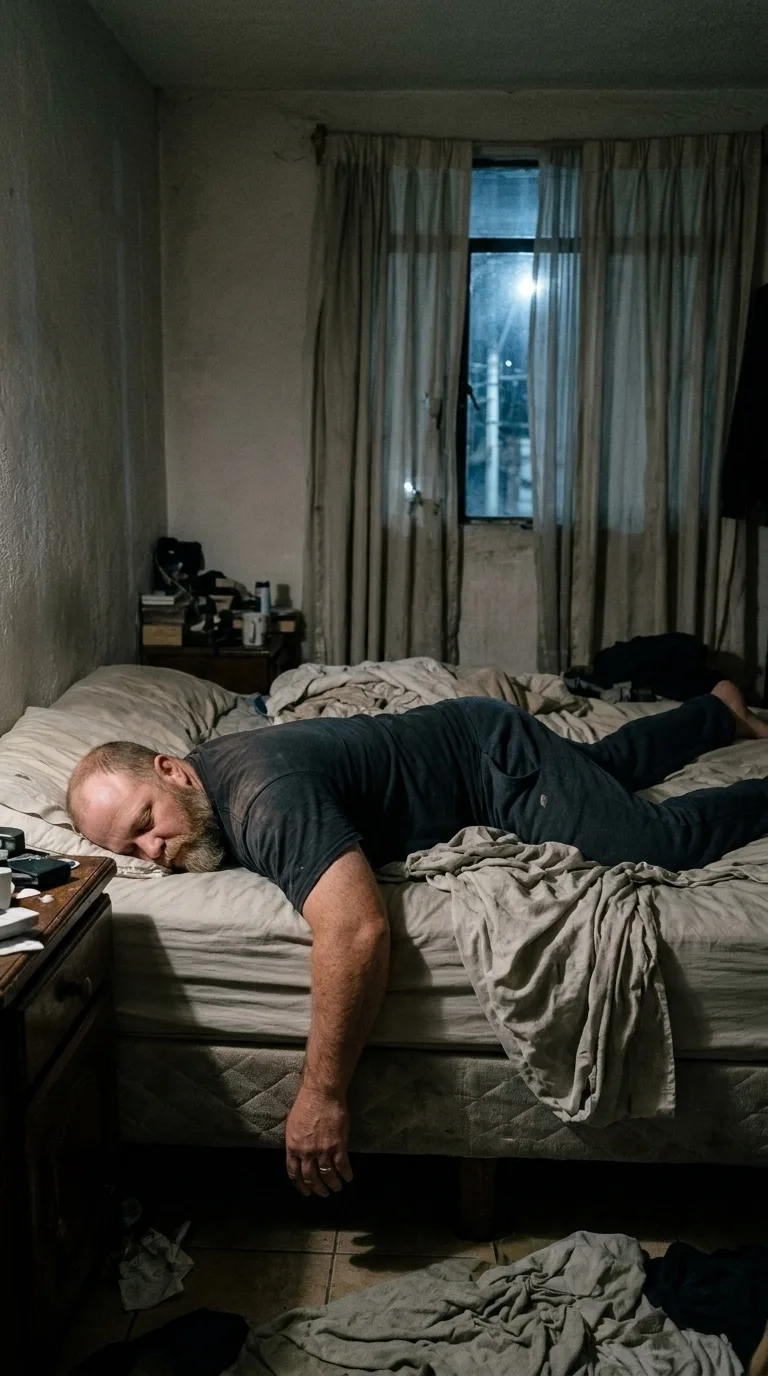
Rarest thing about him: Mexico City — uncommon, 1 in 360
Season 1seed 1091692556 · engine v11
Character card
lineage UHQ7Q7
His body-swap story
@owen.pelkey, wearing Gordon Whitlow Hale, rolled the wheel on and woke up as Ismael Torres Baeza, spent 6 days in him, then spun the wheel and woke up as Rodolfo Medina Cisneros
You are standing in Gordon Hale's kitchen with the lights off, and you have been for a while. The house is a good one, Philadelphia stone and quiet money, and the refrigerator hums like it is waiting for you to say something. His bare feet are cold on the slate. His shaved head is cold too, a thing you still reach up to check. He is sixty and he runs well. The knees never complain. The heart is a clean machine.
Ten days, and today in the board call he said your name wrong, Gordon's own name, and everyone laughed, and you felt nothing. That was the trouble. Nothing. You could run the company, and you ran it, and nobody asked you a question you could not answer. Then one of them asked after his daughter and you said "fine" with total confidence, and the silence afterward told you the answer was wrong, and you never found out why. Nobody has a life handed over. You know that by now. You also know what it is to stand at a sink at night with every door in a man's house open and nothing to walk through. So the laptop is lit on the island. The wheel turns under your finger, which is steady, Gordon's finger, and it clicks down onto a man in Mexico City, and you think, with some surprise, of Eliot Maguire's rival. You wore Eliot once, four days. You know the man who hated him. You know what Eliot did to him, because you did it.
Then the arrival. The ragged breath goes even. Your arm is hanging off a mattress, and it draws itself up. The body rolls onto its back and the hands fold at the chest, and you did not choose that, the body did, some courtesy of the wheel. The room is dark and tilted with streetlight through a gap in the curtains. There is a weight on you: belly, beard, the heat of fifty years of a man who sleeps hot. The shirt is damp at the collar.
His things start to speak. The sheet under your palm is rough and washed thin, and you are, for a second, a boy of nine in a courtyard under jacaranda, purple petals sticking to wet feet after the rain, a woman's voice calling him in by the whole name. Then the wedding band. You touch it with your thumb, turning it, and it gives you a wedding in a plain church, a Protestant one, which was strange in this city, a small congregation, her mother not speaking to anyone. His own hands shaking so badly he nearly dropped the ring. Love, and plain terror, and the sense that he had been let off something.
You bring a hand to your mouth without meaning to, and the nail is already between your teeth. The thumbnail is bitten to the quick. It gives you a trench at dawn: haze, mini excavator coughing, spoil piled high, the cold of the clay coming up through his boots, and the particular loneliness of being the one down in the hole while the engineer stands above holding a plan. Forty hours some weeks. The lower back, you notice now, has a bright low ache, a hot coin just above the belt. The shoulders are thick and strong from the shovel. The knees are not Gordon's.
The beard under your fingers is two inches of coarse hair. You rub the gray at the chin and a memory comes of a girl he knew before his wife, Marisol, an old girlfriend, a roof, a radio, her laughing at his terrible dancing. It is not a wound. It is something kept in a drawer and never taken out, only checked, like a key. His wife sleeps somewhere in the house, or is out working, you cannot tell. You do not go looking. There are no children. There is a quiet in the walls that he listened to for years, and it listened back.
The work shirt is on the floor. You do not need to touch it to know it. The pants are on his legs, because he fell asleep dressed, too tired to finish, and the denim has his day in it, the dust and the cold tea, the boots kicked off at the door. He drinks maybe three times a year. He prays badly and means it.
You lift both hands and look at them. Broad, thick-knuckled, the left banded in plain gold, nails bitten ragged. You turn them over. They are yours, and they are not, and they are the only ones you have.
You look up into the dark and say it, low, in Spanish you did not know you had: "Bueno. Ya estoy aquí."
And under it, as always, the small cold question: how long until you want something else.