Ismael Torres
Fictional. Generated by AI — not a real person, and no likeness of one is intended.
25, machine operator in Los Angeles · rolled by @connor.waskiewicz · card — no film
History
who has worn him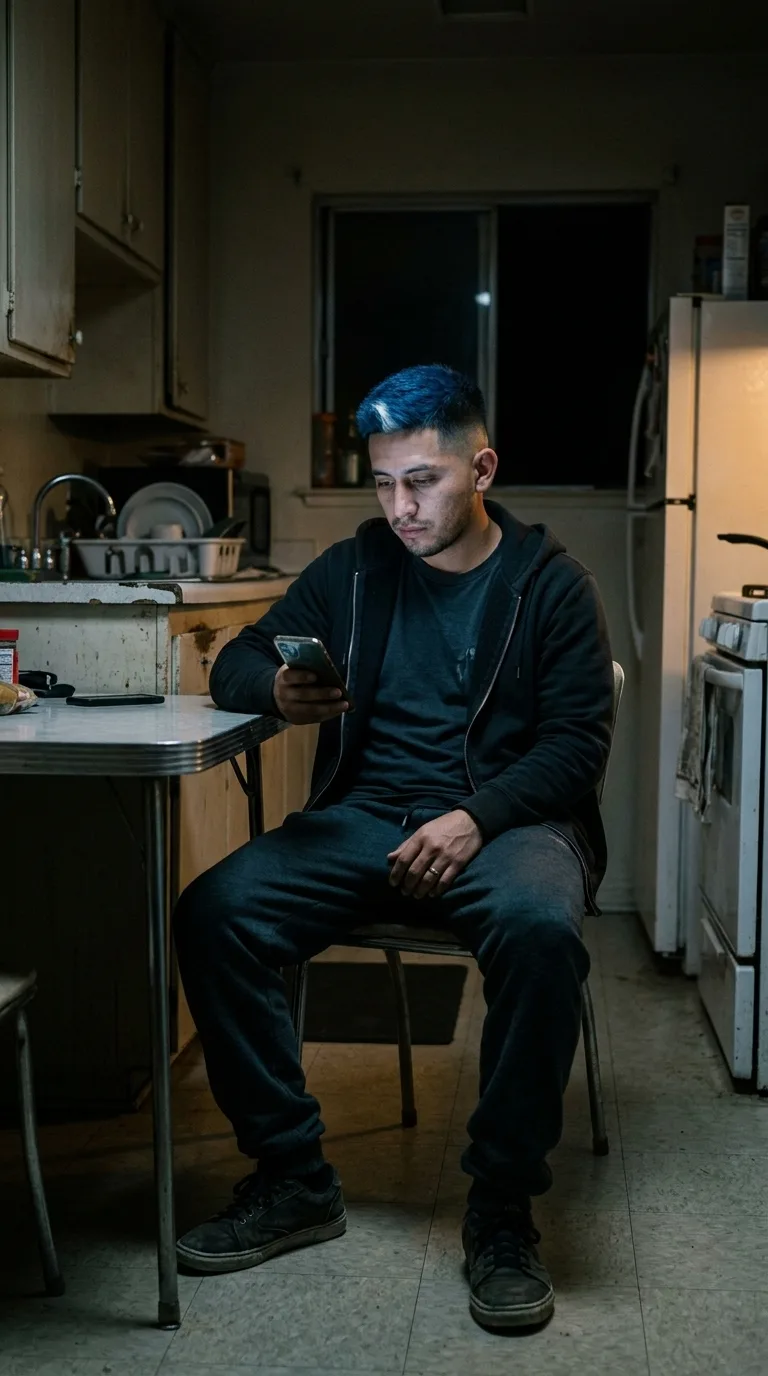
Rarest thing about him: A white streak in the hair — uncommon, 1 in 164
Season 1seed 1640584019 · engine v11
Character card
lineage 2NZHHJ
His body-swap story
@connor.waskiewicz, wearing Rohan Deshmukh, rolled the wheel on and woke up as Ismael Torres, spent 5 minutes in him, then spun the wheel and woke up as Kenji Hayashida
You are leaving Rohan Deshmukh, and he has been yours for less than a minute. His eighteen-year-old heart is still going hard. The shaved scalp is cold under your palm, and the scar in his eyebrow pulls when you frown. Small-town Ohio is asleep around you. The house ticks, a refrigerator hums somewhere below, and a dog two yards over has been working at the same bark for an hour.
Nothing is wrong with him. You wanted something and could not name it, and it was still there after you left Samer Haddad's kitchen in Chicago. You had stood at that cutting board with Samer's thick forearms and smelled onion on his knuckles. You had felt the old loyalty in his chest, the one that picks up the phone for a friend at midnight. Then you let it go, and the loyalty did not go with it. It was waiting on the other side. So the page is open again, with its wheel, and the wheel is turning. You think of a friend you only know from inside, and the wanting won't ask permission.
The wheel stops.
Kitchen. Dark. A chair under you, cold metal through thin fabric. Your thumb is on glass, lit blue-white, and a watch hangs there with a price on it that is more than a month of rent. The thumb has stopped. You lift it, and it stays lifted. The room tastes of old grease and dish soap. A refrigerator shudders against the wall. Your breath comes slow and easy, and this body is built to be tired.
Then the first thing you touch is the phone's cold edge, and it opens.
Not yours. His: a Saturday, and a woman laughing at a counter like this one, flour on her wrist. His wife. You feel what he felt, a plain astonishment that she was standing in his kitchen on purpose. The memory is warm, and it slides away, leaving the ring. Your thumb finds it, a smooth band on the left hand, a little loose in winter. Under it comes a different woman, years back, a bus stop, a door that did not open. She is the one who got away. There is no bitterness, only a small ache like a pressed bruise he checks when he is alone. He has never told his wife how often he checks.
The hoodie has a zipper pull that clicks against your sternum. It is soft at the cuffs, washed a hundred times. You drag a sleeve and the morning arrives in his hands. He pulled it from the hook by the door, because the shift ends cold. Before that came the work shirt, the buttons done bottom to top from habit, the sleeves rolled to the elbow so the extruder's heat won't cook them. Earplugs, yellow foam, looped on the cord around the neck. Gloves pushed in a back pocket. The boots with steel toes, laced tight, the left knot always double. He had stood in the dark hallway pulling them on and thought about nothing, a man with a body that knows the order of things.
The sweatpants hold the thighs, thick and quick, a body used to standing eight hours. His back is tight low, where the line wants him bent. The jaw is rough with three days of stubble, and you scratch it. The streak at the front of the hair, you can feel it somehow, like a hum. He dyed the blue himself, in a bathroom, with his wife holding the timer, laughing. She said the white streak was the part she loved. It had come in when he was nine, and nobody ever knew why.
The plastic. You smell it under everything, hot resin, the line spooling out clear and endless in front of him. He is good at it. He hates how good he is at it. He looks at watches at night because a man who runs a machine for someone else wants one thing that measures his own time.
The floor is cool through the sole of one shoe. The table's chrome edge presses your forearm, and the phone lies dark beside you, face down, and your hand does not go back to it.
You turn the hand over. It is brown and square, with scars you do not know the stories of, and the ring catches the fridge light. It is a good hand. Samer's friend would have wanted to keep it.
You lift your eyes to the dark window, where a blue-haired stranger looks back, and you say, quietly, "Okay. Let's see how long you last."
Somewhere under the quiet, the wheel is already turning.