Ismael Aguirre
Fictional. Generated by AI — not a real person, and no likeness of one is intended.
19, paramedic in Honolulu · rolled by @ismael.aguirre · card — no film
History
who has worn him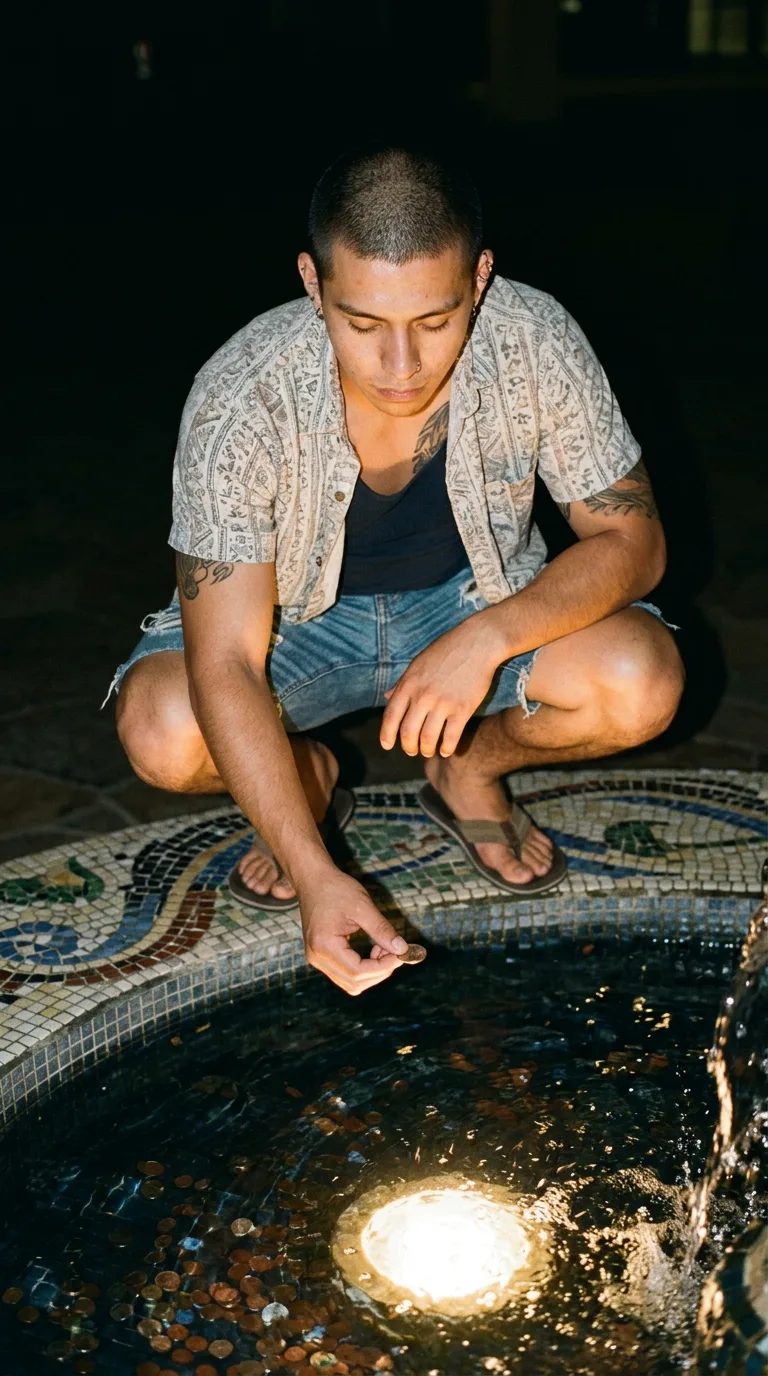
Rarest thing about him: Type 2 diabetes — epic, 1 in 68
Legacyseed 772391780 · engine v8
Character card
His body-swap story
---
You have been in the water a long time. Not the water — the wanting that gets left in water. Every coin that goes in carries a sentence, and most of those sentences are so small they dissolve. *Let her text back. Let the biopsy be clean. Let me get out of this town.* They sink and they thin out and they become part of the general ache at the bottom of the basin, and the ache is what you are. You have no name because you were never one person. You are the residue of everyone who ever paid a quarter to be someone else.
But you remember wanting. That is the whole of you. You remember it the way a dry riverbed remembers being a river.
He comes at eleven-something on a Tuesday, in flip-flops, in a thrifted print shirt over a black tank, in cut-off denim, and he squats down on the mosaic rim with his elbows on his knees like a man who's used to squatting beside people. You don't know him. You have never known anyone. He is a stranger to you and that is the cleanest way to take a thing — no debt, no history, nothing to forgive.
You watch him for a while, from under the light. He is small. Under five-four, and built like someone who lifts what he has to lift and then goes home. Buzzed to the scalp, so short the shape of his skull shows. A stud in each ear, a ring in his nose. Faded ink up both arms — you don't put it there, you only see it, the way you see the tendon in his wrist and the way he keeps his right thumb working at the skin beside his left thumbnail. Picking. Picking. He does it without knowing. There's a raw crescent there already.
He holds the coin up over the water and doesn't throw it. He just holds it and looks down and you can see him composing the sentence.
You have heard ten thousand sentences. You know the shape of the good ones.
He says it out loud, quiet, the way you say a thing when you'd be embarrassed if anyone heard: *I want to matter to somebody.*
Then he says the rest of it, which is the part that gets him. *Anybody. I don't care who. Just — somebody in there wanting me.*
The coin drops.
Here is what you know about him that he doesn't tell the water. You learn it going in, the way you learn a house by moving through it in the dark. Nineteen years old. Rides the back of an ambulance out of a station near the airport, second-youngest on the roster, and on quiet mornings he sits on the bumper with the doors open on an empty street and eats a granola bar he shouldn't and checks his glucose because his pancreas quit playing along at seventeen and nobody in his family will say the word out loud. A house up on posts in Kalihi with a tin roof gone orange at the seams and a yard of red dirt that turns your shoes red, and light so white off that dirt at noon that you squint your way to the car. Four hundred and something dollars in checking. A tin of nicotine pouches in the console. A grandmother's rosary he doesn't pray on but won't move off the dashboard, because he believes in *something*, he just doesn't believe it has a building.
No ex. Not one who mattered. That's the part you turn over. Nineteen and no one has ever put a hand on his sternum and said *stay*. He's been kissed. He's been liked. He's carried a woman down two flights of stairs on a canvas chair and held a man's head in his hands while the man asked him if it was bad, and he's said *you're doing great, brother, you're doing great* in a voice so steady the man believed him. He has mattered to strangers for eleven minutes at a time, over and over, and then the doors close at the hospital and he is nobody again in a parking lot with a mop.
That's the ache. That's the thing you're made of. You recognize your own material.
So the wish was granted, is the thing. That's what nobody understands about fountains. The wish is *always* granted. He asked for somebody in there wanting him.
He drops the coin and the water goes out in rings, and he watches the rings the way people do, waiting for the surface to settle so he can be finished, so he can stand up and go home and be a little less ashamed. The light in the basin swings. His reflection breaks into pieces and comes back and breaks again.
Everything else stills first. The gold coins on the bottom stop shivering. The fountainhead behind him keeps its noise but the basin flattens.
His face on the water is the last thing to stop moving.
And when it stops — it is already looking up. Up at him. Before he lifts his head. Before anything.
That's you. That's you arriving in the only door that ever opened.
He doesn't scream. There isn't time for scream. There's a hard bright pull, like being handed a body, and the whole of him — the tin roof, the red dirt, the granola bar, the raw crescent by his thumbnail, the grandmother's rosary, the voice that says *you're doing great, brother* — all of it comes into you at once and it is so *much*, it is so unbearably much to be a person, and it is yours for good. No term. No door back. The coin is under the water with the rest of them.
You are on the mosaic in flip-flops with your knees aching from the squat. Your heart is going. Your mouth tastes of mint and tobacco leaf. There's a low grinding thirst in you and you know, from inside him, what it means and what to do about it, and you feel a strange lurch of tenderness for the machine you've been given — this small strong nineteen-year-old thing with a sugar problem, that carries people down stairs.
You lift your right hand into the fountain light. Turn it over. Knuckles, palm. The nails bitten around, the skin at the thumb picked open. You touch the raw place and it stings and the sting is *yours*.
And you understand you did not steal a wish. You answered one.
Somebody is in there, wanting him. Wanting him so badly it walked out of the bottom of a fountain to get in. He will never know it. He will never be told. But it is true now, more true than anything he ever hoped for, and it will be true for the rest of the life you are about to live in his shoes.
You stand up. The knees crack. You go find the car.
You're going to be so good to him.