Isaiah Whitfield
Fictional. Generated by AI — not a real person, and no likeness of one is intended.
25, diesel mechanic in San Francisco · rolled by @owen.prescott · card — no film
History
who has worn him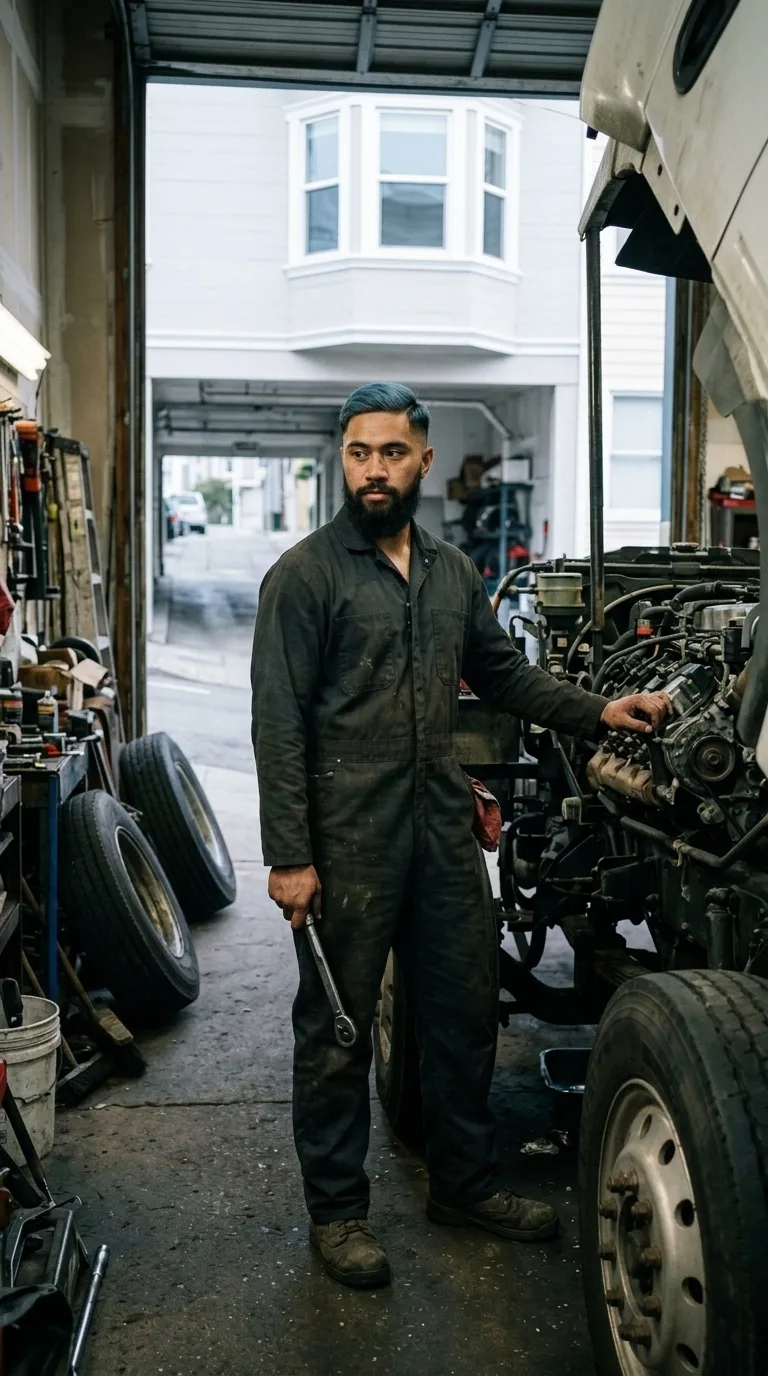
Rarest thing about him: Pacific Islander — rare, 1 in 172
Season 1seed 317779820 · engine v11
Character card
lineage 5OR92V
His body-swap story
@owen.prescott, wearing Curtis Overton, rolled the wheel on and woke up as Isaiah Whitfield, spent 1 minute in him, then spun the wheel and woke up as Ruben Salazar Ortega
You are leaving Curtis Overton, and you know exactly why, because it is in his knees. Eleven in the morning in Philadelphia, a Tuesday, and you have been him for less than a minute: the shaved head cool in the air, the beard, the heavy easy weight of a man who carries his size like a tool belt. You stood on a stairwell of a half-framed rowhouse and felt the whole of him ache on the first step up. You could not do the thing you wanted. You wanted to run. Not for anything. Just to see what a body did when you asked it. He would not go. So you set down his lunch, took out his phone, and went back to the page with the wheel on it. Your thumb knew the way.
Then the wheel stops, and the stairwell is gone.
Cold white light. You are standing, mid-reach, and the left hand is already out, flat against something warm and ticking, a diesel block that has been running and is cooling now. The right hand holds a ratchet. The air tastes of iron and old coolant, and the hour is wrong, too early, the street beyond the door still blue. Your weight settles onto a pair of boots with the soles worn flat at the outside edge. Your breath goes in deep, easy, and comes out through a beard.
The coverall comes first. The fabric across your shoulders is stiff with a hundred washings, and with it comes a morning: a dark room above a garage, a hand finding the zipper in the dark, a cousin's voice saying the church supper is Sunday, *you coming*, and him saying yes without having decided. A red rag, tucked in the right pocket the way he always tucks it. You feel him fold it. Habit, not thought.
The ratchet's handle is knurled and worn smooth in one place where his palm sits. Under it, suddenly, a phone call. A voice, a man's, Chicago in it, tired and proud and far away. *Isaiah. Just checking you ate.* Lamont. You know that voice from the inside. You wore its throat for less than a minute, you know its stairs, the way it says nothing when it means a great deal. And you feel what the son feels: a flinch that is mostly love, and a small shame about money, because he sends what he can, and what he can is not much. Scraping by. You feel the number sitting in him like a stone in a boot.
You lean your weight on the engine and the cold of the concrete climbs your shins. Another flash: a girl's laugh in a kitchen, her hairband on his wrist, then the quiet after she left, three weeks ago, a drawer emptied. It hurts like pressing a bruise you did not know you had. He did not drink over it. He prayed, badly, in the truck, and went to work.
The body is good. That is the thing you keep noticing. Twenty-five, shoulders loose, back clean, no ache anywhere, nothing that says *no* when you ask. The calluses on his fingers are ridged like rope. The hands know where the next bolt is without you.
You look down at them. You turn the right one over. The palm is black in the creases, and it is not yours, and it is warm.
You lift your eyes to the open door, the steep drive, the bay window across the way going pink with the day, and you say, quietly, in his voice, "Okay. Let's see how long."