Isaiah Toussaint
Fictional. Generated by AI — not a real person, and no likeness of one is intended.
34, prep cook in Houston · rolled by @caleb.dunham · card — no film
History
who has worn him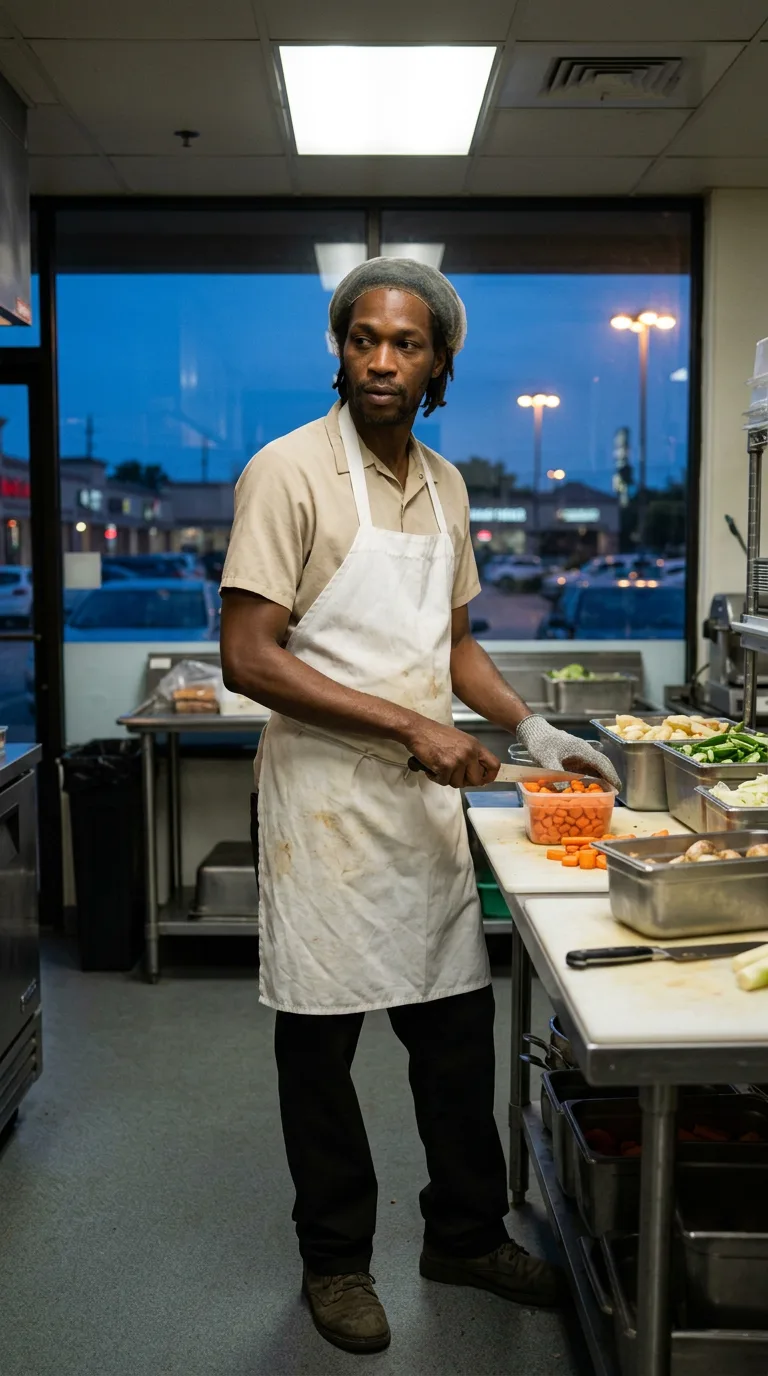
Rarest thing about him: Prep cook — common, 1 in 226
Season 1seed 1778335084 · engine v11
Character card
lineage 9IC4OB
His body-swap story
@caleb.dunham, wearing Gabriel Santiago, rolled the wheel on and woke up as Isaiah Toussaint, spent 3 minutes in him, then spun the wheel and woke up as Caleb Dunham
You leave Gabriel Santiago the way you'd leave a chair that has gone cold. Three minutes in him, and already the headset pinches his ears. His freckled forearm lies on the desk and the call queue blinks its small red number. It is Thursday night in Philadelphia, late enough that the floor has emptied. Somebody's radio mutters in the dark. He is short and thick and comfortable, and he can do everything a call center needs. That is the trouble. A woman an hour ago cried to him about her mother's insurance, and he said the script, and the script worked, and nothing in him moved. You wanted a body that would be moved. The wheel is open on the screen. You pay. You spin.
The knife is already in your right hand.
The rhythm breaks first: one cut lands crooked, the carrot skids, and your wrist corrects before you do. You do it again slowly, properly. Then ten more, each one checked, though this is a job that has not needed checking in years. The room arrives behind the blade. The light buzzes white overhead. Beyond the glass the sky has gone a deep blue and the parking lot lamps have come on, and the heat of Houston presses on the window like a palm. You are tall now. You are six foot one, soft around the middle and long in the leg, and the floor is a long way down.
The glove on your left hand is steel mesh, gritty with starch. Touching it opens something. It is a Tuesday years ago, a cut that went to the bone on a mandoline, and the chef's voice saying *the guard, Isaiah, the guard*. Shame sits in it like a stone, and the habit of the glove grew from there. Your thumb finds the worn handle of the knife. The grip is polished by ten thousand mornings. Under it comes a smaller memory, of a little girl standing on a stool to watch him dice onions, saying *Daddy, don't cry*, and him saying *it's the onion, baby*. There are three children. You feel them as a weight behind the ribs before you have any faces.
The apron strings press at your back. This morning, then: he stood in a narrow hallway and tied the apron twice because his fingers were thinking of something else. They were thinking of a woman he used to love. She called last week about nothing, about a cousin's funeral, and her voice sat in his chest all day. Before that he pulled the khaki shirt over his head, sleeves sticking at the damp of his arms, and buttoned the collar and left it open. He laced the boots that have taken the shape of his feet. Now your toes ache in them. Your lower back has the dull heat of the fifth hour standing. Your knees are thirty-four years old and know it.
You crack your knuckles without deciding to. The pop runs up the tendons, and with it comes church: a hot Sunday, a fan on a stick, his mother's hand on his neck, a hymn he knows to the last word. He has not smoked in six years, and your mouth still wants it. Containers of diced celery and peppers and mushrooms sit around you, cold at the edges, smelling green and wet. Someone paid for this order of squares. It is the most honest work you have ever stood inside.
You lay the knife down. You turn your hand over under the white light and look at it, the thick pads of the fingers, the calluses along the first knuckle, the dark of the palm. It is a whole man's labor, and he is gone out of it. You raise your eyes to the glass, where a tall stranger in a hairnet looks back.
"All right, Isaiah," you say, low. "Show me."
Nothing answers. The lamps buzz. You do not know whether the wanting will come back by morning, or by the time these carrots are done, or whether it already sits somewhere behind your breastbone, waiting like the next cut.