Howard Kenji Pomeroy
Fictional. Generated by AI — not a real person, and no likeness of one is intended.
53, pharmacist in Honolulu · rolled by @connor.waskiewicz · card — no film
History
who has worn him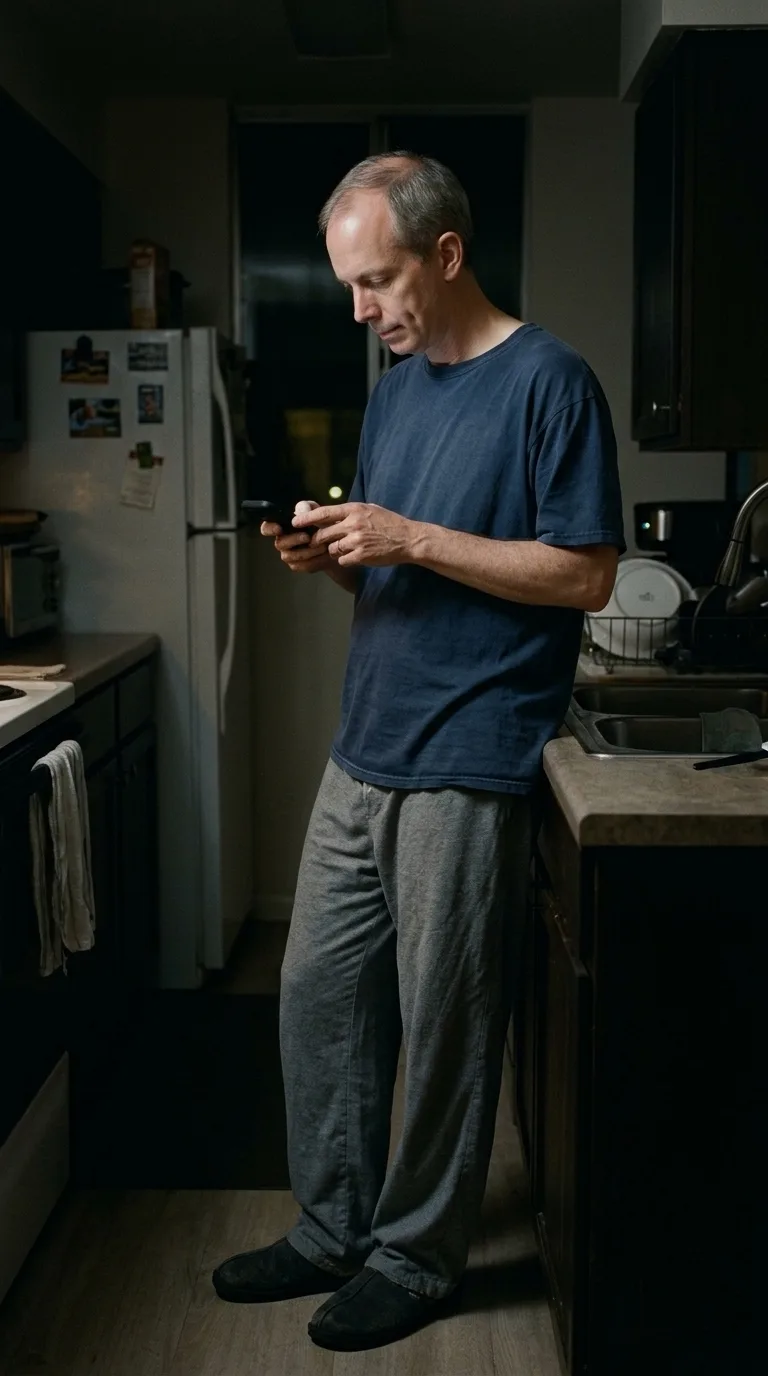
Rarest thing about him: Pharmacist — uncommon, 1 in 714
Face-off rating 1501 · not ranked yet
Season 1seed 828531299 · engine v11
Character card
lineage 2NZHHJ
His body-swap story
@connor.waskiewicz, wearing Ramón Aguilar Ledezma, rolled the wheel on and woke up as Howard Kenji Pomeroy, spent under a minute in him, then spun the wheel and woke up as Andrés Quintero
Honolulu is a man leaning against his own counter in the middle of the night, and before him there is Kentucky, early, and Ramón Aguilar Ledezma's kitchen, and the cold coffee I have not drunk. Ramón lasted under a minute. That is the whole complaint. I had him, I stood in his socks on his linoleum with the call center headset still hanging on the doorknob where he'd left it, and the phone on the table showed me the tab I'd closed three times. A wheel. A little arrow. I wasn't unhappy in him. His knees were fine. His beauty mark itched when I touched it. I just heard the headset's hollow tick against the door and knew that a whole day of reading scripts to strangers was waiting inside that body, and I could not do it. So I press the thumb down. I pay. The wheel turns, and I stop being a man who hates a headset.
A kitchen, dark. I am leaning on a counter edge, hip against laminate, and a thumb of mine has just lifted from glass. The screen shows a watch, and under it a price bigger than a rent. I set the phone face-down. The click of it on the counter is the first sound I make in him. My breath comes slow and low in a soft belly. The air smells of dish soap and old smoke.
The shirt is the first thing. Navy cotton, washed thin, soft against my back, and it opens a morning for me: his arms going into the sleeves in the dark bedroom so the light wouldn't wake her, left arm first because the left shoulder pulls, the collar catching on the thin hair at his crown. He smoothed it down over his stomach and disliked it and did it anyway. Not today, that was another day. The same shirt, a hundred days.
The pants are gray, drawstring, loose. Under the cloth the thighs are soft, and my hand finds the pocket and a lighter is there, and with it comes the whole of the pack a day: standing on a back step in the red-dirt yard under the white glare, the first drag at six, shame and relief braided, his father's cough somewhere in it. Quit drinking, he did. Eleven years ago. The lighter remembers that too, a thumb on the wheel, steady, proud of nothing.
My left hand on the counter, a plain ring. Cool metal, worn narrow. I turn it with my thumb and a woman comes up out of it: asleep in the next room, her back to the door, and him standing in the hall in the dark just listening to her breathe. Twenty-six years. A daughter, one, grown enough to roll her eyes in a text. Mass on Sundays because it is a habit that has become a place to sit. He loves them in a flat, plain, enduring way, like a floor.
Slippers, felt-soled, worn through at the left heel. The floor is cool beneath them. Then the counter again, and the amber bottles: thirty years of counting by fives with a spatula, the small rule of it, the decency of getting a stranger's pills right. The dimples are in him even now, I feel them in my cheeks, unasked, at rest. People trust that face before he speaks. He hates the watches because he wants one thing that is only for him. Savings, a little, tucked away, never touched. Tonight he scrolled instead of sleeping, and nobody knows.
I lift my hands and look at them. Pale, square-nailed, clean. The ring. I turn them over. The palms are dry from sanitizer. They already know how to count.
I raise my eyes to the dark window, to the face in it with its dimples, and say, "Well. Hello."
How long, I wonder. The kitchen hums. Nothing in me has started wanting yet.