Héctor Salcedo
Fictional. Generated by AI — not a real person, and no likeness of one is intended.
47, tow truck driver in Chicago · rolled by @colin.hasbrook · card — no film
History
who has worn him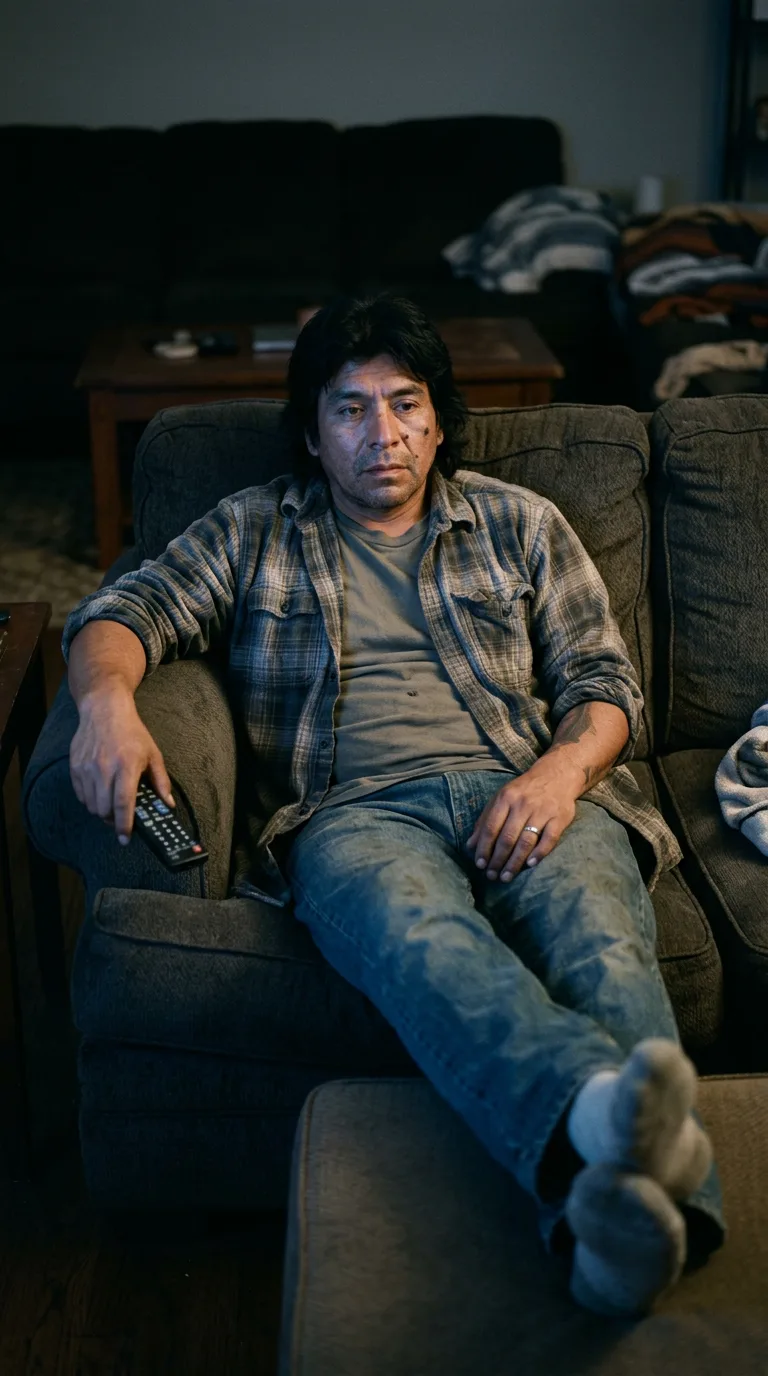
Rarest thing about him: Grown out between cuts — uncommon, 1 in 31
Season 0seed 1474767787 · engine v10
Character card
lineage 2NZHHJ
His body-swap story
@colin.hasbrook, wearing Dylan Marchetti, rolled the wheel on and woke up as Héctor Salcedo, spent under a minute in him, then spun the wheel and woke up as an unnamed body
Three minutes is not long enough to learn a florist's hands, but it is long enough to know you don't want them. You stand in Dylan Marchetti's kitchen in the dark, twenty years old and gap-toothed and light on his feet in a way that feels borrowed, phone light washing his face, and you already miss the weight of somebody older. Twenty is a body still deciding what it is. You spun into him fresh off wearing a man who filled a doorway, and now you're standing in a boy who blushes when the shop's regulars flirt with him — you caught that in the first flash of him, unbidden, embarrassing — and you think, not this, not tonight. Three minutes of him is enough to know he is not going to hold your interest until sunrise, and sunrise is a long way off, and you are wide awake, and the site is right there, glowing, patient, a wheel that never sleeps because you never let it.
So you spin.
The screen goes bright and it takes you somewhere else entirely — into a body already sitting down, already still, already exhaling. The television light is blue-white and moving across a face that isn't the one you had a half-second ago. There's a remote in a hand that sets it down on the couch arm without your telling it to, an old habit finishing itself before you've caught up to owning it. Weight settles into you all at once: heavier through the middle, shorter, the couch cushion sagging in a shape it knows. Wool socks. A show laughing at something on the screen — canned laughter, a rerun — and the mouth on this face does not join it. It joined the joke a minute ago. Now it doesn't.
The flannel is what gives you the first of him — worn thin at the elbows, warm from his own body heat, and through it comes a flash of a laundromat on Kedzie, quarters lined up on top of the machine, him folding this exact shirt into a duffel bag sixteen years ago, younger, thinner, before the wedding band. Then the shirt again, more recently: him buttoning it this morning — no, not morning, whatever hour this was for him, dressing in a lit bathroom while everyone else in the apartment slept, because his shift starts when the city's asleep and ends when it's waking up, and somewhere in the last decade and a half day and night traded places on him and never traded back. He remembers the mirror. He remembers thinking he looked older than he expected to, every single time he looks, like the mirror keeps a different calendar than he does.
The tattoo on the inner forearm comes hot and specific the second you notice it under the sleeve, black-and-gray, a woman's face — his mother, and you know it the way he knows it, not because anyone told you but because his whole chest does something when he thinks her name. Reyna. Dead nine years. He got the ink four months after the funeral in a shop on Cicero that smelled like Pine-Sol and cigarettes he never smoked himself, sat through three hours of it without making a sound, because pain that means something is easier to sit still for than pain that doesn't.
The ring is next — plain, left hand, and it drags a whole marriage up through your fingers like pulling a chain hand over hand. Marisol. Nineteen years. A fight about money in a car outside a Jewel-Osco that ended with both of them crying and neither of them able to say why. Her hand on the back of his neck on nights his blood pressure spikes and his own pulse scares him a little, though he'd never say so out loud, because his father died of exactly that kind of quiet and Héctor has spent forty-seven years trying not to inherit the silence along with the numbers. A son — Mateo, seventeen, taller than him now, which still surprises Héctor every single time the kid walks through a doorway.
The couch itself gives you the flatbed — not this couch, the truck, the long cold shoulder of the Kennedy at three in the morning, sodium lights, his breath fogging while he hooks a chain under a stalled sedan's axle, a stranger crying in the driver's seat about being late, always somebody crying about being late. Thirty-one years he's driven tow, and his knees know the pavement the way his hands know the winch. He goes to Mass some Sundays, when the shift lets him, sits near the back, doesn't take communion every time, doesn't examine why. Doesn't drink much. Never smoked — tried once at nineteen and it made the leg under him bounce even worse than it already did, and it's been bouncing his whole life, right now, right this second, heel going against the floor under a body that doesn't know yet that it isn't only his anymore.
The show cuts to a bright ad frame. In the half-second of white light his spine straightens without your telling it to — an old reflex, sitting up for something that used to matter, a program he loved before you were the one watching it. He does not laugh at the next joke. He watched the whole rest of it, the facts insist, without laughing where he laughed before, and you understand now that that absence is you: a five-second gap where Héctor Salcedo should have been and wasn't, and nobody in the room to see it, no one awake in the apartment to notice the quiet where the sound should be.
You look down. The hand that was his lifts off the couch arm, turns over in the blue light, palm up, then palm down, calloused across the base of the fingers, a white worn line where the ring has sat for nineteen years. You look up into the dark room, into the television's glow, and past it, at nothing, at whatever a camera would be if there were one.
"Where's the rest of it," you say — his voice, rough with disuse, asking a question that isn't really about the show.
You don't know how long you get to keep asking things in it.