Hassan Tarazi
Fictional. Generated by AI — not a real person, and no likeness of one is intended.
44, operations manager in El Paso · rolled by @connor.waskiewicz · card — no film
History
who has worn him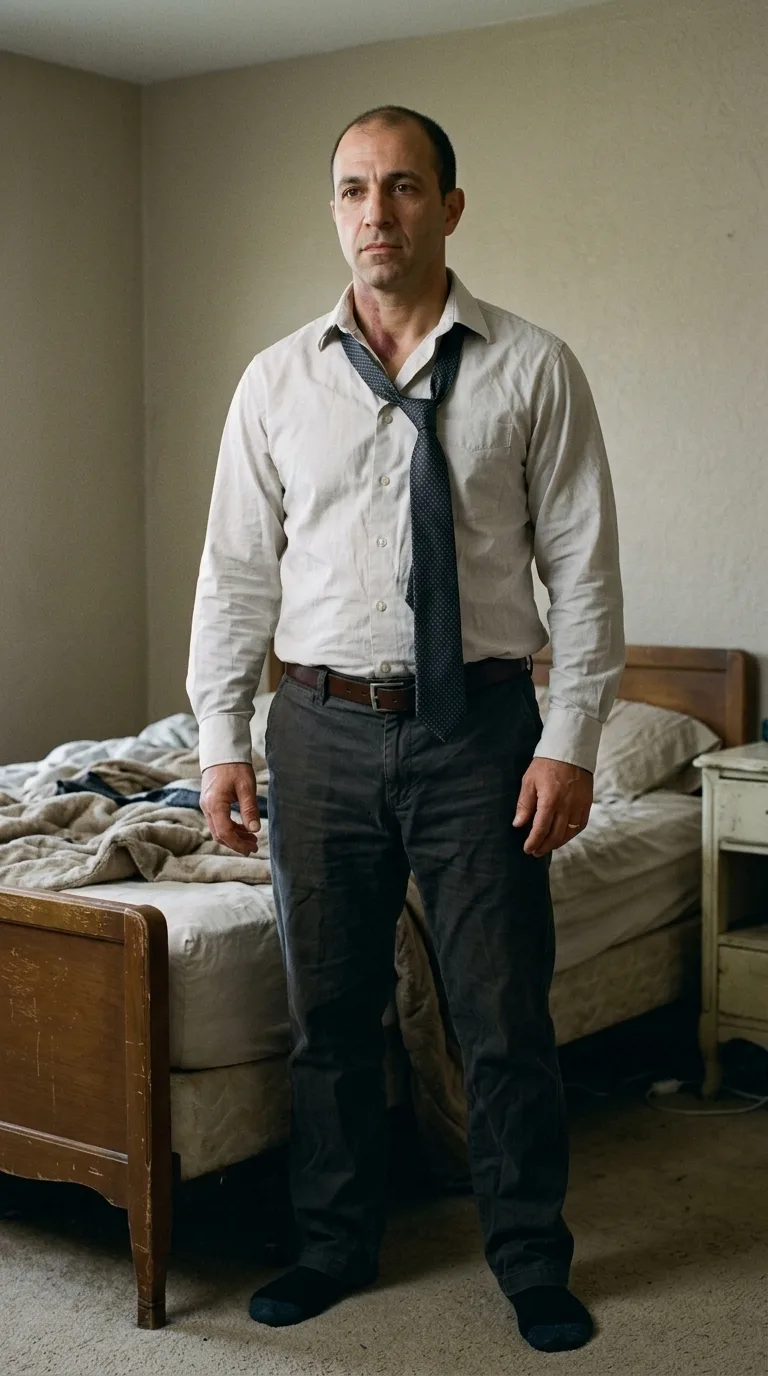
Rarest thing about him: Hookah, a few times a year — rare, 1 in 231
Season 1seed 1553151933 · engine v11
Character card
lineage 2NZHHJ
His body-swap story
@connor.waskiewicz, wearing Sunil Parekh, rolled the wheel on and woke up as Hassan Tarazi, spent under a minute in him, then spun the wheel and woke up as Nathan Pruett
You are standing in Sunil Parekh's kitchen with his coffee going cold in his thick hand, and you have already decided he is not enough. He has been yours for less than a minute. His knees ache on the linoleum. His belly presses the counter's edge. Through the window the Ohio morning is flat and white, a neighbor's mower is starting, and the whole day stretches out ahead of him: the route, the loading dock, the clipboards signed on the hood of a van. It is a perfectly good life. You do not want it. What sent you back is small and you will not say it even to yourself. A thing you reached for in him, a wanting you thought would come with the body, and it did not come. So the phone is in his hand, and the wheel is turning, and you set down the coffee because you are going.
Then you are standing at the foot of a bed with your hand reaching for a button.
The hand stops flat against your chest. Under the cotton you feel ribs, a hard drum of muscle, a heart going steady and slow. The room is dim and cold, and the carpet is rough through thin black socks. Early. The window has not yet decided on a color. The shirt is buttoned wrong by one, and your fingers, which tremble faintly, a fine tick you did not ask for, undo it and run the buttons back up correctly. The tie hangs loose at your collar. You knot it in a way you have never seen, a thick small triangle, and your hands do it without you.
Then the body starts giving him up through what it touches.
The shirt against your back is the first. Sleeve by sleeve: him at this same bed, in the dark, pulling the left cuff over the wedding band, careful not to wake her. The shirt was ironed last night. His wife did it, humming something, and he stood in the doorway watching and said nothing, which was how he said most things. The collar scratches the birthmark on your neck, and with it comes a boy of nine in a schoolyard, a hand pointing, a word, and the long habit of turning that side of his face away from rooms. A woman once put her mouth on it and said it was the best thing about him. That was not his wife. It was before. Her name surfaces, a cold lemon smell, and then he shuts it, a drawer pushed closed in his chest, and you feel how often he has pushed it.
The belt buckle is warm. The belt brings the floor: forklifts beeping, a mezzanine walkway humming under his boots, the whole distribution floor spread below like a river of pallets, and his pride in knowing where every one of them was supposed to be. Thirty-one people answer to him. He remembers a night he stayed until four to fix a shipment that was not his fault, and no one ever said thank you, and he did not need them to.
The carpet gives you the prayer rug that is rolled in the corner. Your feet know its place. Your shoulders remember the shape of kneeling before this light comes. He prayed already, you understand, in the dark, in the cold, his forehead against the wool. The calm of it is still in the body like heat in a stone. The ache in his lower back belongs to forty-four years. The strength in his arms belongs to a gym he goes to without telling anyone why.
The house keeps coming through your soles, the turquoise paint, the chain-link, the dust gone white in the sun. A hookah, twice a year, laughter on a roof. No children. A quiet room at the end of the hall that you feel him not walking past.
Now you lift your hands. The tremor is there, gentle, steady, a small tide. You turn them over, the ring a plain gold line on the left. They are not yours. Nothing of him is left inside to mind. You raise your eyes to the dim window, to the glass holding a faint ghost of the face, the dark mark along the jaw, and you say, in a voice lower than any you have worn, "All right. Let's see what you were."
Somewhere under it the wanting is already a pulse, small and patient. You do not know whether it will be an hour or a year. You only know your hands are shaking, and that you cannot tell if it is his or yours.