Harun Lim
Fictional. Generated by AI — not a real person, and no likeness of one is intended.
45, contractor in New York · rolled by @yusuf.brannick · card — no film
History
who has worn him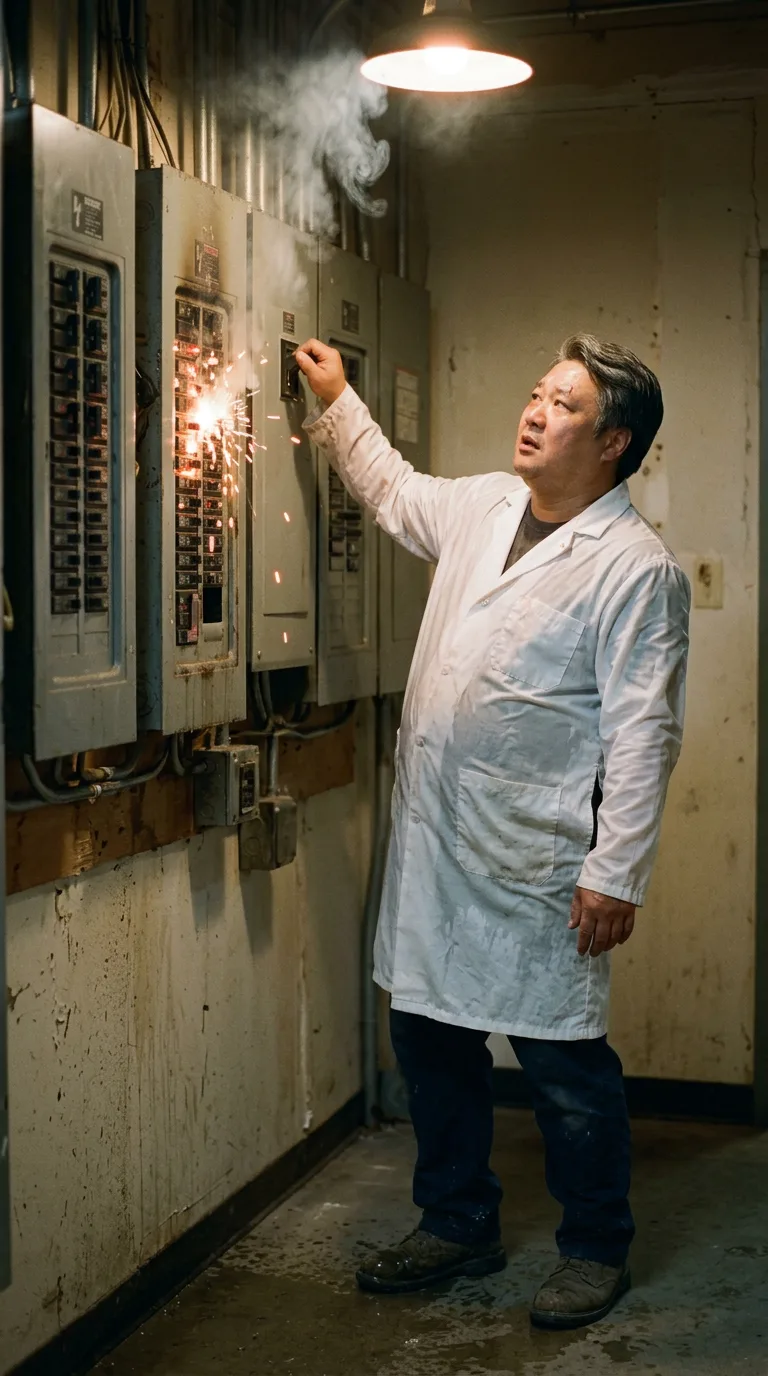
Rarest thing about him: Muslim — rare, 1 in 41
Legacyseed 660344742 · engine v8
Character card
His body-swap story
---
You had been nothing for a while. Not dead — nothing is different from dead — just weather in a place with no sky, pressure without a body to press. You were a wanting with no mouth. That is the whole of what you were until the storm came down the conduit of a sub-basement in Sunset Park and gave you a door.
You do not know him. That matters, so hold onto it: he is a stranger. You did not pick him out of a crowd, you did not follow him home from a bar he never went into, you did not wait outside a school gate to watch him carry a kid on his shoulders. You had no plan. There was a hole punched in the world by four hundred amps and he was standing in the hole with his sleeve wet, and you went in the way water goes into a boat.
Here is what you learn in the first half-second, before you have learned how to think in his skull: he is heavy and he is warm and he is soaked through. The lab coat is not his. Someone in the building handed it to him because the ceiling was raining onto the panels and the coat was the only thing dry within reach and now it isn't. Under it he is wearing his own clothes, work pants gone black at the knees, boots with a rime of joint compound on the toes. He is not a scientist. He is the man they call when the building is old and the drawings are lies. He was up on the third floor framing an office for people who will one day argue in it, and the storm found a roof seam, and someone screamed down the stairwell about the panels, and he came.
You feel him reach. You feel the tendon go tight in the back of his forearm, the callus at the base of the middle finger sliding on the hot enamel of the breaker handle. You feel the exact amount he is afraid, which is: correctly. Not a hair more. Sparks are coming out of the panel like something spat and he is not running, because he has three children under one roof in a brownstone off Fourth Avenue and running is not one of the things he does. You feel him look up at the smoke going into the joists, and his mouth open, and you feel the syllables start in his chest — the beginning of a word in a language he learned in a mosque on Eighth Avenue, said fast, the way a man says it when he does not have time for the whole of it.
Then the white.
It comes from behind you both, and for one beat he goes rigid — every muscle at once, jaw locked, shoulders up, the way a man goes when the current has him and the current is you. One beat. Then he sags. There is a sagging, and it is the most terrible thing you will ever be inside of, because it is him leaving, and he leaves the way a room empties: all at once, and then a long time afterward you keep finding places he was.
And then you straighten up.
*Oh,* you think, in his head, with his tongue lying heavy behind his teeth. *Oh.*
You lift the hands and look at them. The sparks are still going. You do not care about the sparks. You are looking at the hands, at the fingers with their nails cut down to nothing and a hairline of gray dust in every crease, at the thickness of them, the meat of the palms, the way the skin has been rubbed and rebuilt so many times it is more like a tool than a covering. Somebody made these over twenty-five years. You get them for free. You turn them over, then over again, and you laugh — one flat sound out of a chest that has never laughed like that, and it goes up into the burning smell and the sparks and nobody hears it because there is nobody down there but him.
Then you throw the breaker, because you can feel that his arm already knows how.
---
The rest is learning.
You have his body and nothing else. Not his memory, not his loves, not the names. This is the part nobody understands: you didn't take a life, you took a machine that a life had been driving, and the machine has habits and no instructions. So you go up the stairs and a man in a soaked hoodie grabs your shoulder and says *Harun, you okay, you okay?* and you find out your name from a stranger, standing in an inch of water.
You find out the rest one ambush at a time.
You find out about the scar because a woman touches it. Later, in the dark, in a bedroom that smells like cocoa butter and radiator dust, her thumb goes to the place above your right eye where the eyebrow stops and starts again, pale, a little furrow you can feel from the inside like a seam in drywall. She does it without thinking. It is clearly a thing she has done a thousand times, the way another woman would push hair off a forehead. And she says, *You were quiet tonight.* You are seeing her for the second time in your existence and she has been seeing him for four years. You say the storm shook you up. She believes it. She goes to sleep with her hand on your arm and you lie there in a stranger's weight, in a stranger's heat, listening to the throat close.
That's the other thing you find out. Sleep apnea. He has a machine on the nightstand, a hose and a mask and a hum, and the first night you don't use it because you don't know what it's for, and you learn what it's for at three in the morning when the body wakes itself up choking, sitting bolt upright in the dark with the heart going like a nail gun. Twenty-two years of breath he took for granted and this is the toll on it. You put the mask on the second night. You lie under the hum with your eyes open and think: *he had to do this every night of his life and he did it and got up at five.*
You find out about the children by being outnumbered. Three of them, and the oldest is old enough to look at you sideways. Kids don't check facts, they check frequencies. The middle one says *Baba, you're being weird* and you say *I'm tired,* and it works, and the shame of it working sits in his stomach — your stomach — like a swallowed coin.
You find out about God on a Friday, when the body walks itself half a block in the wrong direction before you catch it, toward a door it has gone through every week for a decade. So you go in. You take your boots off. You stand in a row of men in a room with green carpet, and you don't know a word of it, and you follow the man in front of you a half-second late, down and up and down, and nobody notices because you are a big man with gray hair and a scar in his eyebrow and this is his place, everyone here is sure of that. And at the bottom of it, forehead on the carpet, you understand that you have stolen something with a shape you cannot see the edges of.
You find out he never drinks. You find that out by pouring one, in the kitchen, at midnight, out of a bottle somebody gave him for a job well done and he kept sealed in the back of a cabinet for six years — and putting the glass to your mouth and stopping. Not because of him. Because of you. Because there is a whole man's worth of habit in the arm and the arm did not want to. You pour it in the sink. Nicotine, same. You reach for a cigarette one afternoon out of some old muscle of your own and the hand doesn't know the shape and the lungs don't want it and you think, all right. All right. He gets to keep that.
---
You are doing well. That's what the accountant says in April, and you have learned enough by then to nod like a man who already knew: three crews, a truck that's paid off, money in the wall of the brownstone, a number in the middle six figures. He built that with the hands you're using. You keep the crews on. You have gotten good at the work — you had to, it was the only way not to be found out, and now you'd almost say you like it, the framed-out floors with the sawdust turning gold in the window light, the smell of new pine, the sound of a nail going in true.
Nights, though. Nights you sit on the stoop when the rain's just stopped and Fourth Avenue is orange under the sodium lamps and the wet street is throwing all that light back up at you, and you touch the eyebrow. The seam. You do it now the way she does, without thinking. You never asked how he got it. There is no one you could ask who wouldn't find the question strange, and so it stays in the body as a fact with no story, a hole where a whole afternoon of some man's life used to be — a fall, a swinging board, a kid brother, who knows.
There's no way back. There was never a door behind you; there was only the one storm and the one hole, and it closed when the panel died. For good, forever, until this heart gives out and takes both of us. You did not choose him and you cannot give him back and the terrible arithmetic of it is that you are grateful — that the thing you would have taken from him is the only thing you now have to lose.
So you get up at five. You put the mask on at night. You say the words on Friday, badly, from the outside. You carry the youngest one up the stoop when she falls asleep in the car, and she puts her face in your neck like you're him.
You are not him.
Every morning you shave a stranger's jaw in a stranger's mirror and the eyebrow with its pale interruption looks back at you and you think the same sentence, always the same one, the closest thing you have to a prayer of your own:
*Somebody made these hands. I'll try not to ruin them.*