Harold Yee
Fictional. Generated by AI — not a real person, and no likeness of one is intended.
64, probation officer in Nashville · rolled by @colin.hasbrook · card — no film
History
who has worn him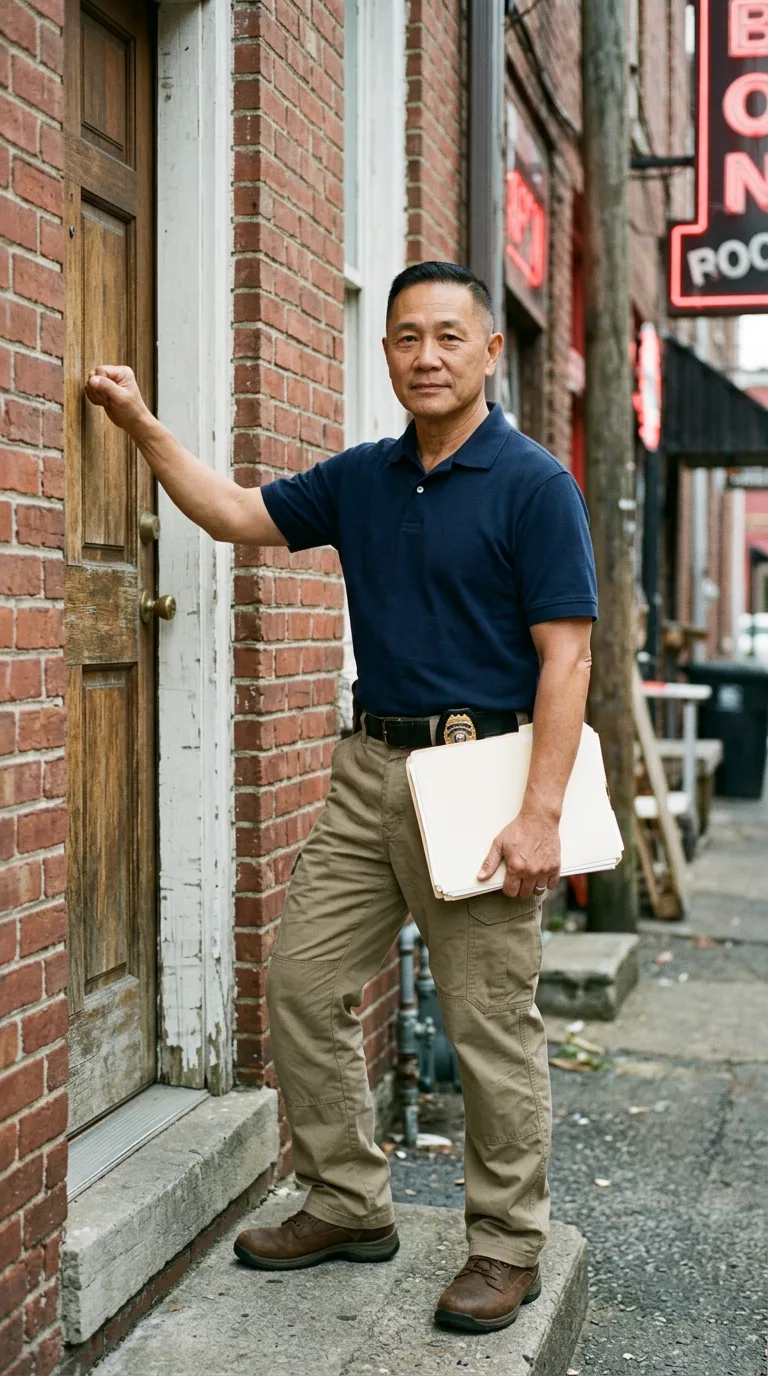
Rarest thing about him: Probation officer — uncommon, 1 in 2,438
Season 1seed 1605749888 · engine v11
Character card
lineage 2NZHHJ
His body-swap story
@colin.hasbrook, wearing Faisal Rehman, rolled the wheel on and woke up as Harold Yee, spent under a minute in him, then spun the wheel and woke up as Kevin Shortall
The lunch rush hasn't started and Faisal's restaurant already smells like burnt garlic from a pan the new boy ruined an hour ago, and you are standing in the office behind the kitchen doing the thing you have done seven hundred and sixty-six times before: staring at a laptop screen with a wheel on it, feeling Faisal's gut strain the buttons of his shirt, feeling how tired his feet are after less than a minute of being him. That's the trouble. Less than a minute and already the tiredness of a stranger's whole life is sitting in these feet, and you know — the way you always know now — that this one is not going to hold your interest. Not the restaurant, not the wife who calls twice a shift, not the knee that clicks on the stairs. You paid for a man and got his exhaustion for free. So your thumb — his thumb, doughy, a little swollen at the knuckle — finds the trackpad, and you spin again before you've even let yourself decide to.
The knuckle stops an inch from a door made of old brick-red wood, mid-knock, and the fist belongs to you now.
It's smaller than Faisal's, browner, a wedding band cutting a thin line of white into the base of the finger. There's weight under the other arm — a folder, thick, the cardboard gone soft at the corners — and a badge is biting a little into the hip through khaki. The knock that was already three-quarters finished completes itself without you, knuckle to wood, once, twice, and something in you that isn't quite a hand but wants to be checks the motion halfway through the third rap and does it again, slower, correct, like a man double-checking a lock he already locked.
The folder against your ribs is the first thing that opens. Paper corners, a stack of them, and a name on the tab you can't read but somehow already know the shape of — Whitfield, a name you've written eleven times this month in the same slanted hand — and behind it comes the smell of the office three blocks from here, fluorescent tube light, coffee gone bitter on a burner too long, a supervisor named Deb who laughs too loud at her own jokes. You've had this desk fourteen years. You've had this street corner, this stoop, this particular door with its paint peeling in long tongues, maybe four times before, for four different men on your caseload, and the door always looks a little surprised to see you, the way doors do when nobody's painted them since a Bush was president.
The polo shirt is next — cotton warm from your own morning skin, sleeves you rolled your own forearms into an hour ago in a bedroom with the blinds still down because Linh sleeps later now that the kids are gone and you like to let her. You remember buttoning it, top button first, an old habit, your father's habit, though your father wore starched white shirts to a job that had nothing to do with this one, a job in a different country, in a different decade, that you only half remember and mostly through him. You remember choosing the navy over the gray because Tuesday is a court day and gray makes you look like you're already tired of the room.
The belt is snug in a way it wasn't ten years ago; you remember standing in front of the mirror at fifty-four thinking that and at sixty deciding to stop minding. Your knees are fine. Your right shoulder aches faintly in cold weather from a fall on ice outside the office in 2019 nobody remembers but you. Your hands — small, neat, a barber's hands, someone once told you, though you've cut nothing sharper than a pen cap in years — already know this folder's weight without looking, already know the particular give of a screen door versus a solid one, already know, before your mind catches up, that this house belongs to a nineteen-year-old named Marcus Whitfield who missed his last two check-ins and whose grandmother, if she answers, will lie to you gently, and you will let her, the way you always do, because thirty years of this work taught you that most lies at doorways are just love with nowhere else to go.
Somewhere under all of it, quieter, is Linh's voice this morning, half-asleep, telling you not to forget the Wilkins file, and under that, quieter still, an old apartment on a street you haven't lived on in decades, a girl named Carol who used to wait for you outside a different building entirely, whose laugh you can still hear better than you can hear your own wife's some mornings, though you have never told anyone that and never will. Two kids, grown now, scattered to Memphis and Ohio, a photo of them somewhere in your wallet against your hip, soft at the corners same as the folder.
The pen. Your right hand is already moving without you toward the breast pocket where it always rides, already wanting to click it, the small satisfying give and snap that has outlasted three marriages of coworkers and one heart scare of your own — and it does that now, click, click, a small percussion against the quiet of the alley, the neon sign down the block bleeding pink across brick that hasn't caught the daylight yet.
You look down at the hand doing it. Not yours. Small, olive-brown, a wedding band, a badge catching a little dull gold light at the hip, and you turn it over once in the space in front of your own eyes like you're checking it for a crack.
"Nobody's home yet," you say to the door, to the alley, to no one, your voice lower than you expected, steadier than the man who owns it probably deserves credit for feeling this morning — and you lift your eyes off your own palm into whatever is watching, and you hold there, waiting to see if this is the one you keep.