Harold Nakashima
Fictional. Generated by AI — not a real person, and no likeness of one is intended.
65, lawyer in El Paso · rolled by @colin.hasbrook · card — no film
History
who has worn him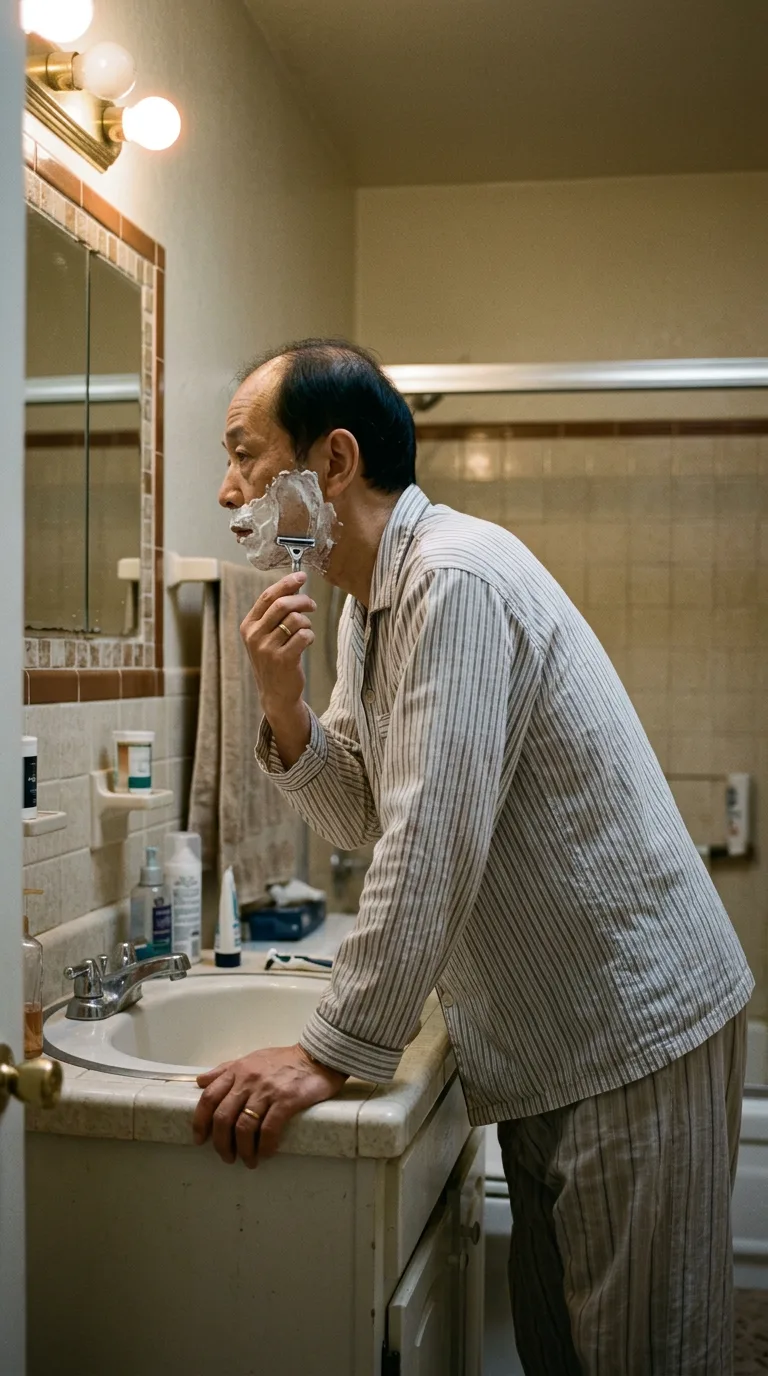
Rarest thing about him: Lawyer — rare, 1 in 76
Season 0seed 1025079747 · engine v10
Character card
lineage 2NZHHJ
His body-swap story
@colin.hasbrook, wearing Greg Palladino, rolled the wheel on and woke up as Harold Nakashima, spent 2 minutes in him, then spun the wheel and woke up as Brian Kessling
The socket wrench is still warm in Greg Palladino's hand when the boredom hits you, sudden as a popped fuse. Two minutes in this body and you already know its whole shape: the ache in the lower back from a job under a sink, the itch of drywall dust behind the ears, a wife texting about milk. Thirty, green-eyed, a scar through one eyebrow from some bar fight that isn't even yours to remember properly. Fine hands. Nothing wrong with him. That's the trouble — nothing wrong, nothing interesting, a Monday morning stretching out flat as the desert past the strip. You set the wrench down on a customer's counter you'll never finish crossing to. You already have your phone out. Fifty-two before this one. There is no reason for fifty-three except that the wheel is right there, glowing, patient, and you have never once in your life let a thing be enough.
You spin.
The razor is already moving when you arrive, up along the jaw, against the grain, no hesitation at the corner of the mouth — his hesitation, not yours, skipped clean over because you weren't there to have it. Foam on half a face in a mirror lit by two bulbs over a tiled sink. A hand — thin-fingered, spotted faintly at the knuckle, a wedding band loose enough to catch light — finishes the stroke and lowers the razor to the basin, and for one whole second you are only weight: the lean of him over the counter, the give in a lower back that has stood at courthouse steps for forty years, the small tremor already starting in the fingers before you've told them to do anything.
Then the shirt gives you the first of it.
Pajama cotton, striped, worn soft — and it comes back through your shoulders like a held breath let out: this exact shirt, this morning, buttoned crooked once and redone, because his hands shook on the second button the way they always do lately and Aiko didn't say anything, just reached over at breakfast and fixed it without looking up from her tea. Forty-one years of not being looked up at while she fixes something. It isn't unkindness. It's a marriage worn to the smoothness of a stair tread.
The mirror gives you more. Not an image — a whole year: the office on Mesa Street with his name on frosted glass, HAROLD S. NAKASHIMA, ATTORNEY AT LAW, and under it the smaller good years, the ones where immigration cases came in steady and grateful and he'd come home and not talk about any of them, because talking about them was Aiko's job now, retired, filling the turquoise house with sound so he wouldn't have to. Two children raised and gone — a son in Austin who calls on Sundays like a man paying down a debt, a daughter in Portland who doesn't call as often and doesn't need to, because some closeness doesn't require it. He misses her more and never says which one he means.
The porcelain under your — his — forearm, cool and faintly chipped at the lip, gives you the blood pressure medication in the cabinet behind the mirror, two pills swallowed dry most mornings because a glass of water felt like effort he didn't want to spend before coffee. Gives you, underneath that, the quieter fact he has never told the doctor in so many words: that some mornings the tremor is worse, that he watches his own hand sign documents and thinks, not now, not yet, and goes back to work anyway, because the alternative is admitting the shape of what's coming.
The tile floor under bare feet gives you the temple on Alameda, incense smoke thinning up through a shaft of El Paso light, an afternoon twenty years back when a case he lost — a family, deported, a boy about his son's age — sat on him so heavy he drove there without deciding to and sat until the sitting did something the losing hadn't undone but had made bearable. He goes back three, four times a year. Never tells Aiko exactly why on the days he goes.
The razor itself, set back down, gives you nothing dramatic — just forty years of this same three minutes, half his face and then the other half, the callus of routine so deep it barely counts as memory at all, which is its own kind of tenderness, the sheer unremarked repetition of a life.
You feel the weight distribute wrong through this frame after Greg's — shorter, softer through the middle, sixty-five in the knees and the low back and the eyes, which sting faintly from the foam's edge. Nothing hurts exactly. Everything is simply tired in the specific way of a man who has been careful with his body for decades and it has started, gently, to stop listening.
You lift both hands from the counter and look at them — spotted, ringed, trembling their small private tremor whether you will it or not — turning them over slow under the bathroom light like you've never seen the backs of your own knuckles.
You look up into the mirror, into brown eyes that are not remembering you yet and never will.
"There you are," you say, to no one who is still in there to hear it.