Grant Delahoyde
Fictional. Generated by AI — not a real person, and no likeness of one is intended.
47, accountant in Dallas · rolled by @grant.delahoyde · card — no film
History
who has worn him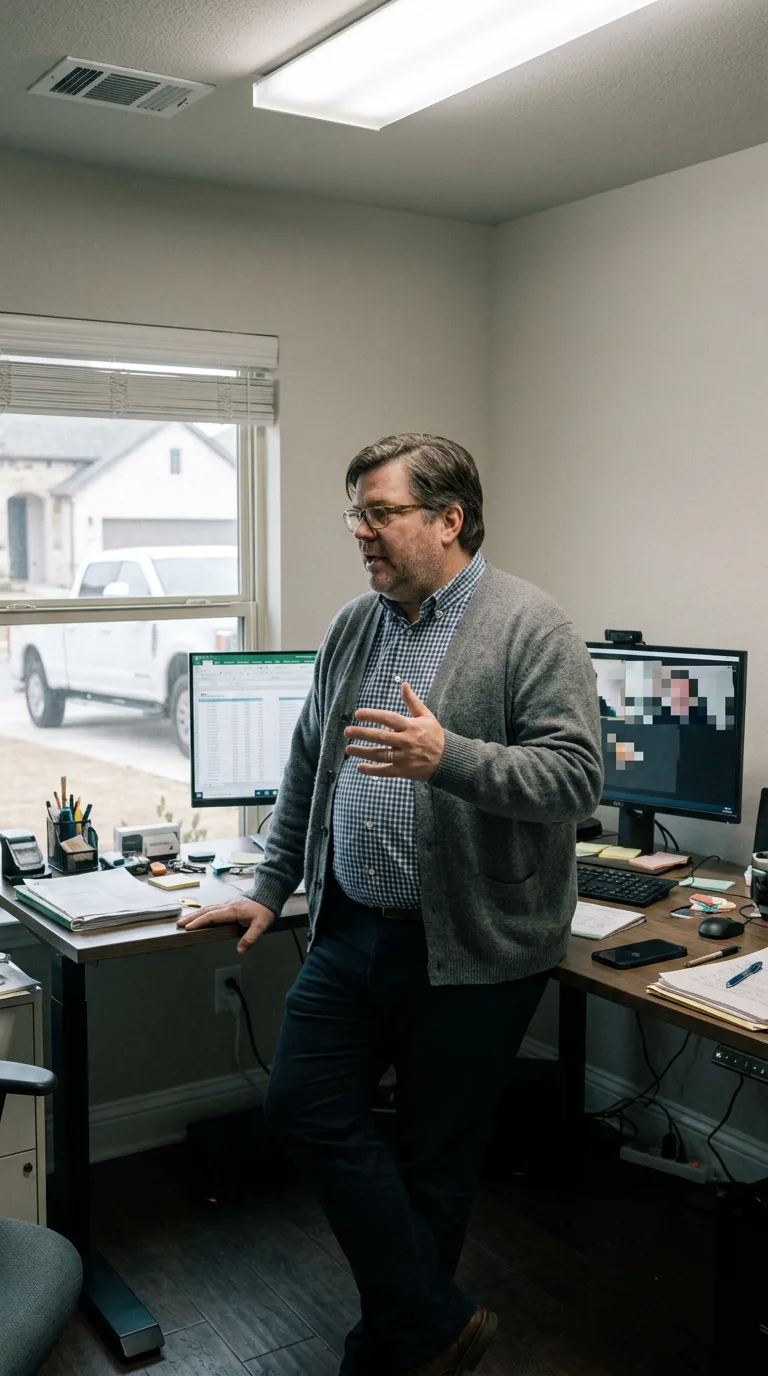
Rarest thing about him: Covers the gray — rare, 1 in 10
Legacyseed 1495980864 · engine v8
Character card
His body-swap story
---
You have been watching him for eleven minutes and he has not once looked at the camera.
That is the thing about a video call. He looks at the screen, at the numbers, at the little rectangle of himself in the corner that he keeps checking without knowing he checks it — chin, hair, the hard part combed over the roots — and never at the black eye above it. So he never looks at you. You are the pixelated square at the edge of his frame, a face broken into tiles, a bad connection on a Tuesday afternoon in a subdivision where every roofline is the same roofline. He apologized for your video quality. He said, *no worries, I can hear you fine,* in a voice with more Dallas in it than he probably wants.
You do not know him. That is the whole point. You didn't choose him for anything he is. You came down the wire looking for a room with a door that shuts, and here is a room with a door that shuts: bonus room over the garage, wood-look flooring, one window, a white pickup parked in the drive with its nose to the glass. Fluorescent panel in the ceiling, the kind that makes everyone look like a photocopy of themselves. Two monitors. Amortization schedule on the left, you on the right.
You notice: he stands up to talk. He can't stay in the chair when he's explaining. He pushes back and leans his hip on the desk edge and works his right hand in the air like he's shaping the number out of clay for you, and his left hand stays down by his thigh with the wedding band on it, plain, worn thin at the bottom where he turns it. He clicks the pen when he goes quiet. Click. Click. A metronome for a man thinking.
You notice: forty-seven and it shows only in the temples and the way he holds his breath at the top of a staircase. There is nothing remarkable about him. Nothing at all. No mark, no scar, no story written on the outside. He is a man who dyes his hair a flat brown you can tell is dye, who quit drinking so long ago it isn't a story anymore either, just a thing he doesn't do. Somewhere in a filing cabinet of him is an ex-girlfriend whose birthday he still knows the date of and would never say out loud. Somewhere downstairs is a wife. Somewhere is one kid, old enough now that the house is quiet in the afternoon.
Half a million, maybe closer to a million, in retirement and equity and the boring genius of a man who understands compound interest. High blood pressure he manages. A pill in the morning. A blood pressure cuff in the drawer with the pens.
He says, *So if you look at row forty, that's where the timing difference —*
The call freezes.
His hand is still up in the air, shaping. His mouth is still open on *timing*. The tiles of your face at the edge of the frame stop moving and then they do not stop moving so much as stop *being* tiles, and they slide, and they blur, and the blur is the shape of a head, and the head is his.
The screen goes black.
And his face stays lit.
That is the part you will remember, if remembering is still what you do: the light on his cheek with nothing left to make it. The window is grey. The fluorescent is above and behind. And still there is a glow across the bridge of his glasses, up under his jaw, in the wet of his blue eyes — coming from a monitor that is off, from a call that has ended, from you, arriving.
His head goes back. The pen leaves his hand and you hear it hit the floor somewhere behind the chair and roll.
Then he is standing in his own body with his hip against the desk edge, and he is not there anymore, and I am.
You take the first breath and it is *heavy*. That is the word. Nobody warns you. The chest is a room you've been let into with the furniture already arranged — the pulse a fraction quick and high in the throat, the knees carrying more than knees should, the small ache in the lower back from a hundred thousand hours in a chair. The glasses are a surprise. Everything past four feet is a rumor and everything inside four feet is unbearably clear.
You look at your hands.
The left one first, because of the ring. You turn it over. Palm, back, palm. The band sits in a shallow groove that the finger has grown around it, and you know without being told that it does not come off easily anymore, and that he liked that. You can feel the groove. You can feel where his body kept a record of a promise he made when he was twenty-four and thinner and had his own hair color.
His whole life is in this hand and none of it is in your memory. That is the arrangement. You get the body and the pressure in the temples and the taste of the coffee he drank an hour ago and the way the hand wants — right now, unprompted, of its own accord — to reach for the pen that isn't there and click it.
You let it reach. Nothing there. The fingers close on air and open again.
For good. That's the term, and there isn't one. No door behind you, no ticket back, nothing on the other side of the black screen but black screen. Downstairs a dryer buzzes. In a minute someone will call his name up the stairwell and you will have to answer to it, and you will, and it will not sound wrong, because it is his throat and his tongue and his flat Dallas vowels, and the only person who could ever have told the difference is the one who just left without saying anything.
You lift your eyes off the hand and look for the camera. Find it. Small black eye on the top bezel, above a dead screen.
Eleven minutes he didn't look at you.
You look now.