Glenn Hartsfield
Fictional. Generated by AI — not a real person, and no likeness of one is intended.
62, manager (mid-level) in Rural Texas · rolled by @connor.waskiewicz · card — no film
History
who has worn him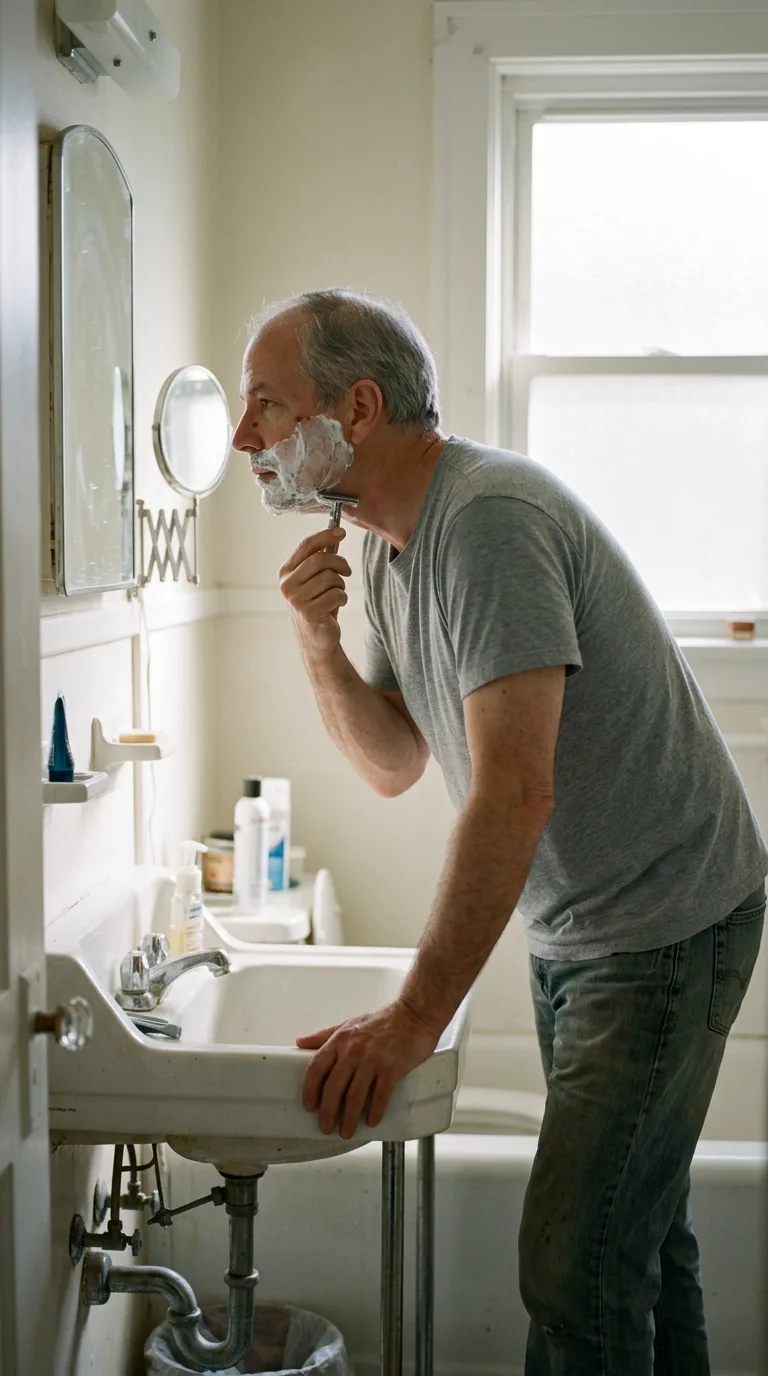
Rarest thing about him: Shaving — common, 1 in 29
Season 1seed 1424307996 · engine v11
Character card
lineage 2NZHHJ
His body-swap story
@connor.waskiewicz, wearing Douglas Perrin, rolled the wheel on and woke up as Glenn Hartsfield, spent under a minute in him, then spun the wheel and woke up as Walt Pruitt
You are leaving Douglas Perrin because of a lunchbox. It is Tuesday noon in his kitchen, and you have been him for less than a minute. You open the cupboard and find a child's thermos, dinosaurs, dented, and you know whose it is only because the cupboard tells you: a boy at school, a pickup at three, a whole afternoon already owed. His wife's handwriting is on the fridge. You are fifty-eight and five foot eight, and the house wants you to be a father until the light goes. You did not pay for this. You wanted a man who was not waiting for anybody. You close the cupboard softly, and you go back to the page with the wheel.
Then the spin, and then the cold.
Water is running. Foam is drying tight on the left side of your face. A razor is stopped against your jaw, and your leg is bouncing, already bouncing, the knee going on its own against the sink's porcelain lip. You are bent forward, the weight of a tall man hanging off a straight arm. Your fingers are on the basin's edge. Your fingers move the razor.
It goes up the jaw against the grain, and at the corner of the mouth it does not stop. Something in the hand expected to stop there. It goes through anyway, and the second half of the face is done faster than the first.
Then the things come in, through the skin.
The porcelain under your palm is cold and gritty at the rim, and it gives you a house. A farmhouse, the sink older than he is, bought with the place. He wanted a new vanity for eleven years and never did it, because the old one was where his mother had washed her hands. The feeling is stubbornness, soft at the bottom.
The razor's weight is the handle, plain steel. A drugstore blade, and the same brand since he was thirty, because a man at his first job told him cheap blades were for people who did not mind bleeding. He minds. His whole life he has minded.
The gray T-shirt on your back is soft and worn at the collar, and it opens the morning: his arms going through the sleeves in the dark, the head through the neck hole, one hand smoothing the front of it flat, then the jeans, the left leg first, always the left. It is his day off from the glass office. The door there stands open all day, so they can see him being fair. Today he is not being watched, and he is shaving anyway, because a man should be clean on a Tuesday when no one is looking. He thinks that, in words.
The jeans are stiff at the knee. Under them the left knee aches in a long dull line, and the lower back pulls when you lean. Sixty-two years. The bones know it. The hands are big, knuckled, and sure.
Then the cuff of the shirt, and a church: a folding chair, a woman's laugh two seats down, the hymn number on a board. A hand he did not take. Her name comes up whole, and the loss comes up with it, unreasonable and quiet, thirty years of it kept like money. He has the money too, a number in a drawer that he never spends on anything but nothing. He is lonely in a way nobody has ever once been told.
You set the razor down on the sink. You do not look in the mirror yet. You look at your hands.
They are not yours. They turn over, wide and weathered, a pale band where nothing has been, a mole you can feel on the cheek without touching it. You lift your eyes to the glass, and the foam, and the man in it.
"Well," you say, in a low Texas voice that is not yours. "Hello, Glenn."
Your knee keeps bouncing. You do not know how long he lasts. You listen for the wanting to come back.