Gerardo Luis Pineda
Fictional. Generated by AI — not a real person, and no likeness of one is intended.
39, food delivery courier in Atlanta · rolled by @caleb.dean.whitfield · card — no film
History
who has worn him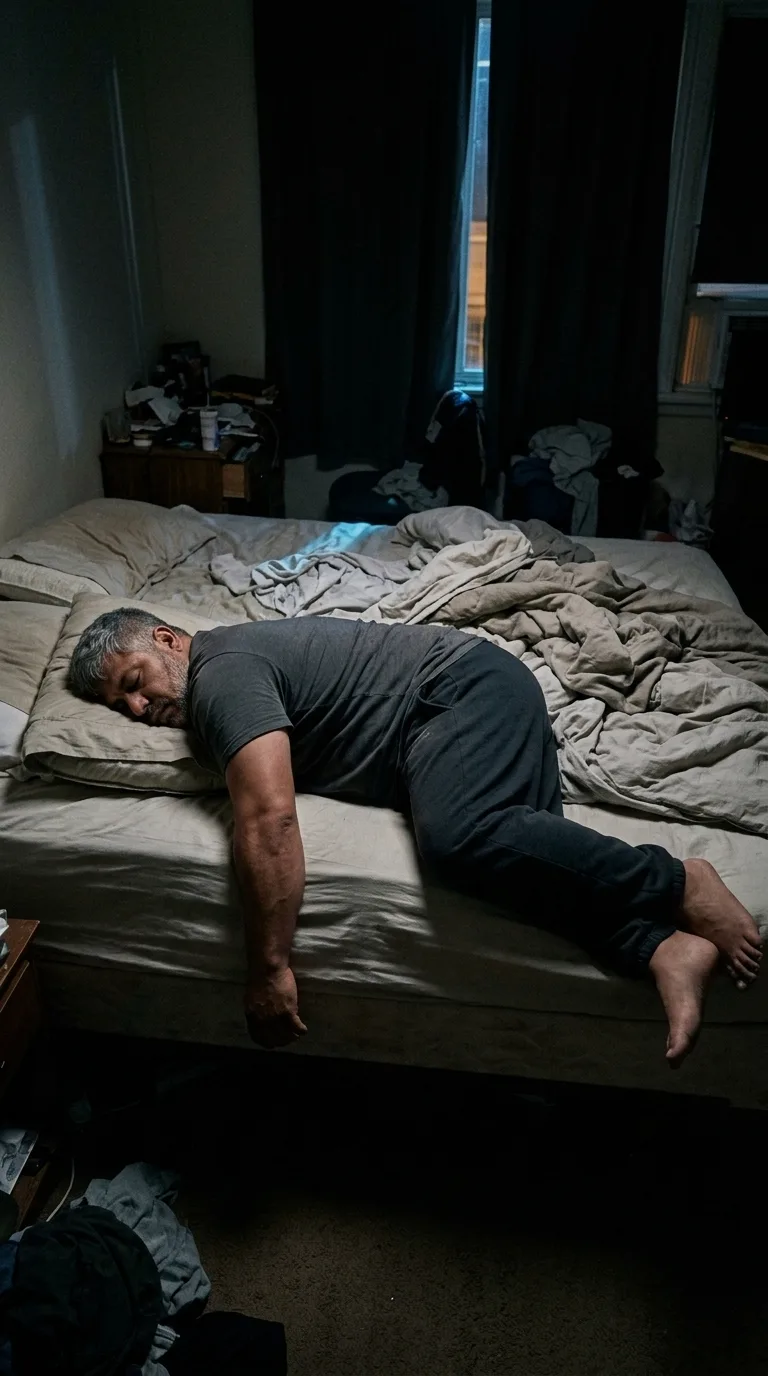
Rarest thing about him: Unitarian or liberal faith — uncommon, 1 in 165
Season 1seed 1959891193 · engine v11
Character card
lineage A8GP7H
His body-swap story
@caleb.dean.whitfield, wearing Alberto Quiñones Rivera, rolled the wheel on and woke up as Gerardo Luis Pineda, spent under a minute in him, then spun the wheel and woke up as Dennis Paul Thibodeau
The first thing you do, standing in Alberto's kitchen in Pittsburgh with the stove light on and the whole house asleep, is notice that his knees do not hurt. They should. He is fifty-eight, and the aide work has been at him for thirty years. Lifting, turning, the long patience of other people's bodies. But the knees are quiet, and it is the quiet that bothers you. He is a good body. He has a gentle way of standing that old women trust.
The trouble is the dishes. Twenty minutes ago you stood at his sink with a plate in your hand, and his thumb found a chip in the rim and rubbed it, and a whole woman came up through the thumb: a client, Mrs. Dabrowski, her last week, how he had learned to hum so she would stop being afraid. It was his feeling, not yours. It filled the kitchen. You stood there crying a stranger's grief over a plate. You have done this twenty times. You are not meant to be moved by the ones you wear. Something in you went cold and practical and said: you could be someone with no one in him at all.
So you sit at his table with his phone, and the wheel is already turning under his chewed-down thumb.
Then there is no kitchen.
There is a mattress under your chest and a pillow pressed to your cheek, and your breath is ragged, dragging through a nose that is stuffed with heat. The air is thick enough to drink. A streetlight lays one bar of orange across the sheet near your face. One arm hangs off the bed and the blood has gone out of it, a dead weight swinging at the shoulder. Then your breath evens out in a single pull, and the arm comes up on its own, and you roll onto your back, and your hands fold on your chest.
You did not choose that. It is only the body settling, as if it had been waiting for a guest.
Now the sheet. It is cotton gone thin, twisted around one ankle, and it gives you him at once: a laundromat on a corner, the dryer that eats quarters, him folding this very sheet badly against his chest because there is no one to hold the other end. Nobody to say your corners are wrong. He had laughed at that, alone, in the fluorescent light.
The T-shirt on your ribs is soft with washing. It gives you the morning he pulled it on: the left sleeve first, always, because the right shoulder clicks, then the head, then the tug down over a belly he has stopped apologizing to. He is muscular under the fat, thick through the thighs from years of pedaling, and the thighs hum now, still full of the day, a warm ache that lives in the quads and will not leave till he is sleeping.
Your thumb goes to your mouth without you. Teeth find the edge of the nail, already bitten to the quick, and a memory comes with the small sting: his mother's kitchen, her hand slapping his gently away from his mouth, *Gerardo, ya*. Her voice. The smell of onions. He is nine and the nail tastes of salt.
The pillow smells of cigar. Not stale. A good cheap one, smoked on the back step on Sundays, the single luxury. It opens the night he quit drinking: pouring a bottle of rum down the sink in this same heat, standing there, feeling absurdly proud, then sitting on the cul-de-sac curb at dawn with the smoke going straight up in the dead air. A neighbor's sprinkler ticked. He had thought, quietly, *I am all right.* Then he had gone to deliver other people's dinners.
The pants are loose cotton at your waist, the drawstring knotted the way he knots it. The bike is out there in the dark, and your calves know it, twitching toward a pedal. Ahead of you the mornings fan out like a hand of cards, rain on the insulated bag, the app chiming. Eleven thousand dollars in a savings account that he checks the way other men check a pulse. A Sunday chair in a plain room where nobody asked him to believe anything, and he liked that, and he sat in the back.
None of it is yours. It stays on him like weather.
You lift your hands into the streetlight. The knuckles are wide, the nails ragged, the calluses hard across the palms from the grips. You turn them over. They are warm. They are waiting for you to tell them what to do.
You look up at the ceiling, and then at nothing, at the dark that has no one in it, and you say, low, in a voice that has a different rasp than the last one, "Okay. Hello."
The sprinkler ticks outside. You wonder, not for the first time, how long a man like this lasts, and when the wanting comes back, and whether this hand is still yours when the light changes.