Gary Truesdell
Fictional. Generated by AI — not a real person, and no likeness of one is intended.
43, paramedic in Chicago · rolled by @marco.villagrana · card — no film
History
who has worn him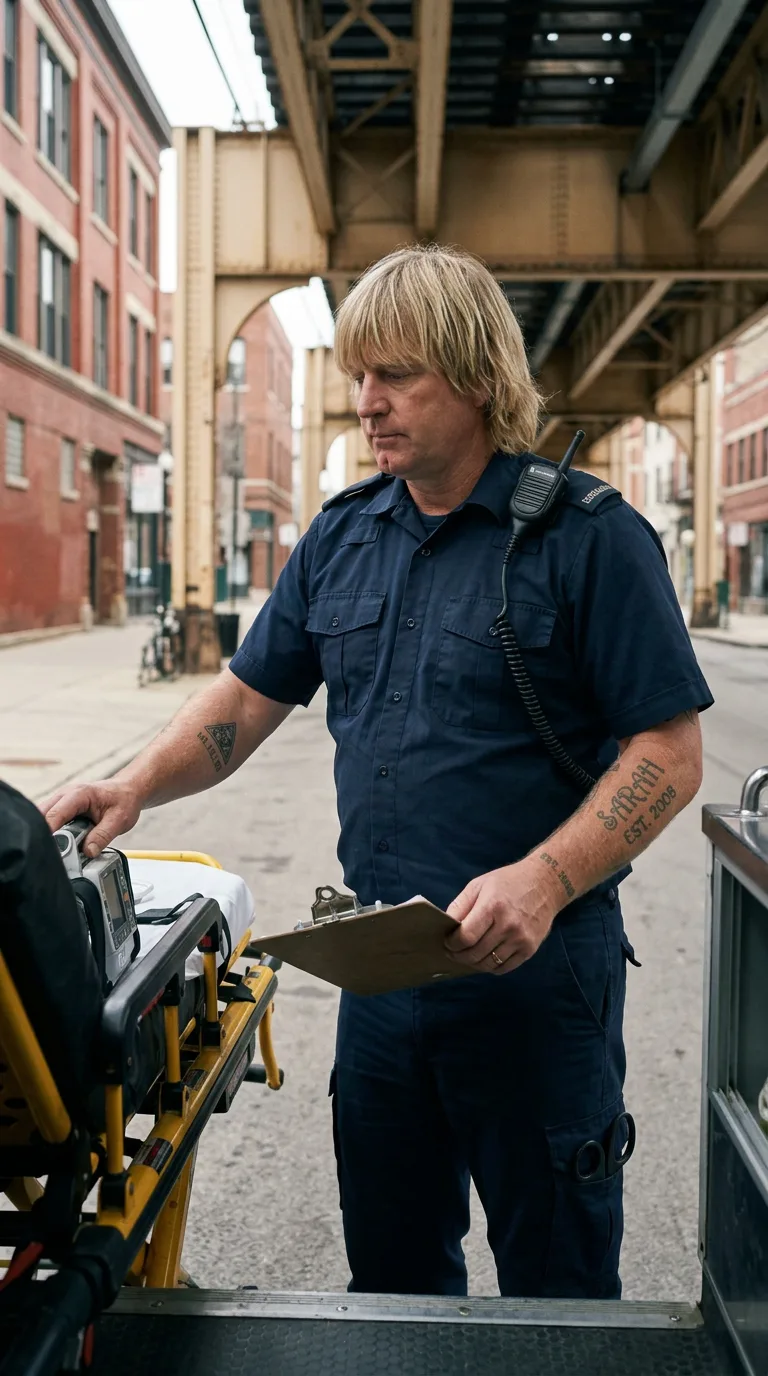
Rarest thing about him: Buried — $100k+ underwater — epic, 1 in 376
Season 0seed 1050168021 · engine v10
Character card
lineage LJL8SV
His body-swap story
@marco.villagrana, wearing Tommy Kessler, rolled the wheel on and woke up as Gary Truesdell, spent 3 minutes in him, then spun the wheel and woke up as Owen Kaczmarek
Tommy's hands smell like the diner griddle three floors down, garlic and burnt butter, and it is eleven in the morning on a Sunday and you are sitting on the edge of his unmade bed with a phone in his grip, and the gray beauty mark above his knuckle keeps catching your eye like a smudge you want to wipe off. Five minutes. That's all he's been. You already know the shape of the boredom coming — you spun for him wanting muscle and a garage and a Brooklyn walk-up, and you got it, and it turns out being a stocky twenty-nine-year-old mechanic on a Sunday morning is mostly just sitting on a bed smelling garlic. There's a woman's voice down the hall, not his, somebody's roommate, and the day stretches out flat as a driveway. You are not attached. You were never going to be attached in five minutes. Your thumb is already on the site before you've decided anything, which is its own kind of decision, and the wheel spins the way it always spins, cheerful and indifferent, and lands on a name that means nothing to you yet.
The rhythm breaks mid-motion — a hand (yours now, not yours yet) reaching to pull the strap across a stretcher and missing the buckle, fumbling, then doing it again slow and correct, like a man relearning a thing he has done since Bush was president. You are standing at the open back doors of an ambulance, girders and brick going up gray-gold overhead, the L quiet on a Sunday, no train yet. There's a clipboard in the other hand, cardboard soft with old sweat. Air is cold enough to sting going in. You did not choose Chicago, or Sunday, or this body's width, which surprises you first — more give at the stomach than you're used to, a low persistent ache behind the beltline you don't understand yet, not pain exactly, just weight, wrongness, a stone somewhere doing what stones do. Ten checks come out of the hands that follow, each one deliberate, each one double-checked, on straps and latches that have not needed double-checking in eleven years.
The shirt against your back gives it up first — the cotton gone thin at the shoulder blades from a hundred washes, and with it: a Sunday morning three years back, him buttoning this exact uniform in a bathroom with a cracked tile, humming nothing, Sarah still asleep, before Sarah was the ex and just the woman down the hall who made coffee wrong on purpose to annoy him. The name on his arm was for her, ten years old this fall, EST. 2008 in narrow serif letters he picked himself at nineteen, before he understood ink outlasts feeling. He got the mortgage the same year he got that tattoo's twin cousin — the triangle, some biohazard joke from paramedic school, MELISSA underneath it, another woman, before Sarah, and both women gone now and both names staying, because removing them costs more than the marriage did. The ring is the newer memory: his wife Denise, second marriage, quieter, steadier, a woman who doesn't ask what the tattoos mean anymore. You feel, through his fingers turning the clipboard over, the hundred nights of paperwork on this exact stretch of street, the partner who used to ride with him and doesn't anymore, transferred to a house on the South Side, missed like a tooth. You feel, low, constant, unglamorous, the stone. Kidney stones — plural, recurring, the reason he stopped drinking anything but water years ago though he never drank much to start, the reason his hand goes to his face when he's not thinking, thumb pressing under the cheekbone the way you press a bruise to see if it still hurts. Underneath the uniform: a gut he's stopped fighting, forty-three years in a body that still does the job anyway, shoulders that know the exact weight of a stretcher without looking, a cleft in his chin that Denise used to run her thumb along before bed, a small unremarkable tenderness he doesn't remember choosing to love. He goes to Mass with her some Sundays, not today, today he's on shift because somebody has to be, and he doesn't mind it, the quiet ones, the half-empty ambulance bay under a track that won't see a train for twenty minutes.
You look at the hand on the clipboard — thicker than Tommy's, softer, a plain band catching gray morning light, script letters climbing out of the cuff toward the elbow — and you turn it over slowly, watching it not quite obey you yet, watching yourself relearn a face you're not wearing but living behind.
"Sarah," you say, out loud, to no one, and it isn't a question and it isn't yours, it's just the first word his mouth makes before you get all the way inside it, and then you stop, and look up the empty street, and wait to see how long you get to stand here.