Gary Petrowski
Fictional. Generated by AI — not a real person, and no likeness of one is intended.
47, manager (mid-level) in Pittsburgh · rolled by @colin.tarwater · card — no film
History
who has worn him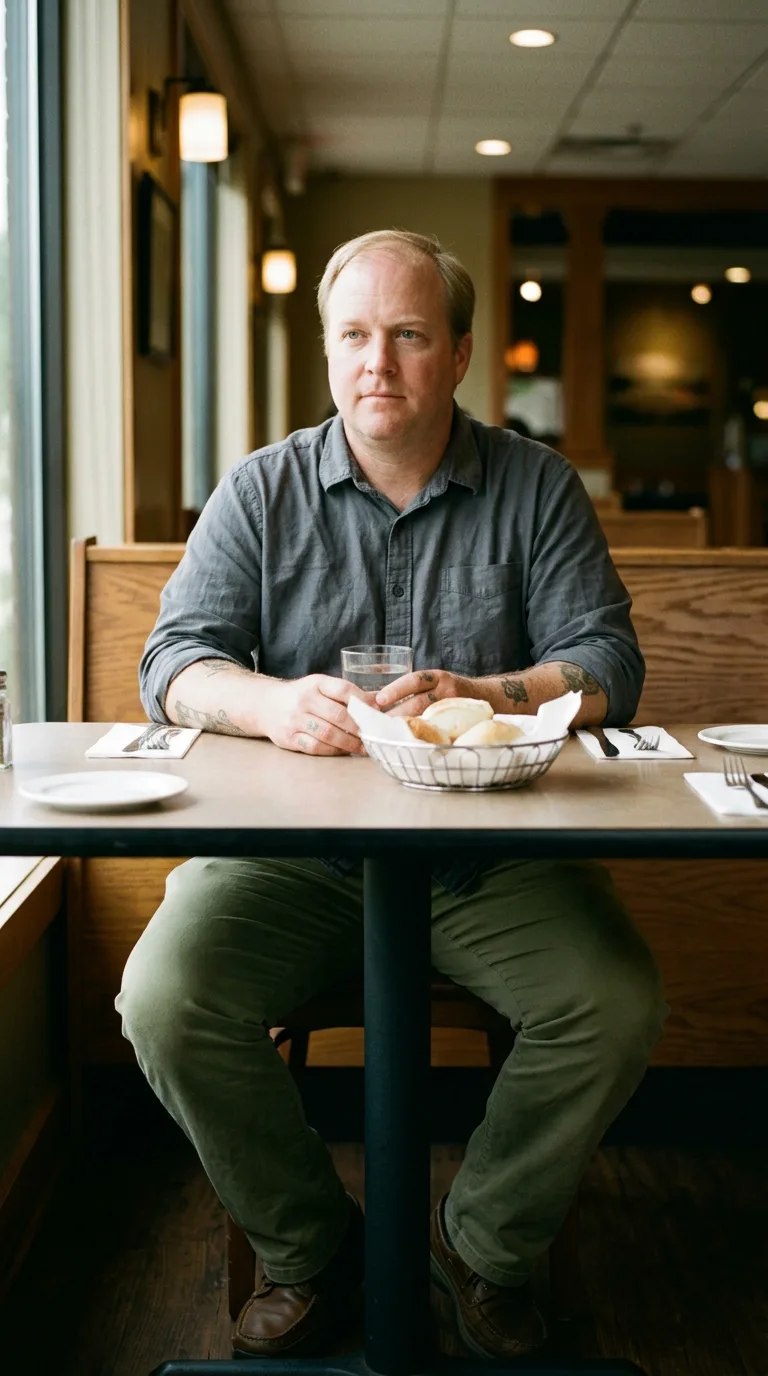
Rarest thing about him: Dating — rare, 1 in 14
Season 0seed 73549644 · engine v10
Character card
lineage COEU7T
His body-swap story
@colin.tarwater, wearing Colton Weaver, rolled the wheel on and woke up as Gary Petrowski, spent 1 minute in him, then spun the wheel and woke up as David Amano
Three minutes in this body and the boredom has already set its hooks in you. Colton Weaver, twenty-one, blond, built like a runway ad, and you spent the whole three minutes standing in his kitchen doing nothing with him, because there was nothing urgent to do — no cockpit, no woman, no problem worth his shoulders. You look down at his forearm, freckled, perfect, and it tells you nothing you want. You did not spin the wheel to stand in a kitchen. You want a decision happening somewhere, a live one, something with teeth in it right now. You want the two or three seconds before a man says the wrong thing. So you go back to vessel.cards on his phone, thumb print and all, and you spin, and the kitchen goes.
You come up mid-sentence.
The weight arrives first — heavier through the middle than you have any memory of being, a gut pressing soft against a table edge, a booth digging into the backs of thighs that are shorter, thicker, tired. Your hand is closed around a water glass, mid-turn, and the sentence is already leaving your mouth before you have any idea what it was going to say, his voice finishing it for both of you, too loud, carrying two tables over: "—and I know that probably sounds like an excuse, but it isn't." The glass stops turning. Silence lands on the table like something dropped.
Across from you a woman is looking at her bread plate like it just insulted her.
The shirt is what opens first — soft, worn-thin cotton against your back, and it comes with a whole morning attached: standing in front of a mirror that shows more scalp than he likes, buttoning this exact shirt with hands that know the motion without watching it, thinking *she said casual, this is casual, right,* rolling the sleeves to the elbow and then unrolling them because rolled looked like he was trying too hard, and he was trying too hard, and hating that he was trying too hard at forty-seven for a woman he met through an app his coworker set up as a joke that stopped being a joke around March. Gary Petrowski, the name comes with the shirt, comes with the belt, comes with the ID badge that isn't on him tonight but lives at his hip five days a week — comes with a glass-walled office on the fourth floor of a building downtown, door always propped open on manager's orders, watching people not watch him back.
The chair under you is a booth bench, and it brings the restaurant: a place he picked because it was safe, not because it was good, and he knew the second they sat down it was the wrong call, too quiet, too many of his own Tuesday-night ghosts in the wood paneling. His knee is bouncing against the underside of the table without his permission, has been bouncing since before the water glass, a motor that runs whether or not the rest of him agrees to be nervous. It has bounced through a divorce mediation, through two kids' school conferences where his ex-wife sat one chair over and didn't look at him, through eleven years of one-on-ones with employees he liked better than the job. His hands know spreadsheets. They know a socket wrench for the mower that's never once started right on the first pull. They don't know, even now, what to do with a bread basket that nobody has touched, sitting between two place settings like evidence.
The woman who got away comes up unbidden with the bread — not this woman, the other one, years back, and the taste of a different bread basket in a different restaurant, her laugh loud enough that people looked over and he loved that about her before he didn't love anything about anyone for a while. That's not who's across the table now. This one has a bread plate and a face doing the math on how much longer politeness requires her to sit here, and some part of him underneath your borrowed weight already knows the answer, has known it since the appetizers, and was trying, badly, to fix it with a sentence he can't remember starting.
You feel forty-seven in the knees. You feel it in the gut resting against the table edge, in the breath that doesn't come as easy as it did three minutes and one whole different man ago. His shoes under the table are worn at the outside heel, a walk that favors one side. None of it is dramatic. None of it is anything he'd bring up if you asked him what he carries. It's just a Tuesday with a bad date in it, a leg that won't sit still, a shirt he agonized over that nobody is going to compliment.
You lift your hands off the water glass and look at them — thicker fingers, a wedding ring gone but the ghost-pale line still there faint under restaurant light, a life you didn't live pressed into skin you didn't grow. Across the table the woman is waiting for whatever comes next, and so, somewhere under everything, is he — except he isn't, not anymore, there's no *he* left to wait.
"Sorry," you say, to her, in his voice, and you almost mean it as him. "Let's just get the check."
You don't know yet how long you keep him. You don't know when the wanting comes back, or what it'll ask for next. But the knee is still bouncing, and for now, for however long now turns out to be, it's yours.