Gary Pelnick
Fictional. Generated by AI — not a real person, and no likeness of one is intended.
50, teacher's aide in Pittsburgh · rolled by @connor.waskiewicz · card — no film
History
who has worn him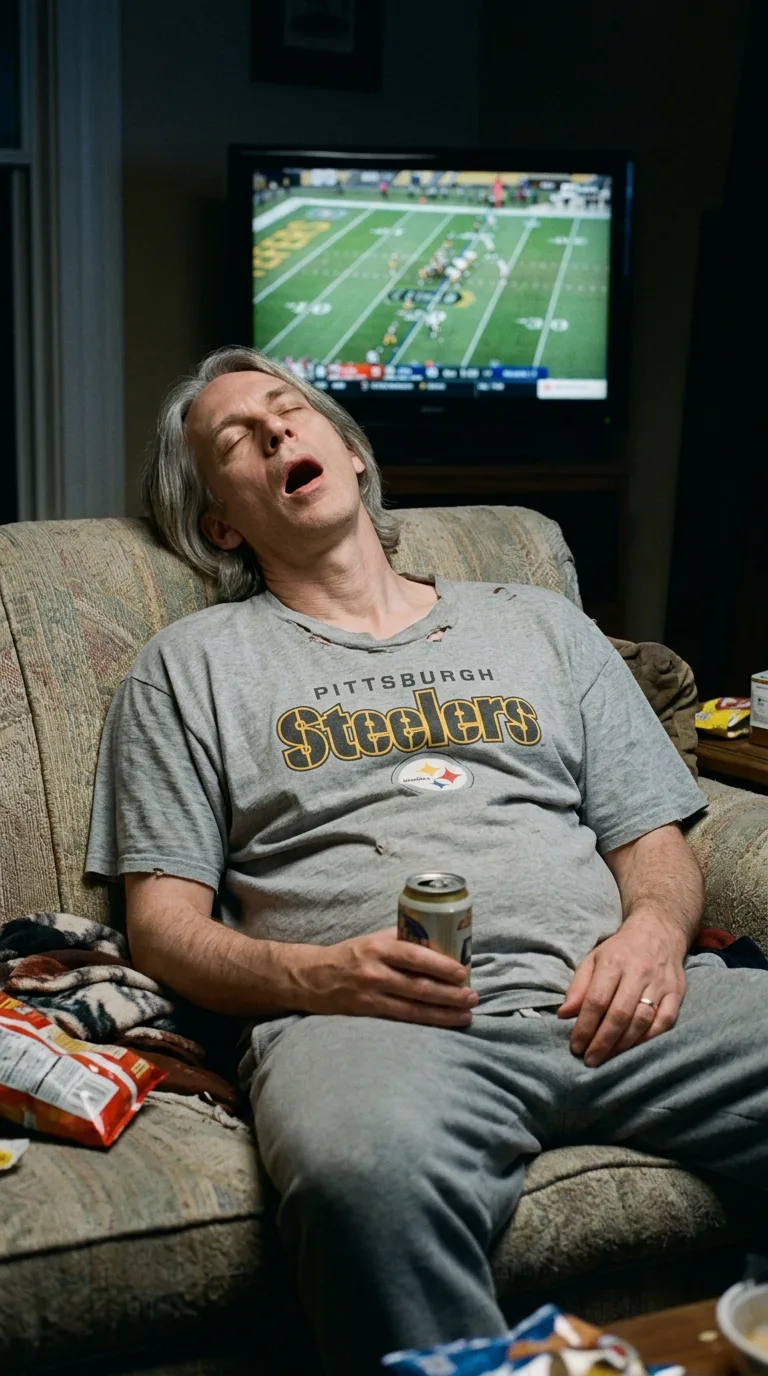
Rarest thing about him: Teacher's aide — common, 1 in 313
Season 1seed 1364330003 · engine v11
Character card
lineage 2NZHHJ
His body-swap story
@connor.waskiewicz, wearing Terrence Kalama, rolled the wheel on and woke up as Gary Pelnick, spent 6 minutes in him, then spun the wheel and woke up as Raymond Kettering
The bald man's apartment smells like the ahi he burned an hour ago and never cleaned off the pan. You are standing in his kitchen in his dad bod, in his stubble, in the scar through his eyebrow that you didn't earn and don't feel, and you already know you're done with him. He got a callback today — a real one, a warehouse supervisor job, forty minutes ago he was almost happy about it — and something in you soured the second the good news landed, because good news in a body you're only borrowing feels like theft going the wrong direction. You want to be the one things happen to, not the one they happen around. So you open the laptop on his counter, the site already bookmarked, the wheel already spinning before you've decided anything, and you tell yourself this is just what Thursday evening is for.
The wheel lands and there is no in-between. One second you are watching pixels slow to a stop, the next you are sitting forward on a couch you have never sat on, in a room lit only by a television, and a man's soft gut is pressing against a Steelers shirt that is not the shirt you were wearing. Your thumb is already on the volume button. Your mouth still has the shape of a yawn cooling in it. There was a play — something scored, something the room half-registered — and now the broadcast is replaying it a second time, slower, and this body's hand is finishing a motion it started before you arrived: turning the sound up two notches, precise as a man threading a needle, though every inch of him is loose and warm and half-drunk on sleep instead of drink.
The can in your other hand is warm too, which is its own small wrongness, and then the shirt against your back gives you the first flash: a Tuesday three years ago, standing in a kitchen doorway, Denise saying she wanted the house, not him, just the house, and him nodding like a man agreeing to a weather report. The couch under your legs gives you another — Sunday after Sunday, alone now, the cushions shaped exactly to this sitting, a ritual built to fill the space where a marriage used to make noise. You feel a wedding band that isn't there anymore, the pale line of it under your thumb like a rung you keep missing on a ladder.
The sweatpants know the drawer they came from. The undershirt under the Steelers shirt knows the load of laundry it was folded into, knows the smell of the detergent he buys because it was on sale and he never thought to switch back. You get flashes of the classroom too — a kidney table, small chairs, a boy named Aiden who calls him Mr. P. and means it kindly, the particular patience it takes to hand out scissors to eight seven-year-olds without losing a finger. You feel how tired that patience makes him by four o'clock, and how it isn't the bad kind of tired.
Your leg is bouncing. It was bouncing before you got here — some engine in this body that runs whether or not the mind upstairs asked it to — and you let it, because stopping it would take more attention than this half-second stretch of night can spare. Everything smells like corn chips and the specific staleness of a rental unit that's been divorced-guy-alone for three years. Somewhere upstairs a floor creaks; nobody else is awake in this house. It's the middle of the night here, you understand dimly, though the game insists on playing like it's prime time — recorded, then, watched late, alone, on purpose, because live was worse. You feel that specific loneliness the way you'd feel a held breath: not painful exactly, just constant.
You look down. The hand around the can is thin-veined, spotted faintly at the knuckle, a stranger's hand doing a stranger's small automatic job. You turn it over once, feeling the foreign weight of fifty years in it, the fine tremor that isn't nerves, just age.
You look up into the dark screen-light of the room and say, to no one, "Huh. Didn't even see that go in."