Gary Nishimura
Fictional. Generated by AI — not a real person, and no likeness of one is intended.
49, firefighter in Seattle · rolled by @connor.waskiewicz · card — no film
History
who has worn him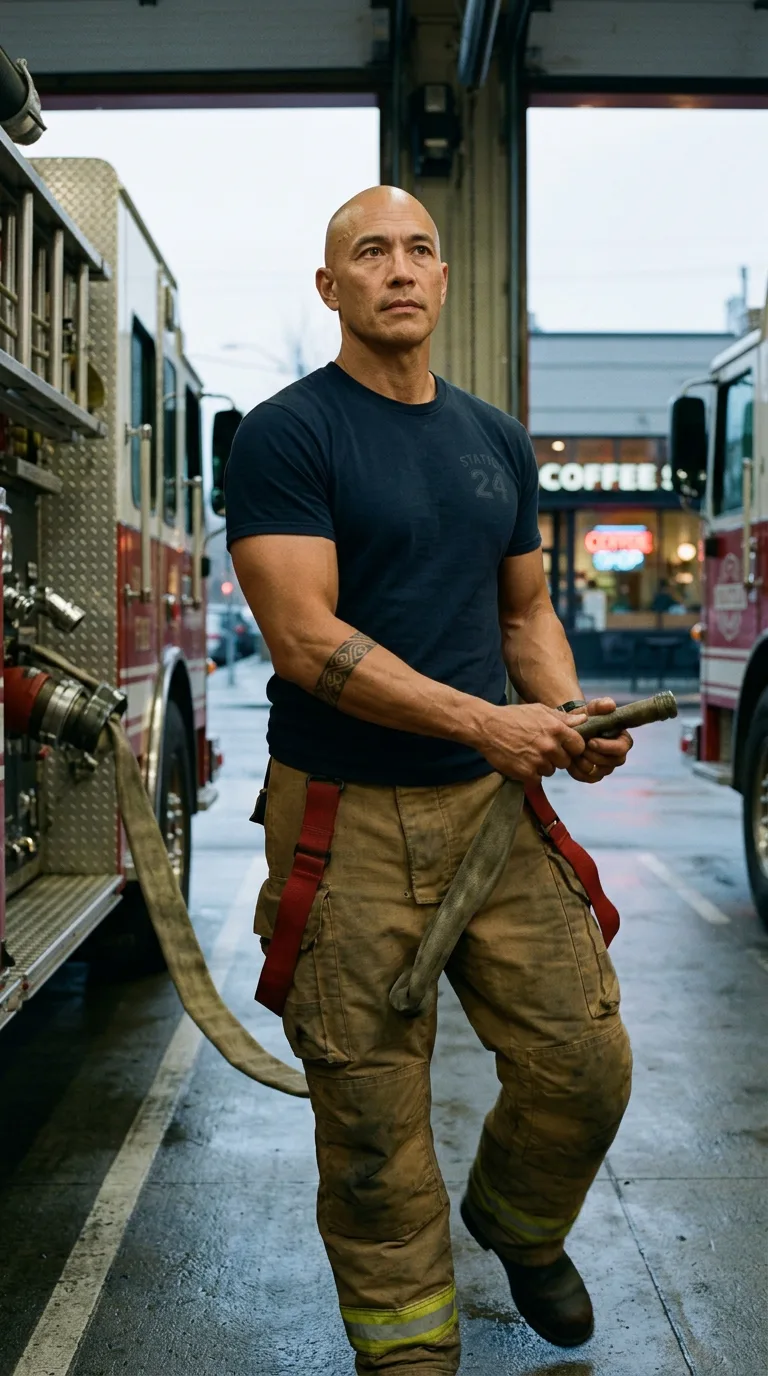
Rarest thing about him: Firefighter — common, 1 in 284
Season 1seed 1232853791 · engine v11
Character card
lineage 2NZHHJ
His body-swap story
@connor.waskiewicz, wearing Peter Maloney, rolled the wheel on and woke up as Gary Nishimura, spent under a minute in him, then spun the wheel and woke up as Ismael Barragán
You are standing at a machine in Boston, in Peter Maloney's chest, and the press has just come down on a blank for the four-hundredth time. Midday, a Tuesday. The moustache itches in the dry air of the shop. You have worn him for less than a minute and already you know it: he is fine. His knees work. His wages come on Fridays. And still your thumb is on the card in your pocket, the one with the wheel, because the fine man has nothing in him you want. Something in you is hungry the way it always is, and the hunger doesn't care how well the body runs.
You pay. You spin.
Gone. Cold air, wet, and the heavy canvas weight of something in both hands.
It is a hose, a length of it, and a brass nozzle, and your hands are mid-coil. The motion is wrong. You feel it go wrong: his hands were moving without him, and now you are in them and they stutter. You do it again, slowly, loop over loop, and it comes out right. Then ten more, each one checked, each one a thing that has not needed checking in years.
Rain on concrete. The engine's red flank to your left, chrome and cold. Across the street a coffee shop glows amber, and the smell reaches you before the thought does: wet asphalt, diesel, roasted beans.
The nozzle is cold brass, and it gives you the first one. Not a picture, a feeling: the weight of a younger hose in a younger year, a rookie's pride, a man shouting "again" and himself wanting to be shouted at. He liked being corrected. It made him feel held.
The shirt against your back is soft and thin from washing. Navy, the station number on the chest. It gives you the morning: standing in a bedroom with the light off so as not to wake her, drawing it down over his head, the cotton cold. His wife's breathing in the dark. The red suspenders hooked up one at a time, left, right, the clasp he has fumbled and cursed a thousand times. The watch last, strapped on in the hallway. Then a child's door, ajar, and a pause outside it that was not a decision, only a habit of love.
The ring on your left hand turns under your thumb. Another flash, sharper: a different kitchen, years back, a woman signing something, and both of them quiet and decent about it. The first wife. No villain in it. A sorrow he had put away folded, the way he folds everything.
Your right hand wants to click something. It closes on air, on a pen that isn't there, and the want has a texture: a drinking man's old restlessness, converted. He quit the bottle and the cigarettes both, and the pen is what's left. You feel the cravings under it like a basement.
Your legs are a firefighter's at forty-nine: strong, the left knee faintly complaining, a stiffness in the low back that says one more year, maybe two. The bald scalp is cool in the damp. Your jaw is smooth. Your forearm, with its black tribal band, is rope under skin.
He has little money. He doesn't mind. That too comes through the cold brass, a plain contentment you have never once been able to buy.
You lift your hands and look at them. His. The ring, the broad palms, the faint tremor of a stranger's weight in them. You turn them over.
Then you look up, into the wet gray morning, and say, quietly, "Okay. Let's see you, then."
You don't know how long he'll last. Maybe the hunger is already stirring.