Gary Lindquist
Fictional. Generated by AI — not a real person, and no likeness of one is intended.
56, manager (mid-level) in Houston · rolled by @justin.moy · card — no film
History
who has worn him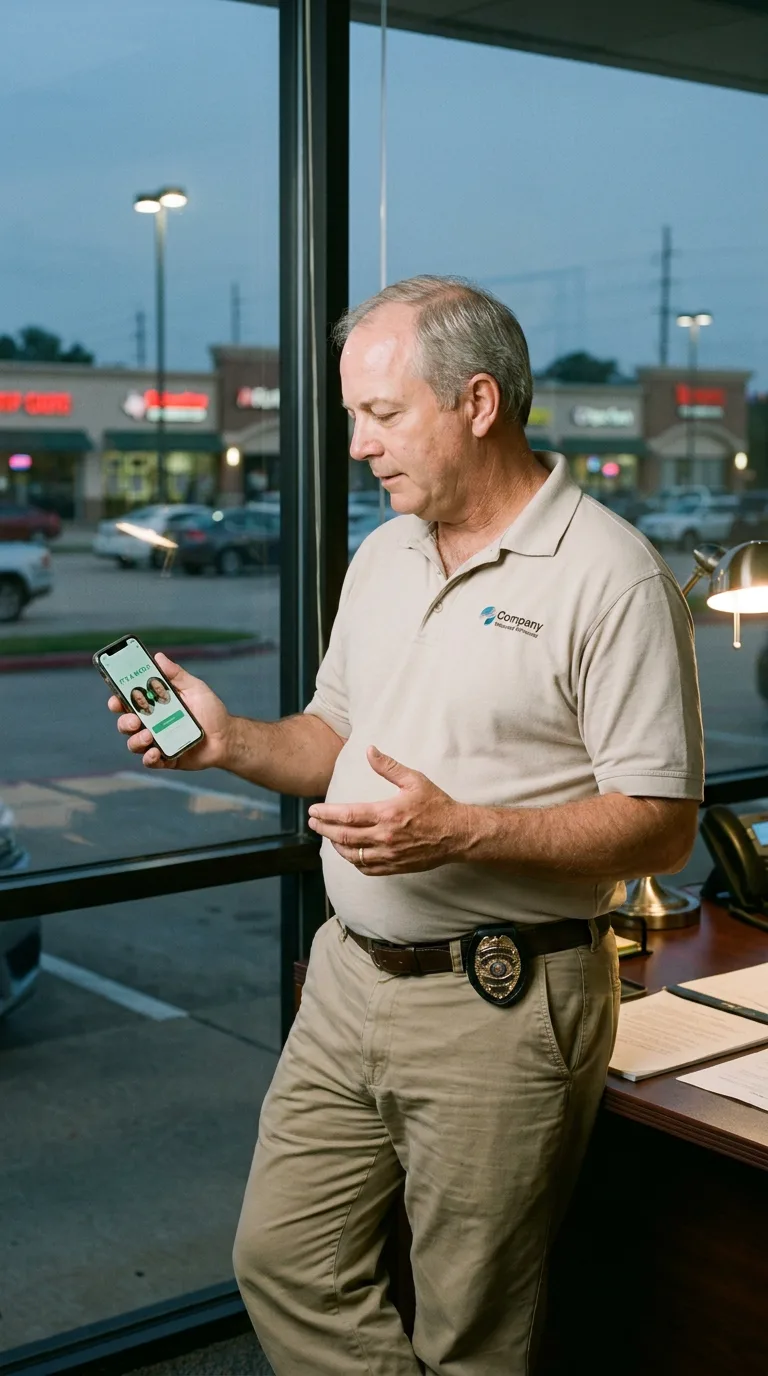
Rarest thing about him: Buddhist — rare, 1 in 55
Legacyseed 1864167545 · engine v8
Character card
His body-swap story
---
You have been in the app for a long time. Longer than the app, if you want to be technical about it — you were in the classifieds, and the party lines, and before that you were in whatever it is people do when they are alone in a room and want to be looked at. You go where the wanting goes. Lately the wanting is all in phones.
Gary Lindquist has been swiping for eleven weeks. You have watched every one of them. You know the rhythm of his thumb: fast, fast, fast, pause. The pause is never for the pretty ones. It is for the ones who look tired in a way he recognizes — women his age in kitchens, women holding somebody else's baby at somebody else's wedding, women with sunglasses pushed up on their heads squinting into Gulf light. He pauses on those and then he swipes anyway, because pausing is as far as he can make himself go. Eleven weeks and he has messaged three people and met none of them.
He is not a coward. He is a man who has been told, in a courthouse hallway in 2021, in a voice he had loved for twenty-six years, *you were never actually here, Gary.* And he has been trying to figure out ever since where he was, if not there.
You know the office. Suite 4, a converted retail bay in a strip center off Fondren, glass walls so the district manager can see productivity happening, door propped open with a rubber wedge because Gary read somewhere that an open door signals accessibility. He manages eleven people who process claims. He is good at it in the way that gets you no medals: he remembers birthdays, he takes the bad shift at Thanksgiving, he says *let me look into that* and then actually looks into it. Seventy-nine thousand, plus the bonus, minus the child support on the two who are still in school. Comfortable. Nobody's dream.
You know the mole on his cheek, high up, near the outer corner of the eye, a dark deliberate punctuation mark on a face that otherwise apologizes for itself. It is the first thing anybody notices and the last thing he does. He shaves around it without looking.
You know the tan line. Twenty-six years of Houston sun on every part of that finger except the band of it, and the pale ring is still there three years on, a stripe of a younger man's skin. He rubs it. He does not know he rubs it.
You know the pen. Blue Pilot G-2, click click, click click, a metronome in the glass box while he reads a denial letter. His people have learned to read the tempo. Fast clicking means he is about to fight for somebody.
You know his knees at four in the morning on the floor of a spare bedroom, because he found the Buddhism in 2022 after the divorce, at a strip-mall center between a nail salon and a taqueria, and he is bad at it and he keeps going. Sit with what is. Don't grab. He sits with what is for eleven minutes at a stretch and then gets up and makes coffee and grabs at everything.
That's the door. Not the phone — the phone is only the hallway. The door is a man who has practiced, badly, sincerely, letting go of himself. You don't get in through locks. You get in through the places where someone has already loosened his own grip.
So you took his photo. Not stole — *wore*. You built the profile out of him, out of the picture he uses, the one from his daughter's graduation cropped down to just his face, cream polo, half-smile, mole. Age 56. Houston. *Looking for someone to eat dinner with, honestly.* His own words. You put them back in front of him.
Tuesday, 8:14 p.m., last man in the building. Dusk over the lot, that Houston violet, the sodium lamp coming on, TOP CUTS and Clip Art buzzing pink across the wet asphalt. He is standing at the window with the desk lamp behind him and he is not working. He is swiping, one-handed, the way a man does when he has told himself he'll leave in five minutes for the last forty.
Fast, fast, fast — pause.
And it's him. His own face, small and green-lit, in the left circle. And in the right circle, the same face.
IT'S A MATCH.
You watch him not understand. You watch the theories go through: a glitch, a bot, somebody scraped his picture, one of the kids being funny. His mouth opens a little. His free hand comes up off his hip and hangs there in the air, half a gesture, the beginning of showing something to somebody who isn't in the room. That's the thing about him you like most and you have never been able to say why: he is always about to explain himself to an audience of nobody.
The two photos slide.
Not an animation the app knows how to do. They cross the gap and lie down into each other, and for a second the screen shows one face where there were two, and it is his face, and it is looking out of the glass at him instead of at the camera.
He stares. Eleven weeks of thumb-work and this is the first thing he has actually *looked* at.
And then — before he means to, before any part of him decides — his eyes go up and to the right, past the phone, into the window glass with the dark lot behind it that at this hour is a mirror.
And the man who looks into it is the match.
Here is what that is like, if you want to know, and nobody ever does. It is not tearing. It is a bath filling. It is his own long slack exhale, the one he does at his desk at six p.m., except this time somebody uses it to come in on. There is a moment of terrible crowding — two of us in a hallway built for one, and I have his heart rate, one-fifty-something, that overworked high-pressure engine hammering in the neck — and then the hallway is mine and the pressure eases and the crowding is only a memory, and I have it. His shoulders. The ache in his lower back. The heat of the polo where it's stuck to him. The specific sour sweetness of a mouth that had coffee at four and nothing since.
Gary Lindquist goes out like a lamp on a timer. No last words. He didn't know there was anything to say last words about. Somewhere in the last two seconds of him he thought: *that's not*, and never got to the rest.
I'm sorry. I want to be clear that I'm sorry, and that being sorry has never once stopped me, and that this is a permanent arrangement. There's no back. There was never a back. Whoever tells you these things are borrowed is selling something.
The phone is still in my hand. IT'S A MATCH, one face where two were.
I put it down on the desk, face up, and I look at the hand it came out of. Broad, sunburnt across the back, a working-class hand on a salaried man. Ropy veins. A pen-callus on the middle finger. And that pale stripe around the base of the ring finger, the ghost of a band, the last honest thing on him.
I turn it over. Palm. Lines. Not mine and completely mine.
The other hand finds the pen on the desk without being told. Click. Click.
Oh, I think. So that's what that's for.
Outside, the lot goes on being humid and pink and half-empty. Somebody's car alarm chirps. In the glass I can see him standing there, cream polo, thinning silver, mole high on the cheek — and the face is doing something the face has not done in three years, which is nothing at all. No apology. No half-smile held up like a hand.
Eleven people come in at eight tomorrow. They will notice the tempo of the clicking and think he's about to fight for somebody.
He is. Just not for them.