Gary Dunleavy
Fictional. Generated by AI — not a real person, and no likeness of one is intended.
50, nurse in New York · rolled by @connor.waskiewicz · card — no film
History
who has worn him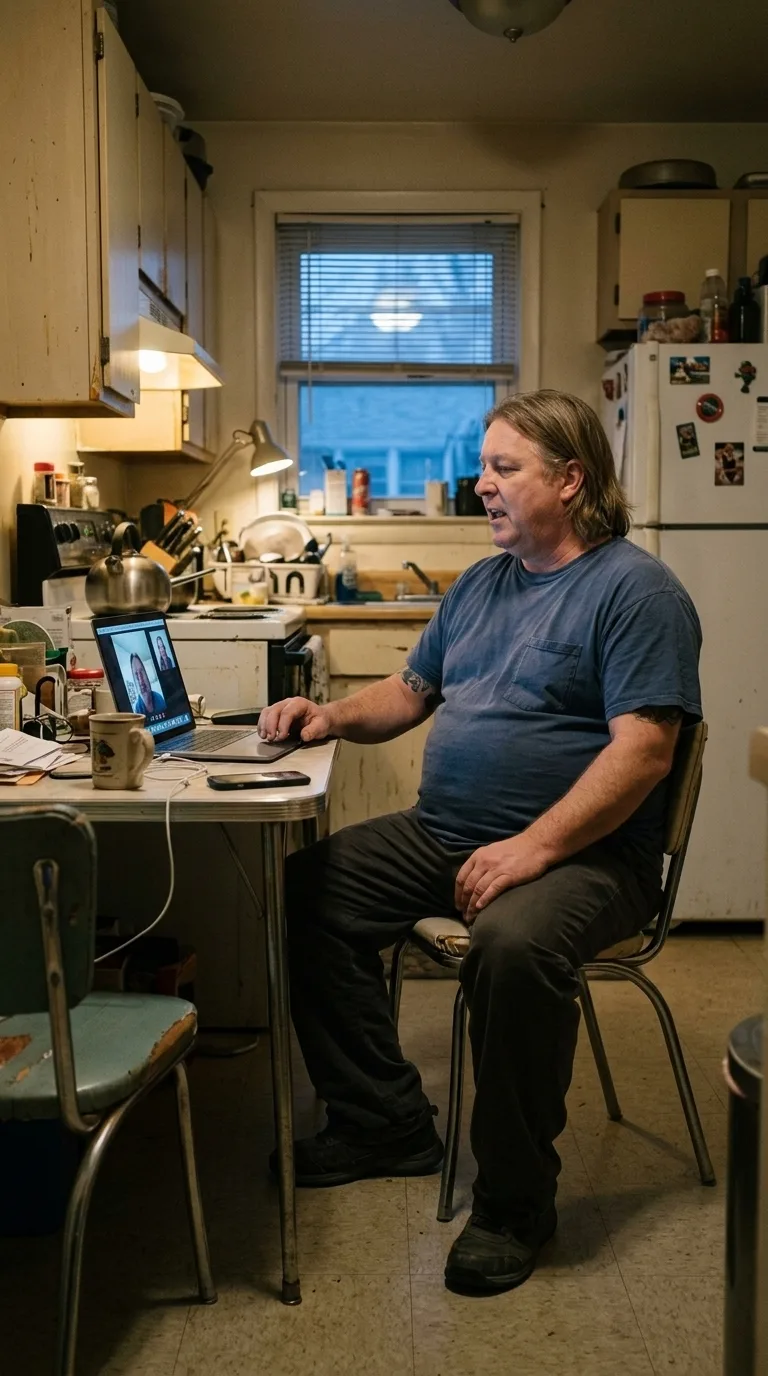
Rarest thing about him: A gold tooth — uncommon, 1 in 141
Season 1seed 1843857874 · engine v11
Character card
lineage 2NZHHJ
His body-swap story
@connor.waskiewicz, wearing Russell Danaher, rolled the wheel on and woke up as Gary Dunleavy, spent under a minute in him, then spun the wheel and woke up as Brandon Yoder
You are standing in a dead man's kitchen in Houston, and you have just decided to leave it.
Not dead. Russell Danaher is somewhere in there, in the sense that you are wearing him. His knees ache on the cold linoleum. His house ticks around you, everyone asleep, the refrigerator humming a note he never noticed and you can't stop hearing. He was sixty-four and a call center agent, and he had a cleft chin you keep touching with your thumb. You have been him for less than a minute. Already you know the shape of the problem: he is a man who sits and listens to other people's troubles for a living and has no appetite in him, no hunger. You wanted a body that wanted things. This one only waits for the clock to turn.
So you open the page. The wheel is there, patient, a little cheap-looking, the way it always is. This is the 1116th time. You pay. You spin. Russell's green eyes watch the colors blur, and you think, without any malice, *sorry about the chin.*
Then the kitchen is a different kitchen.
It arrives mid-sentence. Your mouth is open on a word, and the word is half out already. There's a gold tooth in it, you can feel the cold metal of the canine against your lip. The chair is a steel-legged thing with a cracked vinyl seat, and it creaks under a heavier weight than you've carried in a while. Your right hand is flat on a trackpad. On the screen a small window of a stranger's face has frozen mid-blink, eyelid halfway down, and in the corner is a smaller window, a heavy man with long hair, his own thumbnail, caught talking.
The breath comes first, wide and slow, a belly breath. Then the smell: kettle scale, old coffee, a damp radiator, the blue-gray cold of early morning leaking through the blinds. A streetlight is still on out there. He hasn't slept, or he has just woken. The ache at the base of your spine says the first.
You look down at what's on you. A blue T-shirt gone soft, a pocket on the chest with a pen clipped in it. Your fingers find the pen without being asked. Click. Click. Click.
And he arrives, through the cotton.
The shirt first, against your back, then the sleeves. You see his hands pulling it over his head in the dark of the bedroom an hour ago, careful of the shoulder that catches, the left one. He smoothed the front down over the belly and gave up, the way he has given up on it every morning since the divorce that wasn't quite a divorce. The tattoo on the upper arm throbs faintly under the sleeve, the American-traditional lines, the faded red, and your thumb goes to it and there it is: nineteen, a shop on Coney Island, a boy who thought a swallow meant something about coming home. He doesn't think it anymore. He keeps it anyway.
The pen clicks and clicks. The pen is from the unit. Nights, then. He works nights, which is why the window is blue at this hour and why his eyes feel packed with sand. He works nights and tonight he came home and sat down to try an app his daughter sent him, because she worries.
The mug on the table is warm against your knuckles. The handle opens a different drawer: her, small, in a kitchen exactly this one, standing on this same chair to reach the sugar, and him saying *not the stove, not the stove, baby.* The other one, the boy, taller now, doesn't call. That sits in the chest like a swallowed stone, and you feel it the way you'd feel your own, which is the trouble with this, it is never yours and it is never anywhere else.
The table edge presses your forearm. Under the paper at its corner are envelopes with windows in them, and your fingers know without looking how thick the stack is, how long since he opened the top one. The number is a weight, a figure in the dark he does not say aloud. Tens of thousands. He does the arithmetic at four in the morning and always gets the same answer. You feel his shoulders rise toward his ears.
Under your shoes the floor is sticky in one spot. The soles are worn on the outer edges, nurse's shoes, black, and the memory runs up through the heels: twelve hours of corridor, a man in bed nine holding his wrist and saying *don't let me go yet,* and him saying *not on my shift,* and meaning it, gold tooth and all. He used to drink after those. He doesn't now. The cabinet over the stove has nothing in it but tea, and some quiet part of him is proud of that, and some quiet part of him is still thirsty.
Light, he thinks, in his private way. Not church. Just something that holds when you lean on it. He leans on it a little every night.
The ex is on the refrigerator, in a photo gone yellow under a magnet. You don't need to touch it.
The call is still frozen. The seconds counter keeps counting up past the half-blink.
You sit up dead center into the camera. Your hands are his hands: wide, warm, a nurse's, a little dry from the soap. Click goes the pen once more in the right one, and you stop it. You turn the hand over. The palm is creased and scrubbed pink. It has held people steady. It is yours now, until it isn't, and you have no idea whether that means a lifetime or the time it takes the kettle to boil.
You lift your eyes to the still face on the screen, and then past it, to the lens, and you say, trying the volume of the voice, the gold tooth catching the light:
"Hello?"